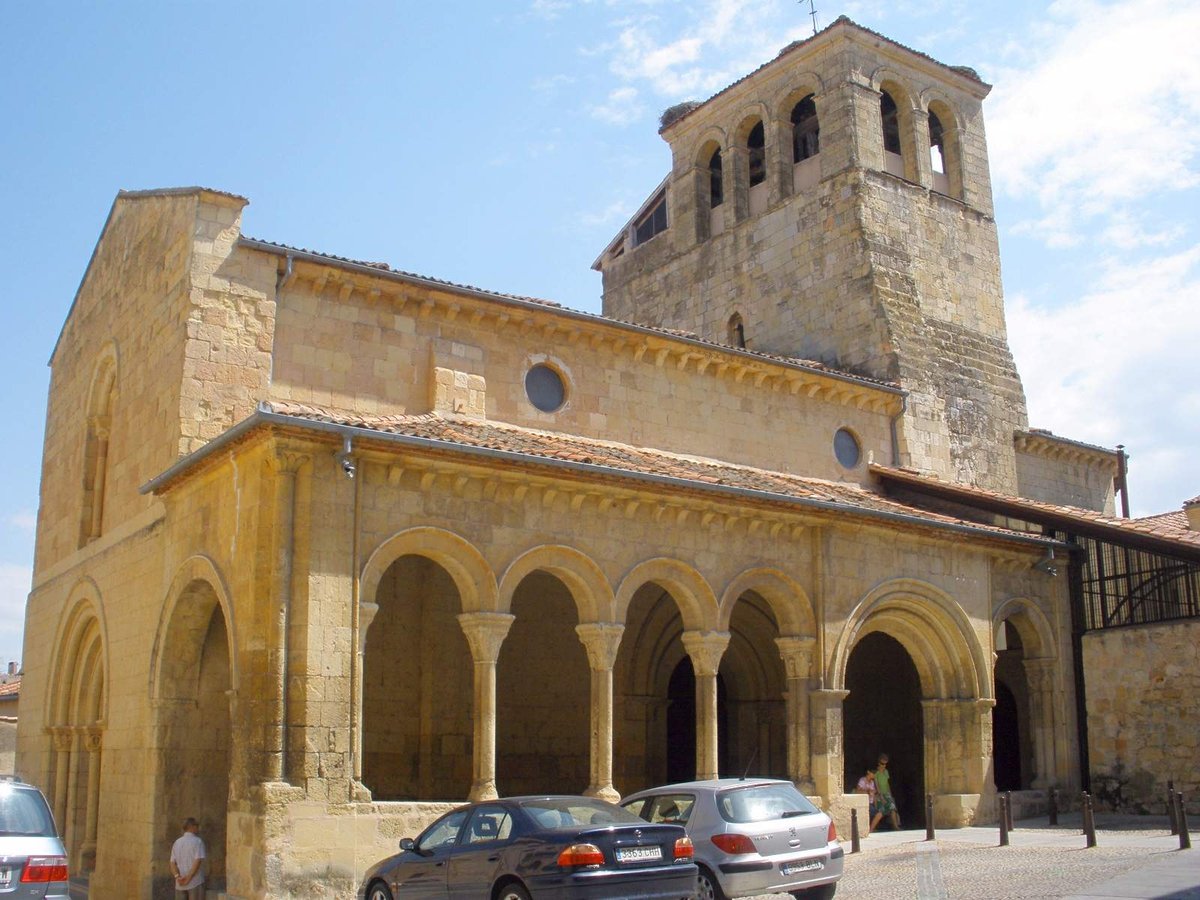

The Church of the Santísima Trinidad in Segovia, Spain, is a hidden gem, a stunning example of Segovian Romanesque architecture, constructed in the 12th century. Its exterior is positioned in a confined alley, divided by two half-columns into three sections, each containing a window with two spiral columns and decorated capitals. The facade features three horizontal lines of impost, one at the height of the water spout, another as an extension of the capitals' cymatium, and another above the arch.
The interior is notable for its two levels of arches superimposed, with historiated capitals, vegetal motifs, fantastic beasts, of great sculptural and iconographic value, with some remains of its original polychromy. The southern side, as typical of Segovian Romanesque architecture, features a gallery. The western and southern facades each have a portada, the western one simpler and the southern one more ornate. The western portada has semicircular arches resting on elegant capitals with mythical beasts and flora.
Above the western portada is a window that illuminates the main nave. There is a lateral portada at the south with access from the atrium, of great beauty in the decoration of its capitals. The temple has a single nave covered with a barrel vault supported by three arch cells, which rest on half-columns adjoined to the lateral walls. The torre, which forms an interior double-height space, is constructed on top of the nave.
Sources: Wikipedia, OpenStreetMap, Wikidata, Wikimedia Commons
Written by Nik Frost
Discuss this with the author and others
No comments yet. Be the first to start the conversation.