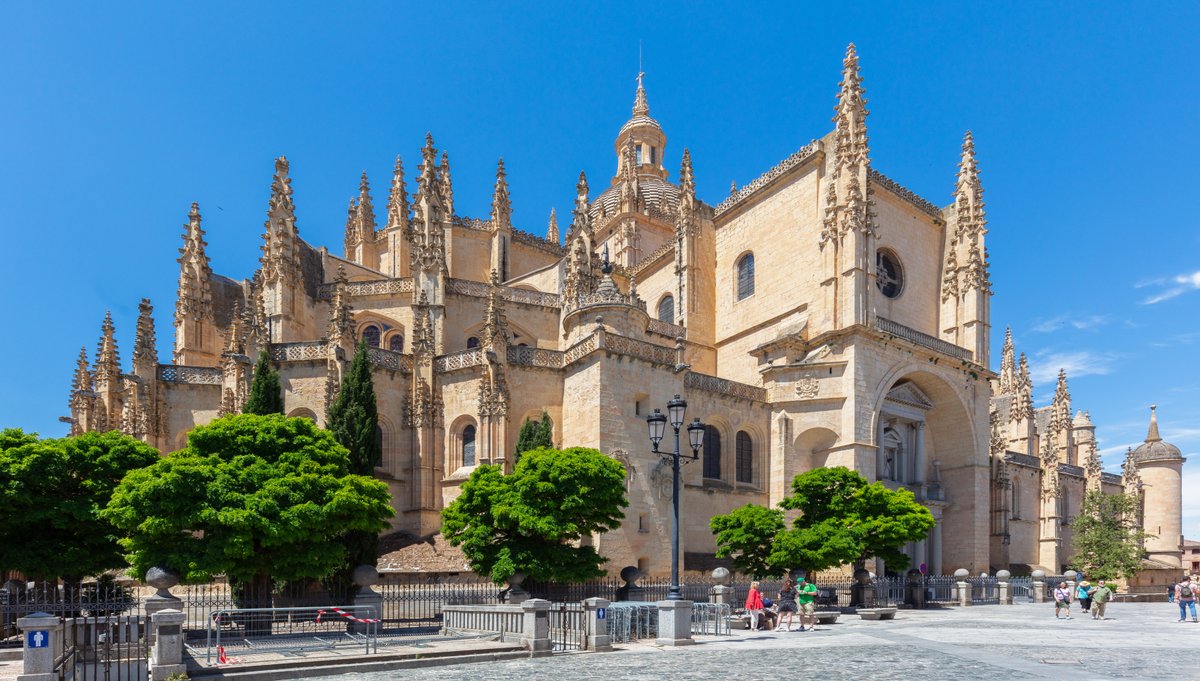

The Segovia Cathedral, located in the Spanish city of Segovia, is a Roman Catholic cathedral dedicated to the Assumption of the Virgin Mary and to Saint Fructus. It serves as the seat of the Diocese of Segovia. With a history tracing back to the 16th century, the cathedral was built in the Flamboyant style, a unique architectural style that can be identified by its pointed arches, ribbed vaults, and intricately carved ornamentation. The new cathedral was built on the site of the destroyed church that was attacked during the siege of Segovia in 1520 following the murder of Rodrigo Ronquillo who investigated the murder.
Juan Gil de Hontañón, a native of Segovia, was chosen as the lead architect, and he carefully planned the cathedral's construction to be leaner and more resilient. The first stone was laid on June 8, 1525. Three construction stages took place between 1525 and 1685, with different architects involved at each stage, such as Juan Gil de Hontañón, Rodrigo de Solar, Juan Pescador, Diego de Sisniega, Pedro de Brizuela, and Francisco de Viadero. Notable events took place during the cathedral's construction, such as the arrival of the Virgin of Peace, donated by King Henry IV, which is now covered with silver.
Charles III also ordered the construction of a new altar in 1768, and the main altarpiece of the cathedral was made by Francisco Sabatini, featuring neoclassical elements made of various colors of marble and bronzes.
Sources: Wikipedia, OpenStreetMap, Wikidata, Wikimedia Commons
Written by Nicolo Ciampini
Discuss this with the author and others
No comments yet. Be the first to start the conversation.