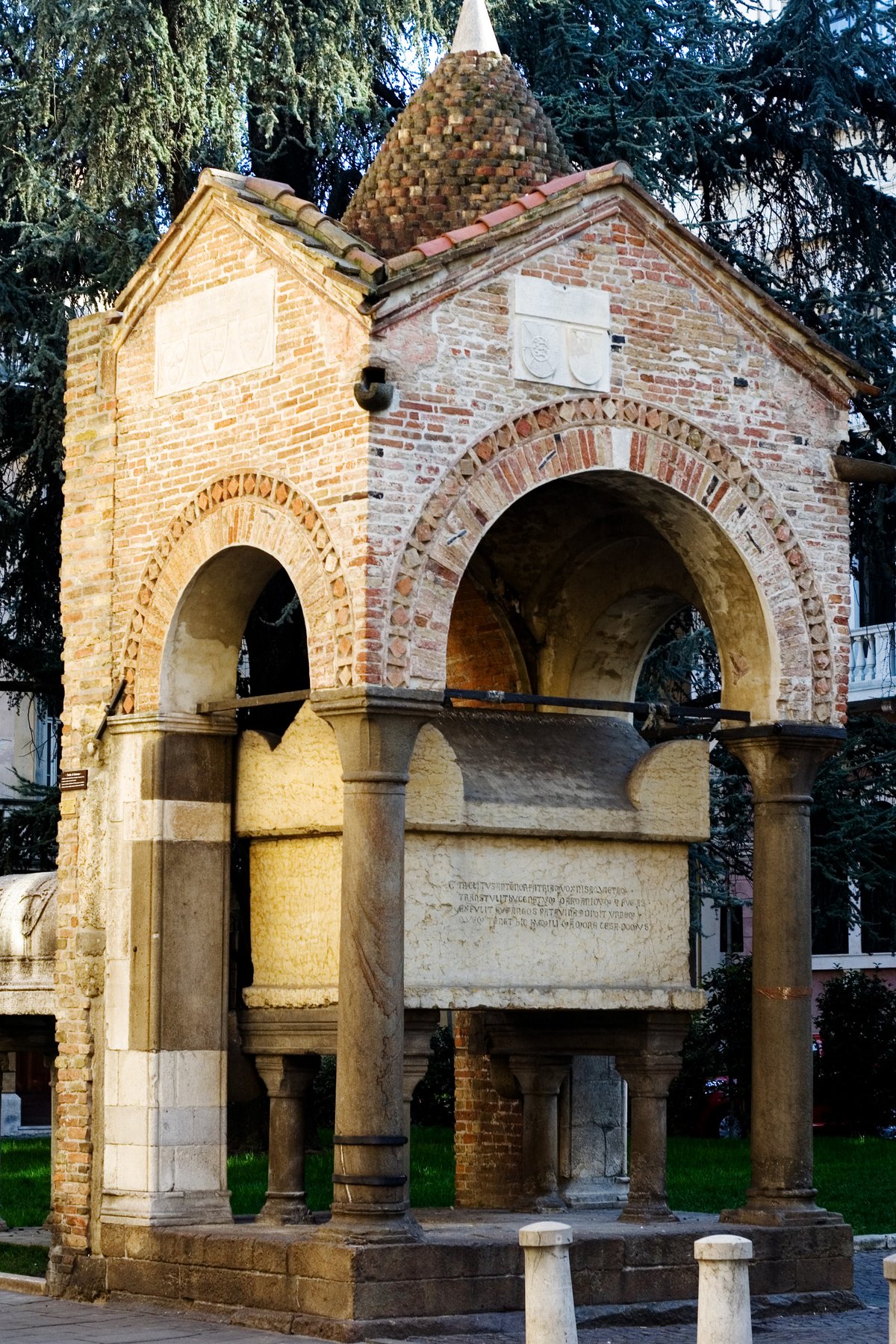

The Tomb of Antenor, also known as the Sepulchre of Antenore, is a 13th-century monument erected to honor an unearthed ancient relic, claimed to be that of the Trojan warrior and councilor Antenor, the fabled founder of Padua. It can be found nestled in Piazza Antenore, in the region of Veneto, Italy. In the year of 1274, during the construction of an orphanage in Padua, an ancient marble slab was discovered. A local scholar, Lovato dei Lovati, declared to have found inscriptions on a bronze plaque attached to the inner wooden coffin, proclaiming the burial to contain the remains of Antenor.
However, the origins of this tomb are cloaked in mystery. While the legend has been debunked, the Tomb of Antenor remains a significant cultural and historical landmark, embodying Padua’s medieval antiquarian revival of classical myths and its links to ancient Veneti settlements in the region dating back to the 13th–11th centuries BC. The tomb survived urban changes such as the 1937 demolition of the nearby Church of San Lorenzo, forming the modern piazza.
According to historical records, the Tomb was opened and inspected in 1334 by Alberto II della Scala, who claimed to have found a disturbed coffin containing various bones. However, carbon-dating of a fragment of bone found suggests that the tomb may not be as ancient as claimed.
Sources: Wikipedia, OpenStreetMap, Wikidata, Wikimedia Commons
Written by Nicolo Ciampini
Discuss this with the author and others
No comments yet. Be the first to start the conversation.