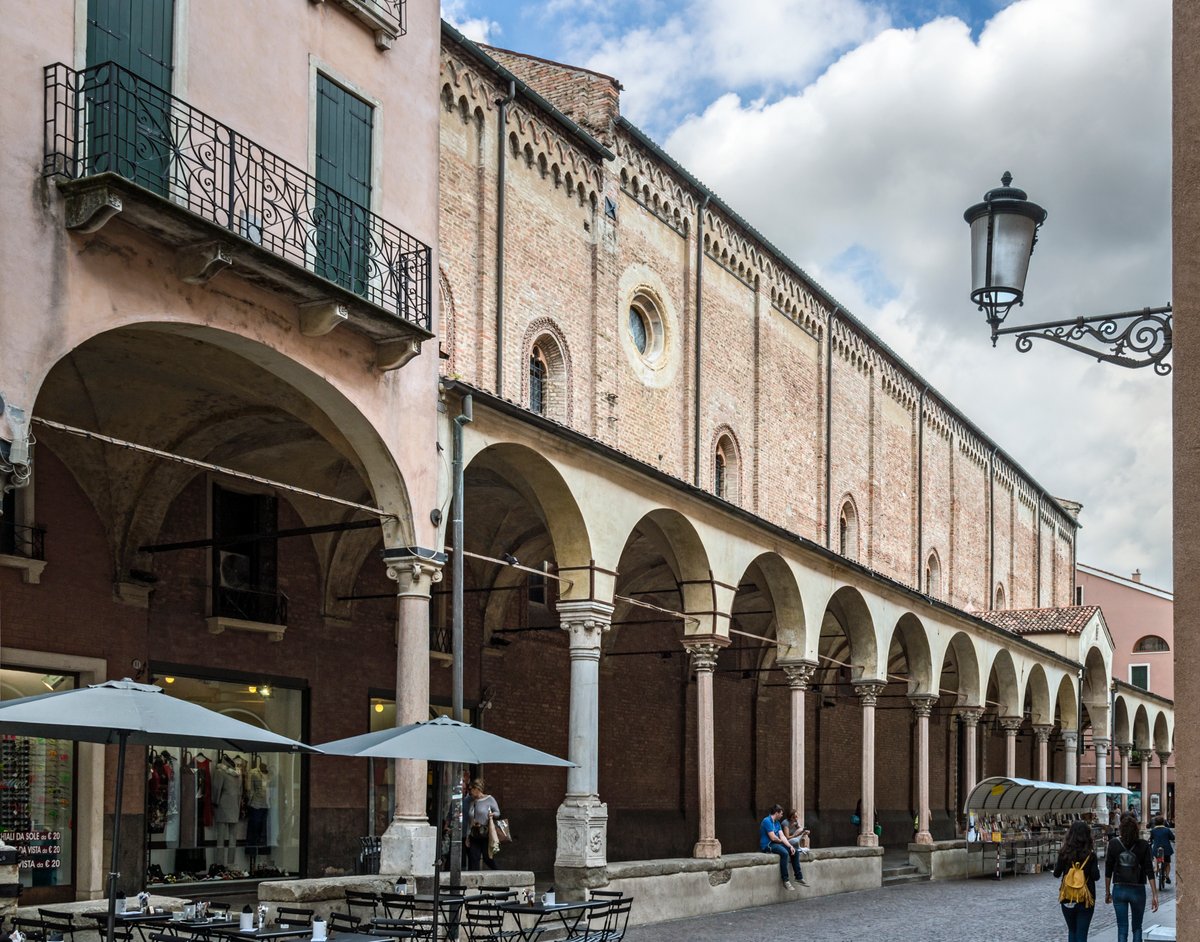

St. Mary's Servite Church, or Chiesa dei Servi, is a 14th-century Roman Catholic church located on Via Roma in Padua, Veneto, Italy. It is a parish church under the vicariate of the Cathedral Basilica of Santa Maria Assunta, governed by the Servite Order. The church contains outstanding works of art, including a wooden crucifix by Donatello. The construction of the church, begun in 1372 and completed in 1390, was financed by Fina Buzzaccarini, wife of the Prince of Padua, Francesco I da Carrara, who built the church on the site of the razed palace of Nicholas Carrara, who in 1327 betrayed Francesco by conspiring with Cangrande I della Scala.
After the death of Fina in 1378, the task of completing the construction was left to her sister Anna. In 1393, Francesco Novello da Carrara, son of Fina and lord of Padua, gifted the church to the Servites. During the Napoleonic era, the Servite Fathers were expelled and the church was confiscated and forfeited as state assets. It was converted into a parish church, run by secular clergy. In 1927, the interior of the church was restored to its 14th-century appearance.
The building was reconsecrated in 1963. In June 2014, the Bishop of Padua accepted the request of the Superior of the Order of Servants of Mary to be able to return to their historic church after 207 years of administration by the secular clergy. The delivery was on 6 September of the same year. The church's architecture is a mix of Gothic and Lombard Romanesque styles, with a striking Gothic portal and a bell tower that rises above the chapel on the right side of the church. Two notable figures are entombed inside the church - Count Emilio Campolongo and Doimo Olzignani.
Sources: Wikipedia, OpenStreetMap, Wikidata, Wikimedia Commons
Written by Nicolo Ciampini
Discuss this with the author and others
No comments yet. Be the first to start the conversation.