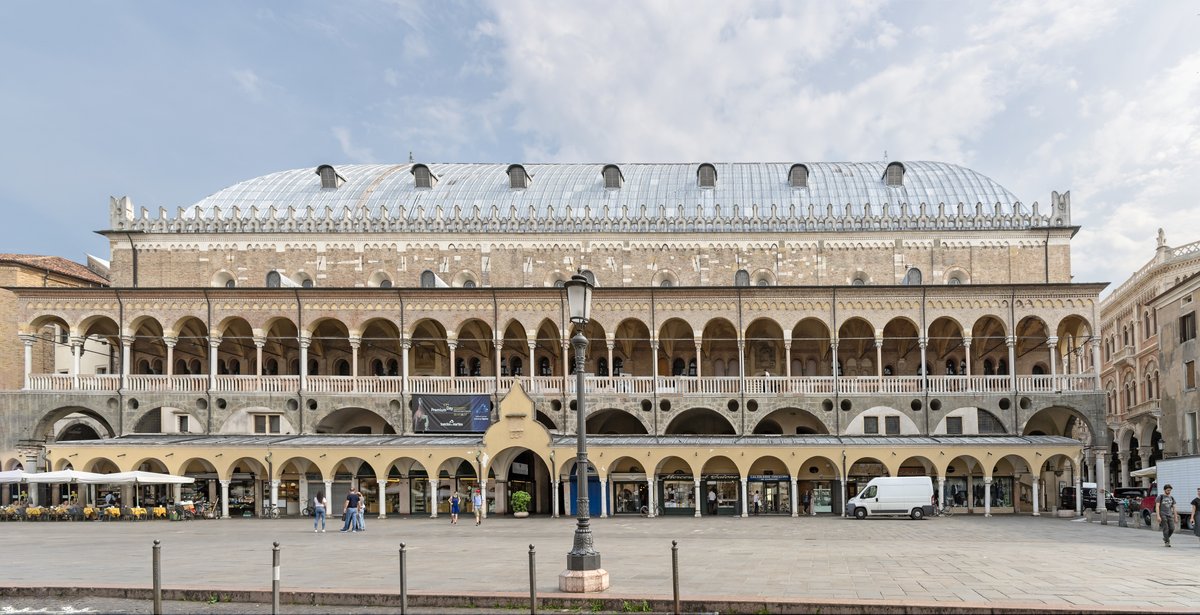

In the very heart of Padua, Italy, the Palazzo della Ragione, a 13th-century building, divides Piazza delle Erbe and Piazza dei Frutti. Surviving through the ages, this grand medieval hall has served as a market, a town hall, and a court of law. It is believed to be one of the oldest structures within the European Union, with its ground floor buzzing with Padua's market for 800 years. <br><br> Giotto decorated the walls of the Palazzo della Ragione earlier, but it was Nicolò Miretto and Stefano da Ferrara who embellished the palace between 1425 and 1440.
<br><br> Each month of the year correlates with certain signs of the zodiac in the upper section of the frescoes, while the lower section might mirror the upper section. The lower section of the frescoes was painted according to the original functions of the spaces they occupied.<br><br> The ground floor, once a bustling trade center for food, clothing, spices, and jewels, now mainly caters to the food and beverage sector. A striking wooden horse, modeled on Donatello’s Equestrian statue of Gattamelata, is hard to miss on the western side of the hall.<br><br> The upper storey of the Palazzo della Ragione boasts an open loggia, resembling the Basilica Palladiana in Vicenza, which was itself inspired by the Palazzo della Ragione in Padua.
<br><br> The walls bear allegorical frescoes. In the Middle Ages, the Palazzo della Ragione used its ‘pietra del vituperio’ to humiliate those in debt, forcing them to sit on the stone like stocks. <br><br> The building was started in 1172, completed in 1219, and given a single roof in 1306 by Fra Giovanni, an Augustinian friar. After the fire of 1420, the internal partition walls were removed, creating the present great hall, the Salone.
Sources: Wikipedia, OpenStreetMap, Wikidata, Wikimedia Commons
Written by Nicolo Ciampini
Discuss this with the author and others
No comments yet. Be the first to start the conversation.