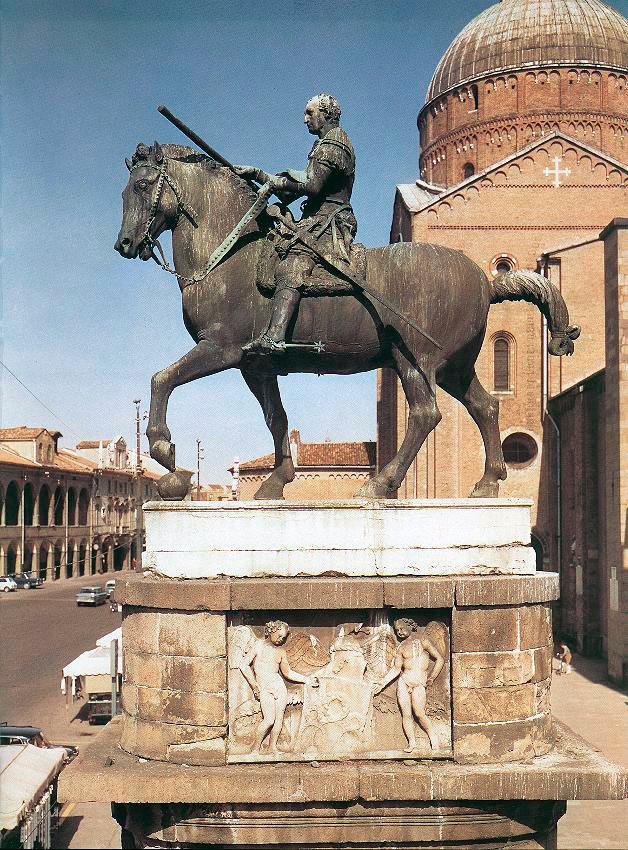

In 1453, the inimitable Italian artist Donatello skilled his hands to produce the Equestrian Statue of Gattamelata, a grandiose piece of art that graces the Piazza del Santo in the heart of Padua, Italy. This statue, dedicated to the condottiere Erasmo da Narni, known as Gattamelata, who predominantly served under the Republic of Venice, is a remarkable testament to the times. Unlike its Gothic counterpart, the Equestrian Statue of Marcus Aurelius in Rome, where the scale exudes power, Donatello's statue highlights the real-life individual's influence. Made in the lost wax method, this statue towers at 340 x 390 cm, with the base measuring 780 x 410 cm. It stands proudly atop a pedestal, with both the condottiero and his steed displayed at their actual size. The equine's musculature, so accurately portrayed, gives testament to the Renaissance's preoccupation with anatomical precision.
The pedestal, cradling the horse, features two mystifying reliefs at the top, resembling gates to the underworld, creating an illusion of a burial site. The first portrays Gattamelata's coat of arms presented by two whimsical putti, while the second showcases two putti displaying battle gear. In 2025, the statue remained unbudged from its pedestal for restoration, but more recently, it was moved indoors for a €1m makeover. The restoration, funded by the benevolent organizations Friends of Florence and Save Venice, lingers in uncertainty; a decision has yet to be made concerning its future - whether the statue shall return to its original outdoor setting or be exhibited in a museum.
Sources: Wikipedia, OpenStreetMap, Wikidata, Wikimedia Commons
Written by Nicolo Ciampini
Discuss this with the author and others
No comments yet. Be the first to start the conversation.