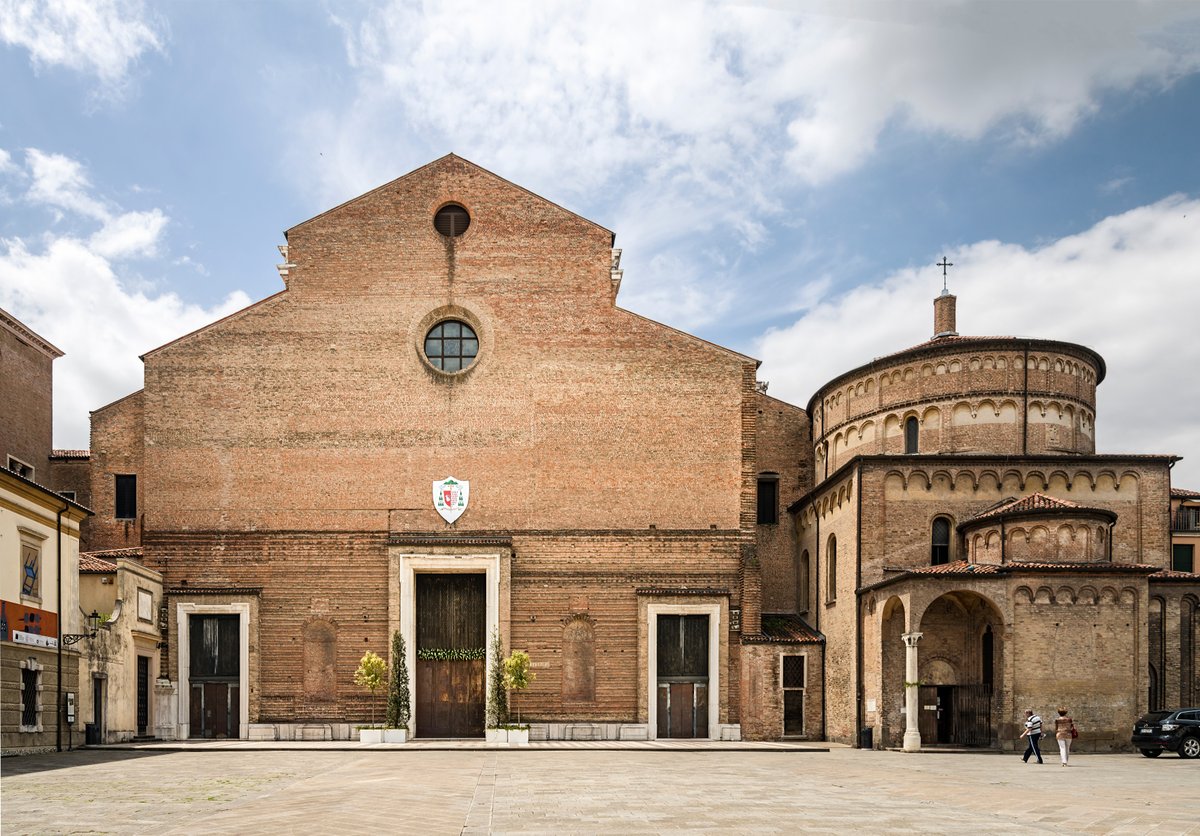

The Basilica Cathedral of Saint Mary of the Assumption, or Duomo di Padova, sits on the east end of Piazza Duomo, adjacent to the bishop's palace in Veneto, Italy. The church building was first erected as a cathedral in the 4th century and has undergone major reconstructions over the centuries. The present church is the third structure built on the same site.
The current building dates from a reconstruction during the sixteenth century. Construction began on the new Renaissance building in 1551 and continued for two centuries, eventually being completed in 1754, yet leaving the façade unfinished. While in the past the design was attributed to Michelangelo, it was performed rather by Andrea della Valle and Agostino Righetto and has much in common with earlier Paduan churches.
In 1522, Cardinal Francis Pisani and the Canons funded the reconstruction of a new, great presbytery. The project continued until the presbytery was inaugurated in 1582. Following this, the new nave was built on the same site, and the cathedral was consecrated in 1754. The basilica is a Latin cross with three bays and an octagonal dome, located between the episcopal palace and the Baptistery.
Sources: Wikipedia, OpenStreetMap, Wikidata, Wikimedia Commons
Written by Nicolo Ciampini
Discuss this with the author and others
No comments yet. Be the first to start the conversation.