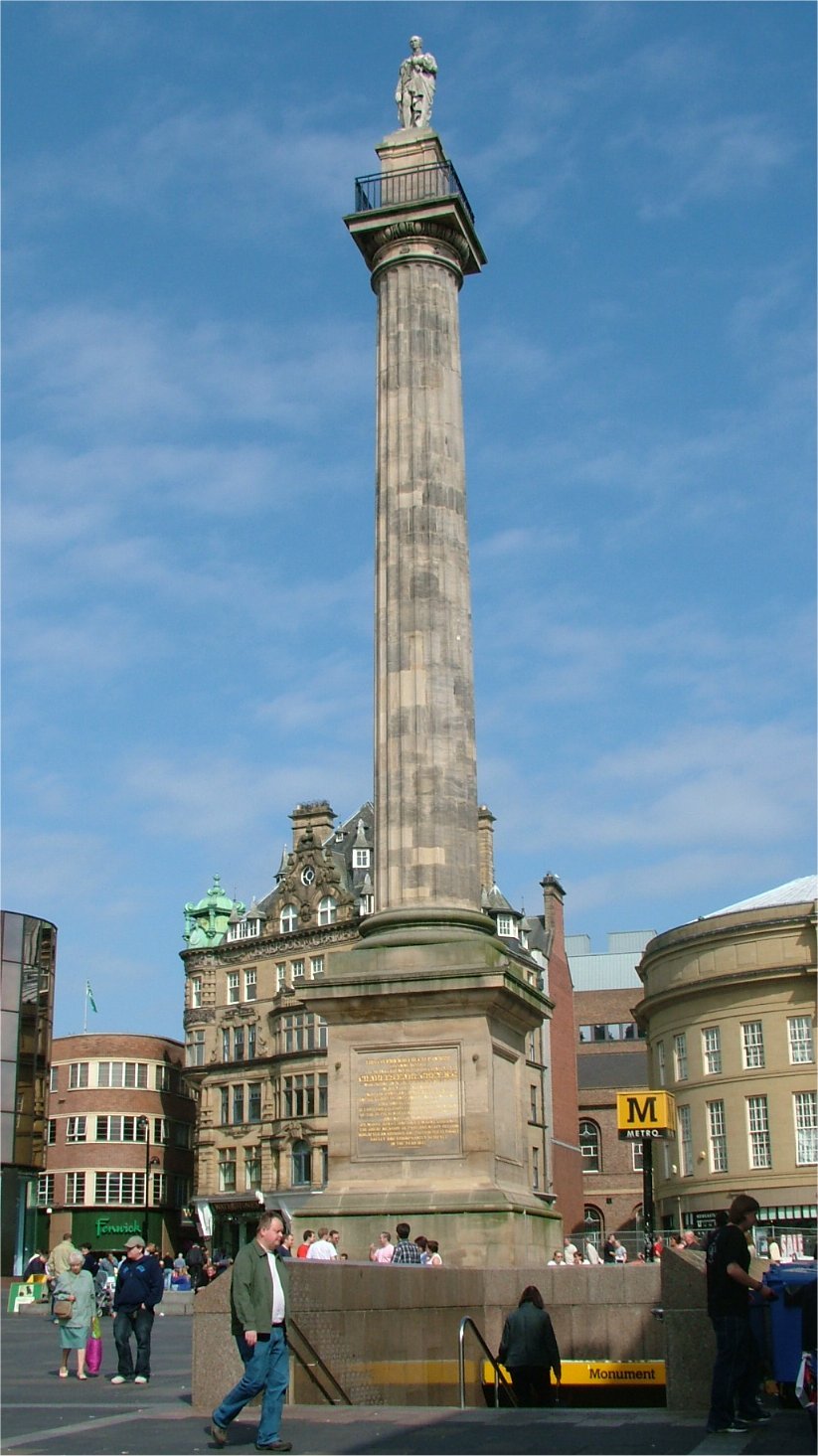
Grey's Monument, a 133 ft (41 m) tall column standing atop a Roman Doric column, is a Grade I-listed monument located at the busiest pedestrian crossroads in Newcastle upon Tyne. It was built to commemorate Charles Grey, 2nd Earl Grey, who served as Prime Minister from 1830 to 1834. The monument also commemorates the passing of the Great Reform Act 1832, one of Grey's legislative achievements, which reorganized the system of parliamentary constituencies and increased the number of those eligible to vote. The base of the monument is a popular meeting place and is used as a speakers' corner. Let's take a look at the history and creation of this monument.
Context:
Earl Grey was born in 1764. He represented Northumberland in Parliament from the age of 22 and served as Prime Minister from 1830 to 1834. He was made First Lord of the Admiralty in 1806 and later Leader of the House of Commons. In 1830 he was invited to form a government and became Prime Minister. It was during his time as Prime Minister that he passed the Reform Act 1832, which brought about constituency reform and extended the right to vote.
Conception and planning:
Grey's Monument was first proposed by the Newcastle-based architect, John Green, in 1832. Green envisaged a statue in Northumberland Square, North Shields, depicting Grey in parliamentary robes, holding the Magna Carta. However, the location was changed to Newcastle upon Tyne. The statue atop the column, designed by Edward Hodges Baily, was constructed from Portland stone. Benjamin Green, another local architect, designed the column, which is Roman Doric in style. The construction of the monument was funded via public subscription.
Today:
Grey's Monument remains a significant landmark in Newcastle upon Tyne. It is located in a pedestrianized area, making it a popular meeting spot. However, the original wax coating on the statue at the top of the column has decayed in recent years, and efforts are underway to restore the statue to its former glory.
Sources: Wikipedia, OpenStreetMap, Wikidata, Wikimedia Commons
Written by Nicolo Ciampini
Discuss this with the author and others
No comments yet. Be the first to start the conversation.