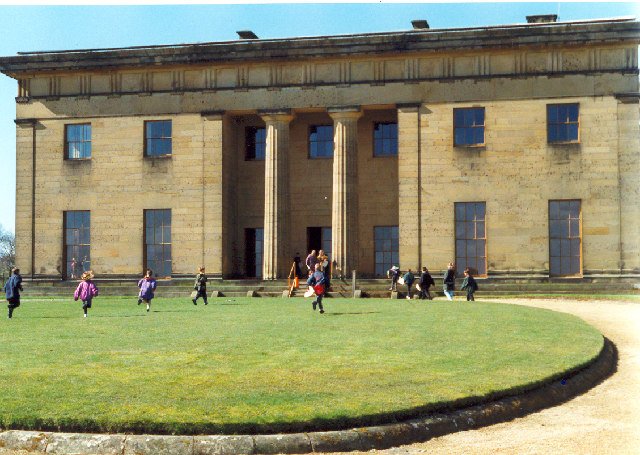
Belsay Hall, in Northumberland, England, is a Grade I listed House Museum that defies expected architecture. Built by Sir Charles Monck between 1810 and 1817, it is the first British country house to be created entirely in the Greek Revival style. Monck, possibly assisted by architect John Dobson, modelled his creation on buildings he encountered during his honeymoon in Athens – notably the Temple of Hephaestus. Belsay Hall stands on the same estate that once housed an earlier hall and Belsay Castle.
The Greek influence is evident in the Doric columns covering the exterior of Belsay Hall. However, the interior of the house is left unfurnished, with only necessary structural maintenance undertaken. The property hosts bespoke art installations every summer, although it is maintained in a state of benign decay. During the 1970s, the service side of the house was affected by dry rot and following remedial work, it was intentionally left as a weather-proof shell, emblematic of the history and preservation work that characterizes Belsay Hall.
English Heritage manages Belsay Hall, and in 2023, completed a two-year conservation project that included a new roof for the hall and considerable work on the gardens.
Sources: Wikipedia, OpenStreetMap, Wikidata, Wikimedia Commons
Written by Nicolo Ciampini
Discuss this with the author and others
No comments yet. Be the first to start the conversation.