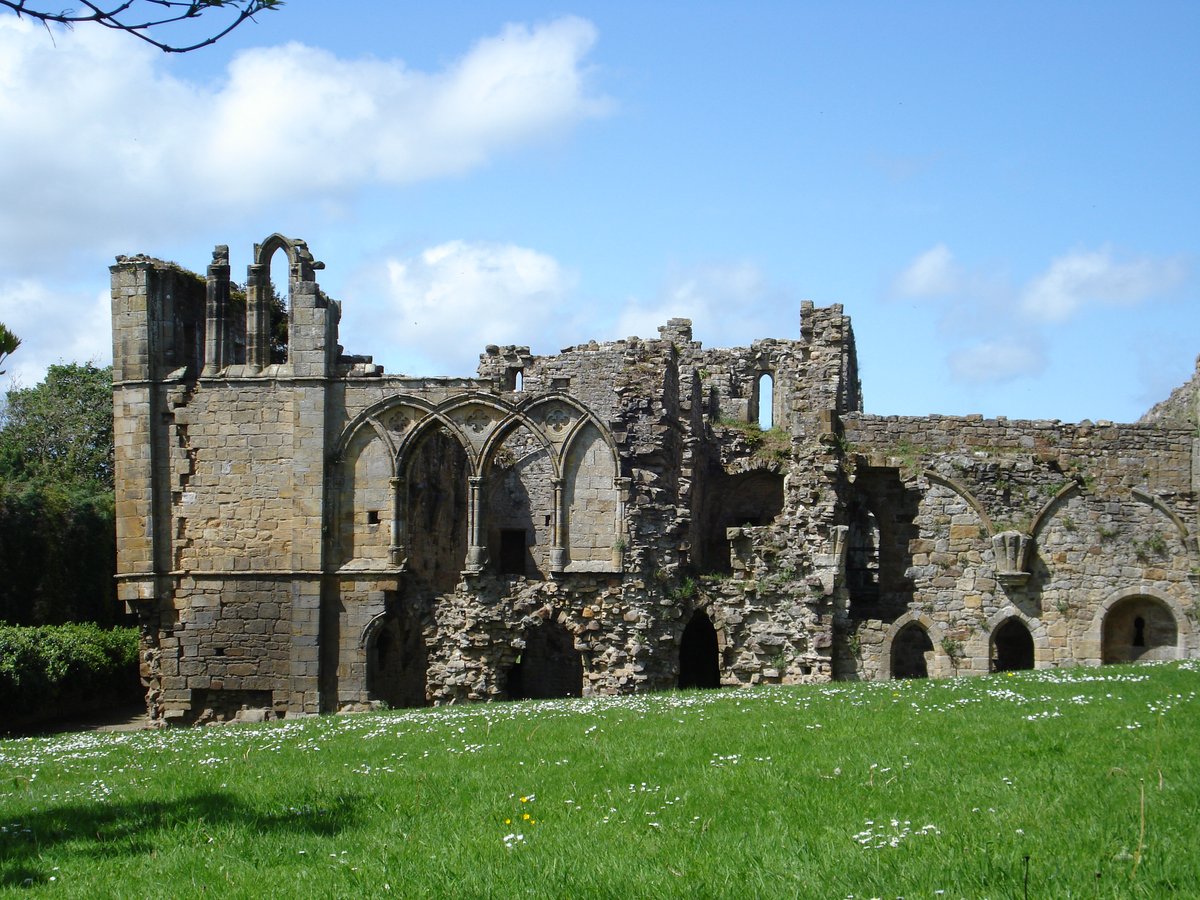
Easby Abbey, also known as the Abbey of St Agatha, is a ruined Premonstratensian abbey founded in 1152 by Roald, Constable of Richmond Castle. Located on the eastern bank of the River Swale on the outskirts of Richmond in the county of North Yorkshire, it is privately owned but maintained by English Heritage. Within the precinct of the abbey is the still-active parish church, St Agatha's, displaying 13th-century wall paintings. The inhabitants of Easby Abbey were canons rather than monks, known as the White Canons.
Unlike monks of other orders, they were exempt from episcopal discipline. They undertook preaching and pastoral work in the region (such as distributing meat and drink) and raised sheep. Other former Premonstraterian houses in the north of England include Egglestone Abbey in County Durham and Shap Abbey in Cumbria. Like most northern monasteries, Easby suffered from frequent Scottish raids during the Middle Ages. Great damage was caused to Easby and Egglestone Abbey in 1346 when the English army was billeted there on its way to the Battle of Neville's Cross.
In the late 1530s Henry VIII dissolved the monasteries, and the abbey was abandoned and left to fall into ruins. However, some of the best features were salvaged: the fine canopied choir stalls are now found in Richmond parish church. Besides being a historical place, Easby Abbey is also a burial site for several important figures, including Henry le Scrope, William le Scrope, Roger Scrope, Richard Scrope, and John Scrope, who were all buried at the Abbey.
Sources: [1] Easby Abbey on English Heritage's website: <https://www.english-heritage.org.uk/visit/places/easby-abbey/> [2] Easby on Wikipedia: <https://en.wikipedia.org/wiki/Easby> [3] Easby Abbey on the National Heritage List for England: <https://historicengland.org.uk/listing/the-list/list-entry/1149328>
Sources: Wikipedia, OpenStreetMap, Wikidata, Wikimedia Commons
Written by Nicolo Ciampini
Discuss this with the author and others
No comments yet. Be the first to start the conversation.