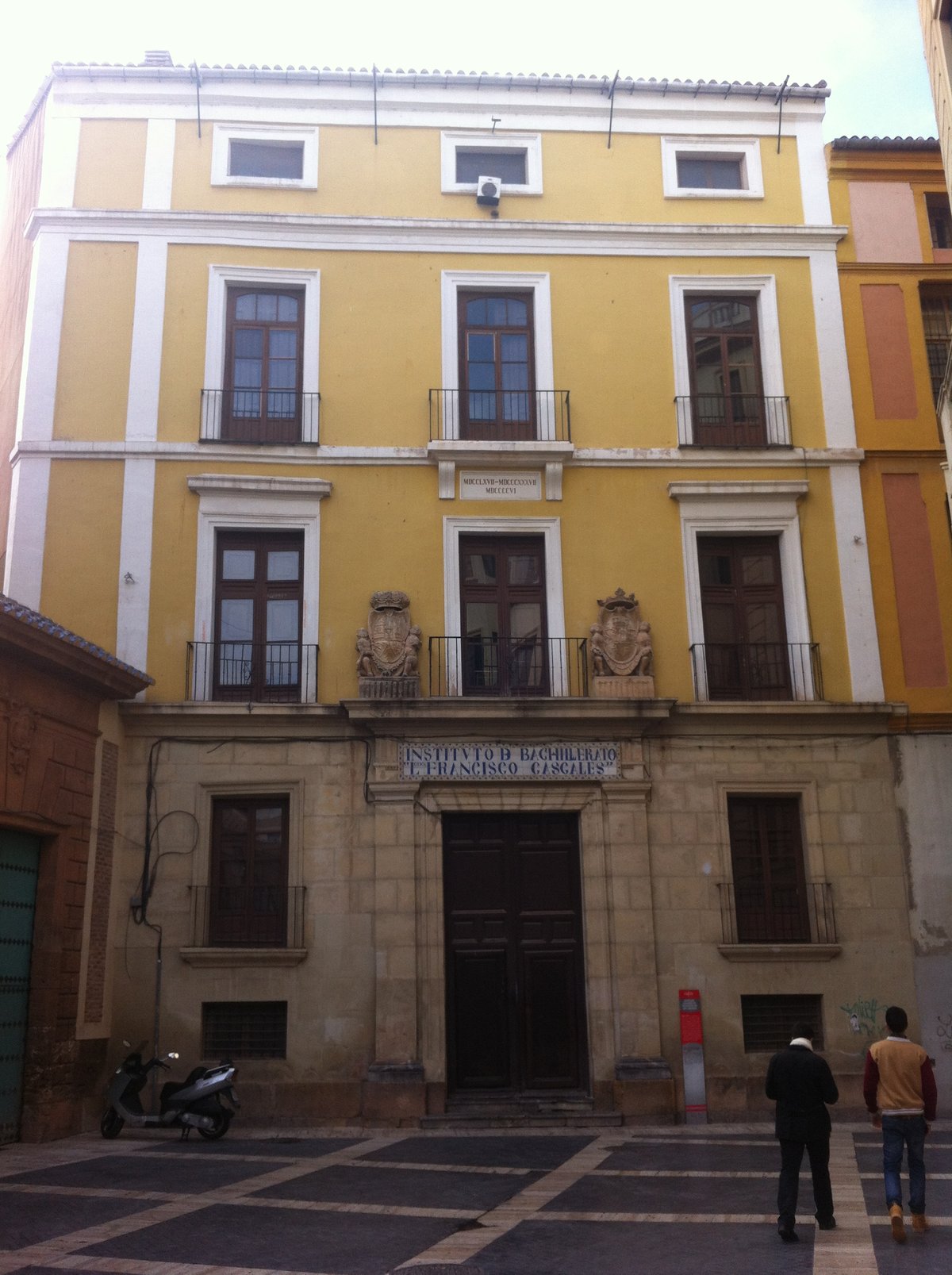

Founded by the bishop Cardenal Luis Belluga y Moncada, the antiguo Colegio de Teólogos de San Isidoro was definitively created in 1733 during the episcopacy of Tomás José Ruiz Montes. The current building was completed in 1767 during the episcopacy of Diego de Rojas y Contreras. Over the centuries, the site has been a central hub for the region's academic life, evolving from a theological college into a space for diverse educational pursuits.
Throughout the 19th and 20th centuries, the building hosted several significant institutions. It served as the Universidad Literaria (1840), the Universidad Libre de Murcia (1869-1873), and the first seat of the Universidad de Murcia (1915-1920). It also became the Instituto Provincial de Segunda Enseñanza de Murcia, the third of its kind founded in Spain. In 1939, it was renamed Instituto Alfonso X el Sabio before eventually becoming the IES Licenciado Francisco Cascales in 1981.
In 2018, the building was declared a Bien de Interés Cultural with the category of monument. The site remains an important part of a monumental complex that includes the Seminario Mayor de San Fulgencio, the Church of San Juan de Dios, and the Episcopal Palace of Murcia. Its history remains preserved in its architecture, notably in the assembly hall which features an 18th-century pictorial cycle by Vicente Inglés.
Sources: Wikipedia, OpenStreetMap, Wikidata, Wikimedia Commons
Written by Nicolo Ciampini
Discuss this with the author and others
No comments yet. Be the first to start the conversation.