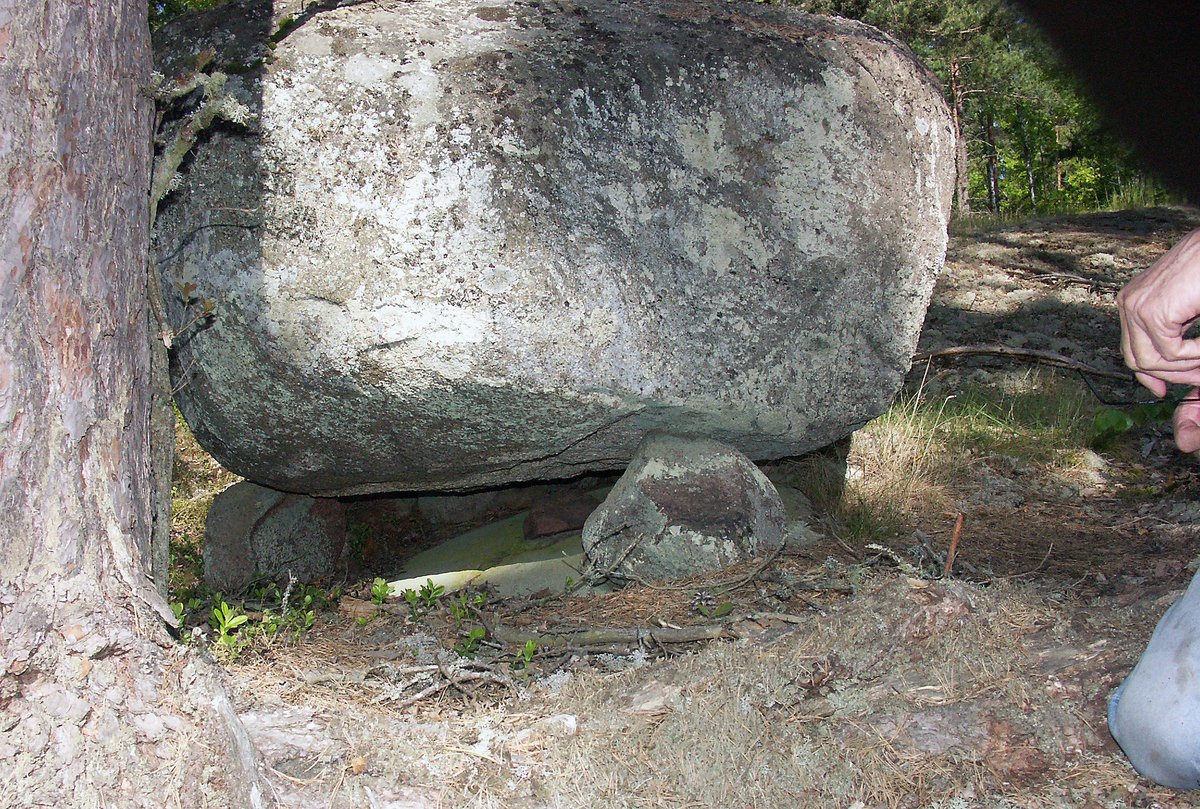

The **upallated block**, known colloquially as the **trefotssten**, the **stenpall**, the **flygande sten**, the **liggande höna**, the **höna på ägg** or the **ruvande ripa**, typically consists of a large block sitting on three smaller stones. It can be likened to a standing hen or a small child perched on a stool. However, these stone formations are not wholly natural. They are found worldwide in various shapes and forms, but the Nordic region is known for its unique occurrences, particularly in Sweden.
In Sweden, the stones are usually found in hilly or sloping granite outcrops, and the stories about them often involve their use as sacrificial stones or ritual places or as graves. Controversial theories from new age believers claim that they are megalithic monuments carved by human hands. These beliefs persist despite the fact that most researchers agree that most of the stones are a natural phenomenon. A small number of occurrences associated with Iron Age grave fields show a different history, as they were obviously placed by human hands.
This applies to several grave fields on Öland, Gotland's Trullhalsar, and some grave fields near Nässjö in Småland, where unlike the presumably naturally formed stones, the grave field constructions are smaller, approximately one meter in size, and often seem to belong to judgment rings or corner blocks in rectangular stone settings. The most common explanation for the stones' occurrence is that they were transported by the glacier with a layer of sand, gravel, and small stones.
Later, the action of the sea in connection with land uplift or the meltwater from remaining glaciers spooled away the finer material, leaving only the stones that were firmly secured. Specifically in the Lärbro Tängelgårda stones in Sweden, the best known of which is Tängelgårda I, a five-panel tall stone variously dated to 400–550 CE, the 8th century, the Viking Age, or the early Middle Ages, has a bottom panel showing a large ship and upper four panels that have been related to the cult of Odin; they include a battle scene with birds of prey (ravens), a horse (possibly Odin's eight-legged horse, Sleipnir), and two valkknuts.
The fourth panel, in particular, has been interpreted as a hero and his followers being welcomed into Valhalla, related specifically to the legend of Sigurd. Tängelgårda III is heavily damaged and dates to the Viking Age, between 800 and 1100 CE. Tängelgårda IV, a two-panel dwarf stone, has a suggested date range of the second half of the 8th century, or the Viking Age or earlier, between 500 and 1100 CE or to the Viking Age or the early Middle Ages, between 800 and 1250 CE.
Sources: Wikipedia, OpenStreetMap, Wikidata, Wikimedia Commons
Written by Nik Frost
Discuss this with the author and others
No comments yet. Be the first to start the conversation.