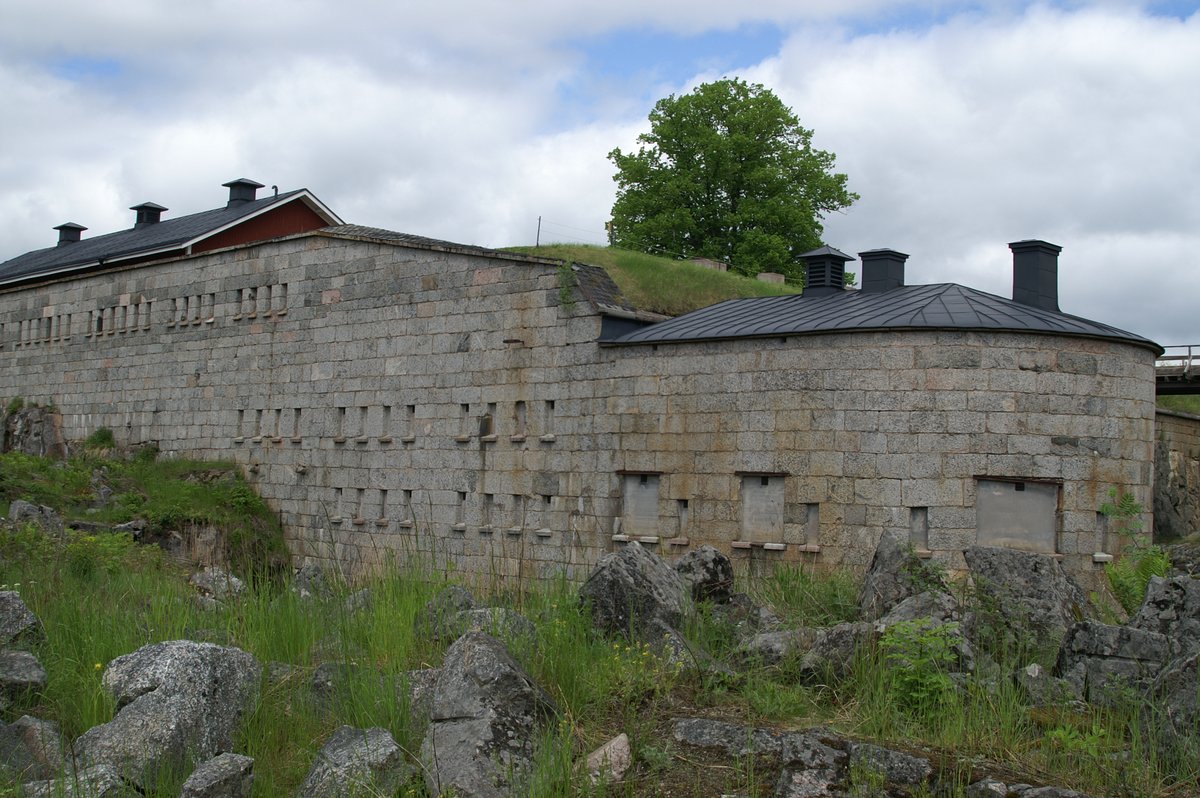

In the heart of the Stockholm archipelago, Rindö Redoubt stands as a testament to Swedish defensive ingenuity. Built between 1858 and 1863, it was designed to complement the historic Vaxholms Kastell, serving as a guard for Stockholm's northern entry. Rindö Redoubt is notable for being one of the earliest examples of its kind in Sweden. After undergoing modifications in 1872, it was equipped with a new battery, a first for the country, which was located in front of the fortress.
This battery, constructed underground with four 15.2 cm cannons, once again marked a first for Sweden. This innovative fortress served as a key element of Sweden's defense system for almost a century, even withstanding the advances in modern weaponry and military technology. However, after the shooting tests of 1872, it underwent significant changes. It was redesigned under the guidance of fortifications engineer Johan af Kleen. The main facade of the fortress faces northwest, and it was built of tegel with stone gavels and stone facades towards the sea.
It has a barrier wall in the southwest, with the rest of the sides surrounded by walls and a deep trench. Rindö’s installation was later equipped with the 12th battery, which was the first of its kind built in the country. This battery, with its partial burial in the ground and with four 15.2 cm cannons, served until the end of the 1960s. Through the defense decision of 1925, the inner defense line of Vaxholms, sheltered by the redout of Rindö, lost its function.
Rindö redutt wasarmed and had troops stationed within its walls until the 1940s. After the 12th battery was disbanded in 1933, three of its four cannons were moved to the 15.2 cm battery on Landsort, where they served from 1938 until the end of the 1960s. Rindö redutt has been a protected building since 1935 and is managed by Statens fastighetsverk.
Sources: Wikipedia, OpenStreetMap, Wikidata, Wikimedia Commons
Written by Nik Frost
Discuss this with the author and others
No comments yet. Be the first to start the conversation.