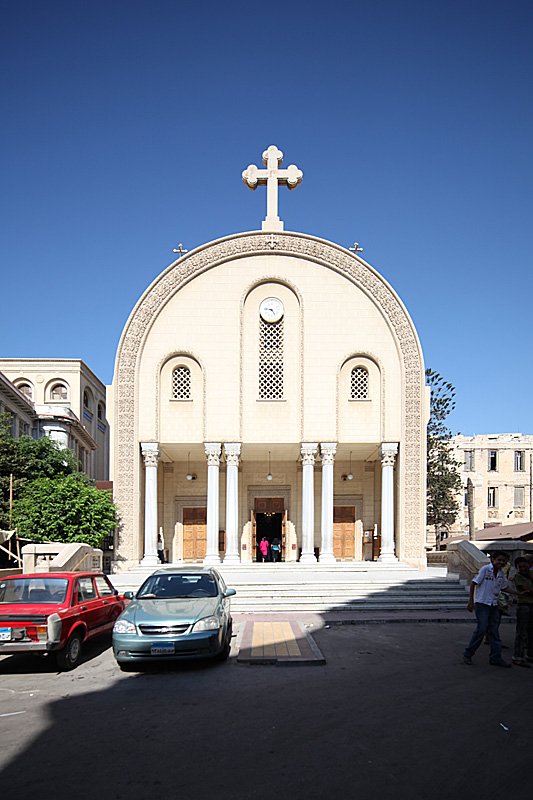

In the heart of Alexandria, Egypt, stands Saint Mark's Coptic Orthodox Cathedral. As the historical seat of the Pope of Alexandria, it has undergone numerous transformations and reconstructions. The site is believed to stand on the ground where a church was founded in AD 67/68 by Mark the Evangelist in Baucalis. The church was enlarged in the days of Pope Achillas, the 18th Pope.
In 641, the church was greatly ruined when the Arabs invaded Egypt, but Pope John III rebuilt it in 680. In 828, the body of Saint Mark was stolen by Italian sailors and taken to Venice, though his head remained in Alexandria. The church was destroyed again in 1219 during the Crusades and rebuilt once more. It was pulled down during the French invasion of Alexandria in July 1798, then rebuilt and reopened in 1819 by Pope Peter El Gawly. In 1870, the church was renewed under Pope Demetrius II.
Between 1950 and 1952, in the time of Pope Yusab II, the building was pulled down, except for its two bell towers, and replaced by a larger building of reinforced concrete. The six marble pillars were transferred to the outer entrance, and the icon carrier was accurately cut into parts, given numbers, and cautiously returned to its original position. The two bell towers were reinforced with concrete and decorated with Coptic engravings. From 1985 to 1990, the church was widened, doubling its size while keeping the bell towers in their places.
Coptic Christians believe that Saint Mark the Evangelist arrived in Alexandria around AD 42 and stayed for about seven years. Today, the head of Saint Mark remains in the cathedral. Every year, on the 30th day of the month of Paopi, the Coptic Orthodox Church celebrates the commemoration of the consecration of the Cathedral of St. Mark and displays the purported head of the saint at the cathedral.
Sources: Wikipedia, OpenStreetMap, Wikidata, Wikimedia Commons

Written by Mutabor
Discuss this with the author and others
No comments yet. Be the first to start the conversation.