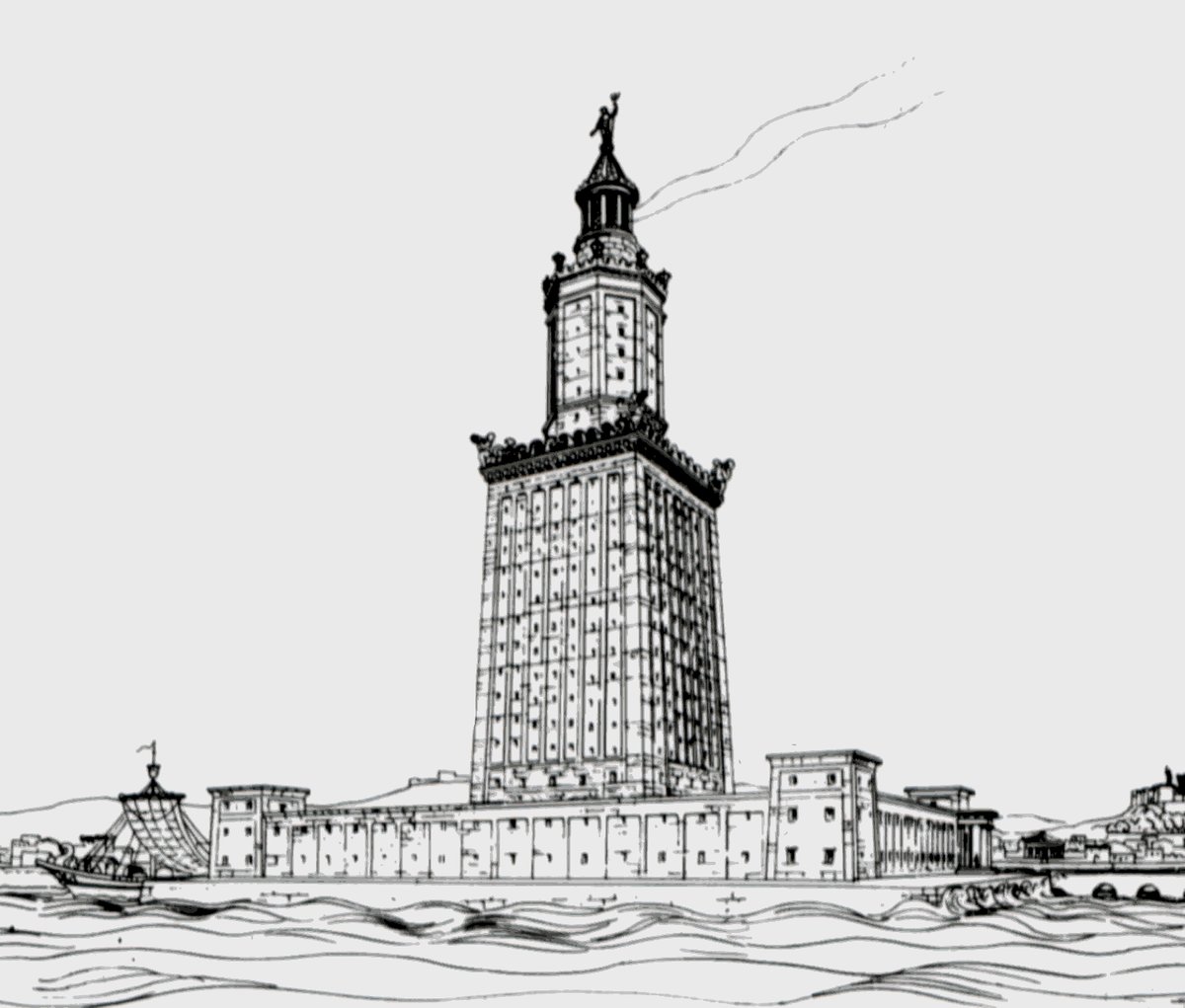

In the city of Alexandria, Egypt, there once stood a mighty lighthouse known as the Pharos, one of the Seven Wonders of the Ancient World. Commissioned by Ptolemy I Soter and finished during the reign of his son, Ptolemy II Philadelphus, between 280 and 247 BC, the construction took twelve years and cost 800 talents of silver. The lighthouse was estimated to have been at least 100 metres in height. Built mostly with solid blocks of limestone and granite, the tower was composed of three tapering tiers: a lower square section, a middle octagonal section, and a circular section at the top. A furnace at the top produced the light, and lead was used as a filling agent between the masonry blocks at the base.
A seaward inscription dedicated to Zeus was featured on the structure. The lighthouse's endurance was tested by nature, as it was severely damaged by three earthquakes between AD 956 and 1303. Following the collapse of a statue that previously topped the structure, an Islamic-style dome was installed as a repair. By 1480, the last of its stones was used to build the Citadel of Qaitbay on the site. Today, the Ras el-Tin promontory represents all that is left of the island of Pharos, as the eastern point of the site has been weathered away by the sea.
In 1994, a team of French archaeologists discovered remains of the lighthouse on the sea floor of Alexandria's Eastern Harbour. In 2016, Egypt's Ministry of State of Antiquities planned to turn these submerged ruins into an underwater museum. To aid in architectural reconstruction efforts, parts of the lighthouse's entrance, threshold stones, and foundation paving stones were resurfaced in 2025. The Pharos remains a significant archaeological site, with parts of it still preserved beneath the water.
Sources: Wikipedia, OpenStreetMap, Wikidata, Wikimedia Commons


Written by Mutabor
Discuss this with the author and others
No comments yet. Be the first to start the conversation.