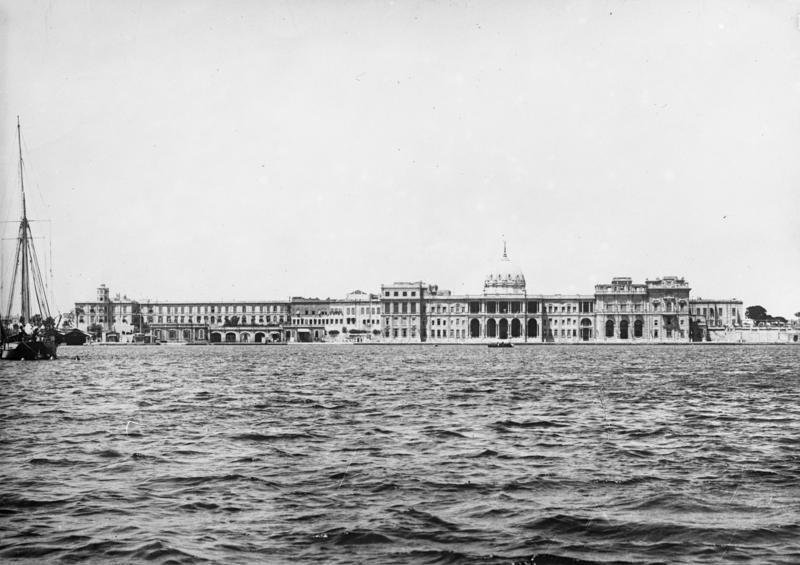

Construction of the Ras El Tin Palace began in 1834 under Muhammad Ali Pasha. Although initially planned as a fortress based on a Roman fort design with Ottoman features, the project developed European characteristics under the influence of Italian architect Pietro Avoscani. Avoscani designed the entrance gate with its coat of arms. The palace was completed to its original design in 1845, and further construction continued until 1847. Built in the style of a grand château, it served as the official summer residence for the Egyptian monarch and government when Alexandria was the working capital.
Following the Muhammad Ali dynasty, the palace became the summer vacation home of Khedive Ismail, who constructed a private railway line between the palace and Cairo. The palace was later totally reconstructed by Fuad I in the 1920s with modern services and redecoration. During this period, overseen by engineer Ernesto Verrucci Bey, it became a three-storey building and a mosque was built on the site. The interior décor combined Renaissance, Byzantine, French, and Modern elements, featuring opulent furniture supplied by the Parisian ébéniste François Linke.
King Farouk added the Princesses Building to the palace and had a marine pool built on the Mediterranean breakwater after the Second World War. The pool was linked to the palace by a long paved lane atop the breakwater. Today, the palace serves as a presidential residence and a venue for hosting state guests and events, while its formal garden is open to the public.
Sources: Wikipedia, OpenStreetMap, Wikidata, Wikimedia Commons

Written by Mutabor
Discuss this with the author and others
No comments yet. Be the first to start the conversation.