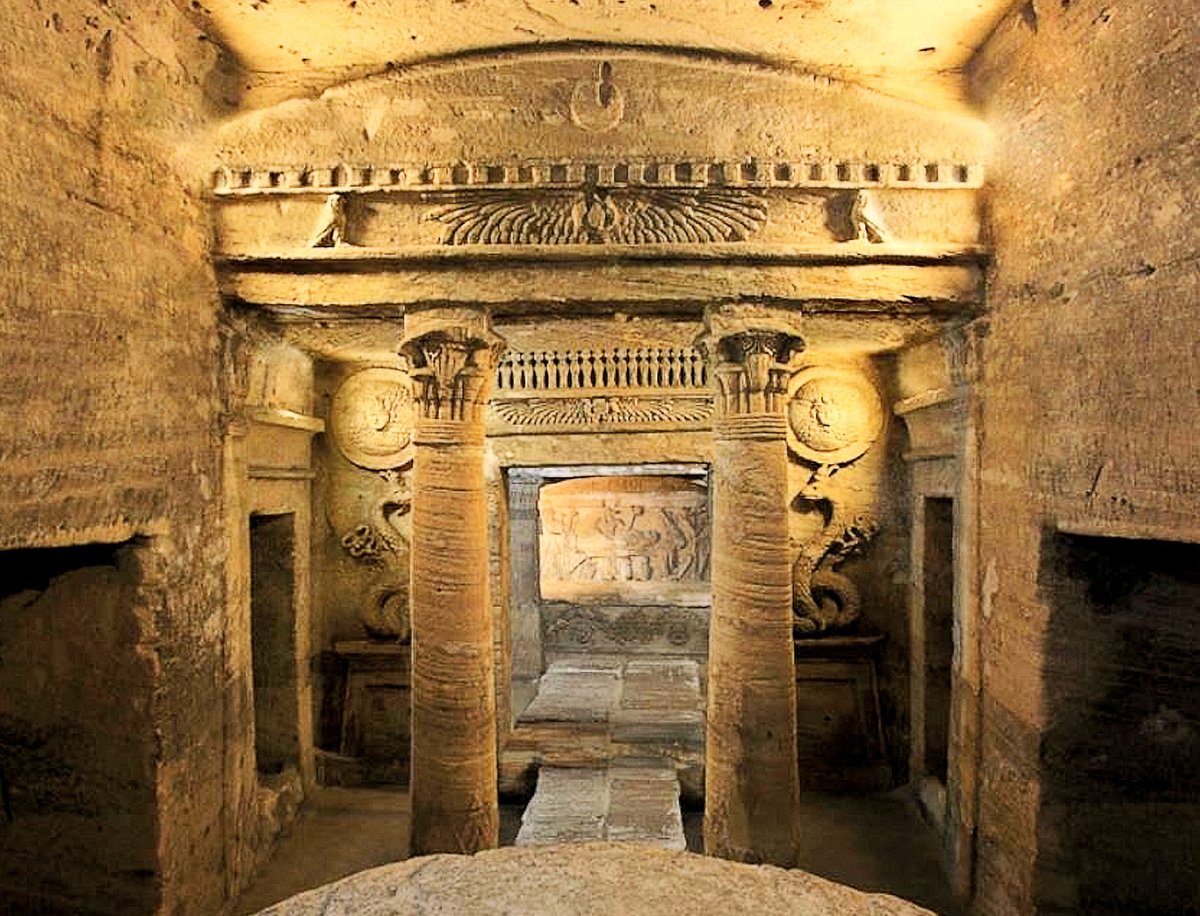

The catacombs of Kom El Shoqafa, meaning Mound of Shards, are an archaeological site in Alexandria, Egypt, considered one of the Seven Wonders of the Middle Ages. The necropolis consists of a series of tombs, statues, and archaeological objects that merge Egyptian, Hellenistic, and Roman cultural attributes. A circular staircase was often used to transport deceased bodies down into the tombs that were tunneled into the bedrock during the 2nd century CE. The site was used as a burial chamber until the 4th century before being rediscovered in 1900 when a donkey accidentally fell into the access shaft.
The catacombs consist of three levels cut through solid rock. Visitors can reach the first level through a breach in the rotunda wall, which leads to the Hall of Caracalla. This hall contains the bones of the horses of emperor Caracalla, for which the tombs were created in 215 CE. On the left of the layout is a triclinium, a funeral banquet hall where friends and family gathered on stone couches covered with cushions during the time of burial and on future commemorative visits.
The name Kom El Shoqafa comes from a mound of terra cotta shards, mostly consisting of jars and objects made of clay, left by those visiting the tombs. These visitors would bring food and wine and break the containers because they did not wish to carry them home. It is believed the catacombs were only intended for a single family, but it is unclear why the site was expanded to house numerous other individuals.
At the front of the tomb chamber is a temple-like façade with columns topped by papyrus, lotus, and acanthus leaves, supporting an architrave with a relief of a central winged sun-disk. Carved figures of a man and a woman flank the entrance. The man's body has a stiff hieratic pose typical of Ancient Egyptian sculpture, with the head carved in the lifelike manner of the classic Hellenes. The woman's figure is also rigidly posed but bears the Roman hairstyle.
Sources: Wikipedia, OpenStreetMap, Wikidata, Wikimedia Commons



Written by Mutabor
Discuss this with the author and others
No comments yet. Be the first to start the conversation.