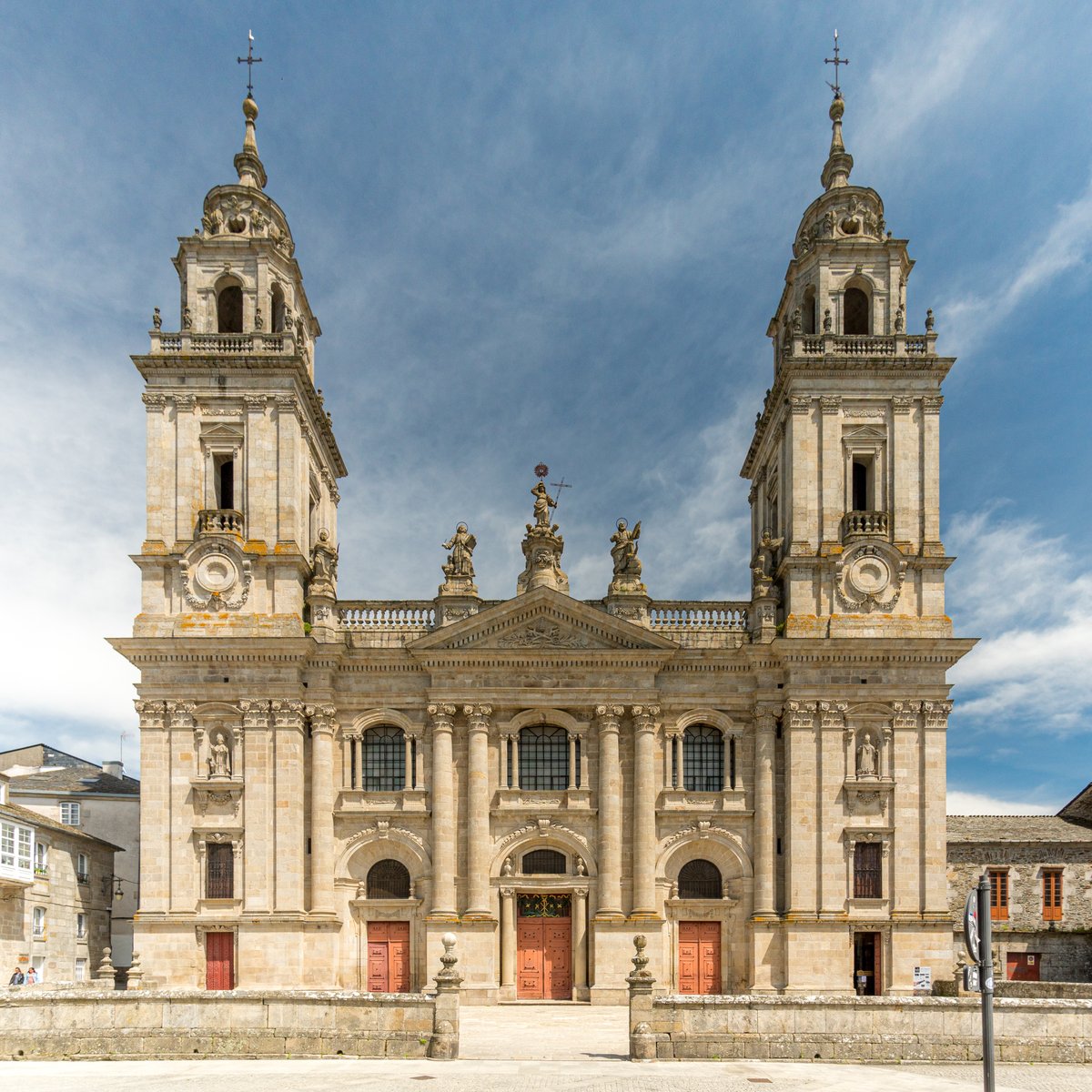

Lugo Cathedral, known as Saint Mary’s Cathedral, is a stunning Roman Catholic church and basilica in Lugo, Galicia, north-western Spain. Constructed in the early 12th century, the cathedral was commissioned by Bishop Peter III and Raimundo de Monforte in 1129 and completed around 1273. Before the current Cathedral was commissioned, there was a pre-Romanesque church on the site, erected by Bishop Odoarius in 755.
The 14th century added a larger Gothic apse and chapels. During the Renaissance, a retablo was added at the high altar, which was damaged in the 1755 Lisbon earthquake and underwent repairs and relocation within the cathedral. The cathedral retains the privilege, traced to a 6th-century conciliar decision against Priscillianism and reaffirmed in 18th-century episcopal documents, for the permanent exposition of the Holy Sacrament.
The present-day structure of the cathedral features a Latin Cross, measuring 85 meters in length. It houses a nave, covered by a barrel vault, and two aisles, with an ambulatory and five apse chapels. The triforium features triple ogival mullioned windows.
Sources: Wikipedia, OpenStreetMap, Wikidata, Wikimedia Commons
Written by Nicolo Ciampini
Discuss this with the author and others
No comments yet. Be the first to start the conversation.