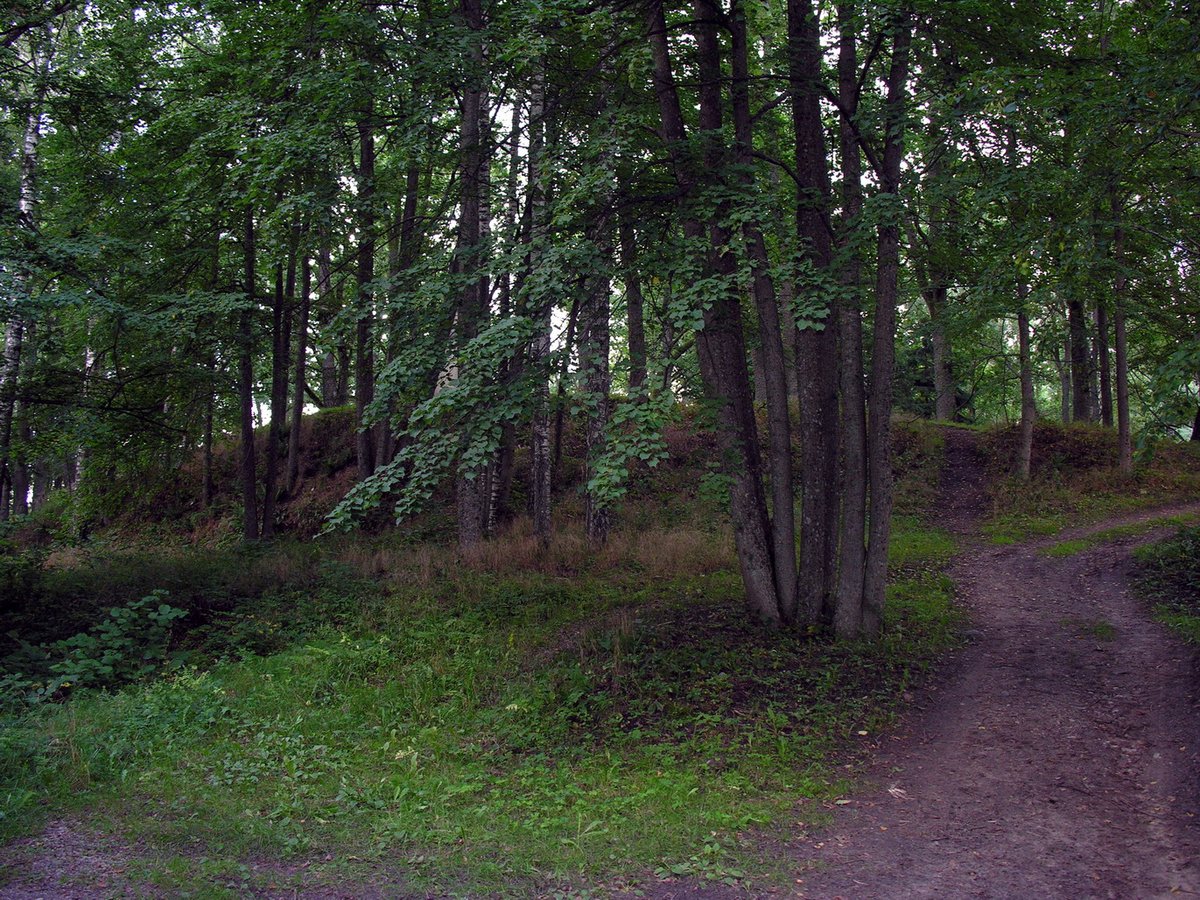
Standing 80 meters tall, 57 meters wide at its base and 40 meters wide at the top, Skomantų hillfort is hard to miss when driving down the road between Gargždai and Švėkšna in western Lithuania. To reach it, take the road that jogs away from the main road for around 450 meters into the forest on the right-hand side. After turning on the dirt track to your right for 100 meters, you'll arrive at a gravel parking lot, where the forest dissolves, replaced by open fields and the hillfort rises abruptly before your eyes.
Skomantų hillfort is located on a high hill on the right bank of Veiviržė river. It is a hillfort that bears the marks of countless battles, hidden in a forest for centuries, but now revealed to visitors. The hillfort is not only a testament to the battles that raged on its lands, but also to the lives of the people who lived here. The hillfort sits on a strategic location, overlooking the Veiviržė river and the flatlands beyond. Its shape is unusual for a hillfort, with two smaller hills stacked on top of one another.
The upper hill has a gap in its center, through which a stone sculpture of Žemaitis (1969, sculptor V. Majoras) is installed, marking the adjunction of Klaipėda region to Lithuania. The hillfort's total area is 1 hectare, and about 500 meters from the hillfort there are remains of a 3rd – 13th-century medieval village. It is not known exactly when it was built, but it is believed to be at least 2000 years old. The hillfort was built from bone, stone, and wood material.
The German archaeologist Dr. Poosekkis discovered two burials in the hillfort in 1903 with pottery, jewelry, and other items dating back to the 6th – 7th centuries. Archaeological excavations also revealed stone grinding mills and fireplaces in the hillfort. The hillfort remains under the protection of the Cultural Heritage Department of Lithuania, and it is strictly forbidden to walk around it. Also, it is advisable to explore the area with trained professionals, as the hill fort contains many unexploded shells and other artifacts.
Sources: Wikipedia, OpenStreetMap, Wikidata, Wikimedia Commons
Written by Nicolo Ciampini
Discuss this with the author and others
No comments yet. Be the first to start the conversation.