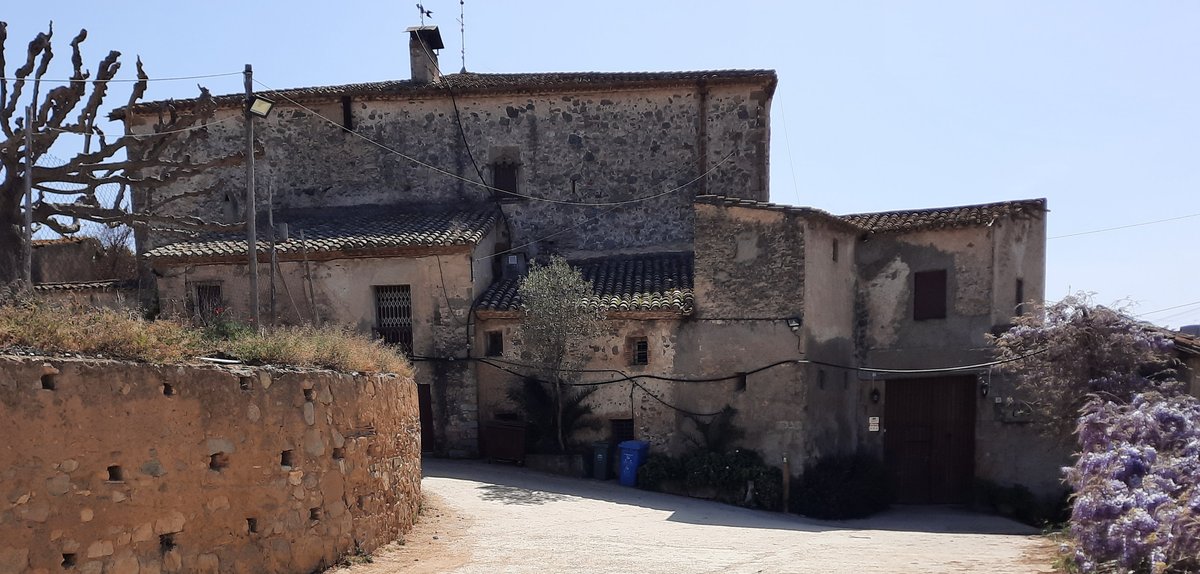

Can Roca, a gothic manor in Tiana (Maresme) protected as a cultural asset of local interest, hides a curious secret. A capital, thirty centimeters high, adorns the rear wall, with a round face, almond-shaped eyes, a straight nose, a simplified hairdo, a large mustache, and carved lines representing wrinkles on the forehead. The secret lies in the tube that emerges from the capital - it is not functional. The manor was built in the 17th century, as a large, quadrangular building with four-sloped roof.
The angles of Can Roca are made of stone. The facade of Can Roca has an adobe-arched doorway at the ground floor and three windows on each upper floor. Some of the windows on the upper floor have been reduced. The porch and the gothic window are significant annexes that change the overall appearance of the facade. The porch occupies the entire ground floor and extends to the height of the first floor laterally. The ground floor of the porch is formed by large, shallow arches supported by pillars.
The upper floor of the porch is formed by an arcade of pointed arches. A lateral and external part of the building has a typical Gothic window in the form of a conical arch with lobed figures.
Sources: Wikipedia, OpenStreetMap, Wikidata, Wikimedia Commons
Written by Nik Frost
Discuss this with the author and others
No comments yet. Be the first to start the conversation.