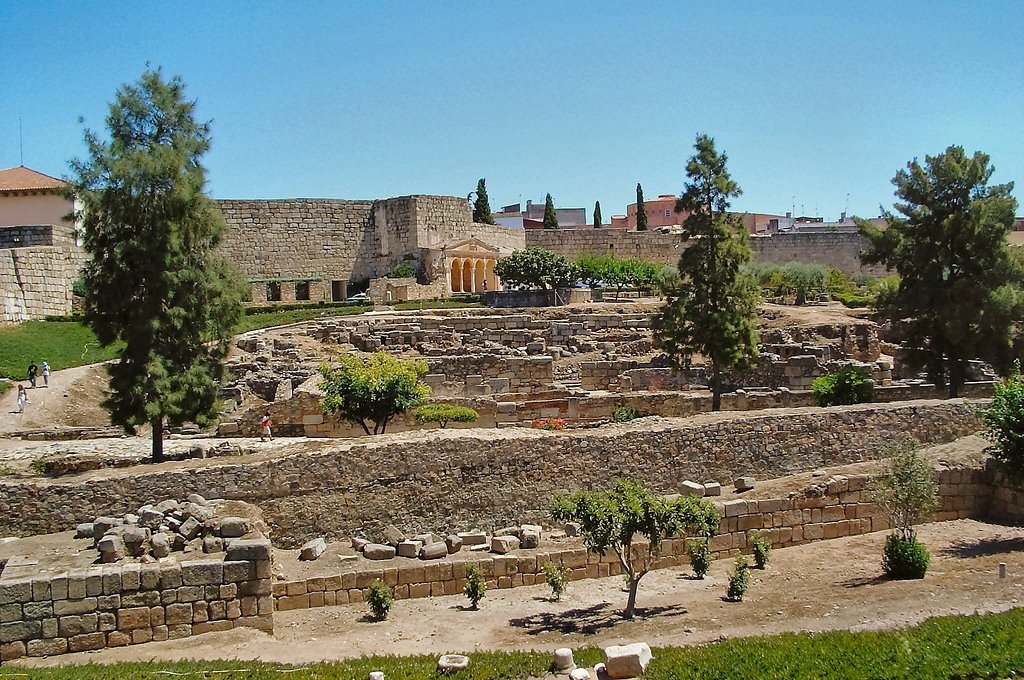

In 835, Emir Abd ar-Rahman II of Córdoba decided to end a rebellion in Mérida not with an invasion, but by building a new fortress. This squared line of walls, each 130 metres long and 10 metres high, is called an alcazaba. It was built not as a defensive structure, but as a statement of power: a showcase of Muslim wealth and a counter to Roman ruins. Inside the alcazaba are 25 towers, each with a quadrangular base. They served not only as lookout points, but also as counterforts, providing structural strength to the walls.
One of these towers, guarding the entrance, features an inscription praising Abd ar-Rahman's patronage of the project. Additionally, the alcazaba houses an aljibe, a water tank that collected and filtered rainwater. This was necessary for the city's growing population, for which water was becoming scarce. After the Muslim rule ended, a convent of the Order of Santiago took over the alcazaba. The fortress also hides beneath its walls remnants predating its construction, such as a well-preserved segment of a Roman road that lies just beyond its walls. Today, it is home to the council of the Extremadura community.
Sources: Wikipedia, OpenStreetMap, Wikidata, Wikimedia Commons
Written by Nicolo Ciampini
Discuss this with the author and others
No comments yet. Be the first to start the conversation.