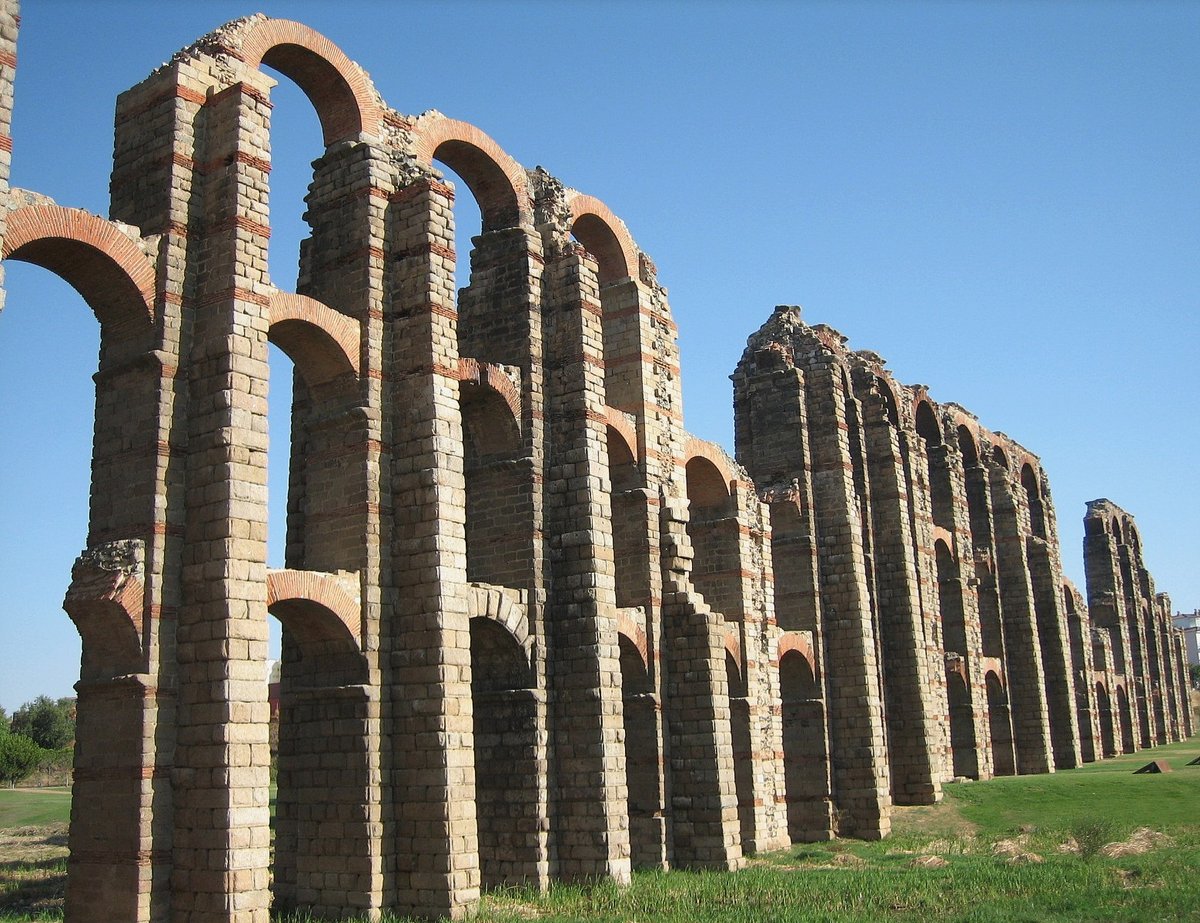

The Aqueduct of the Miracles is an ancient Roman structure in Mérida, Spain, and a testament to the ingenuity of the Romans. It was built during the first century AD to supply water from the Proserpina Dam into the city. While much of the aqueduct has been lost to time, a small section still stands, featuring thirty-eight arched pillars rising to a height of 25 meters. The structure is constructed from opus mixtum – granite ashlar blocks interspersed with red brick.
The aqueduct originally brought water from the Proserpina Dam to the city. It is thought to have been constructed during the first century AD, with a second phase of building or renovations around 300 AD. In later centuries, the residents of Mérida dubbed it the 'Aqueduct of the Miracles' for the awe that it inspired. The aqueduct is one of three built at Mérida, the other two being the 15 kilometers long Aqua Augusta, fed by the Proserpina Dam, and San Lázaro, fed by underground channels.
The aqueduct is preserved as part of the Archaeological Ensemble of Mérida, which is a UNESCO World Heritage Site. In the immediate vicinity, a small Roman bridge called Puente de Albarregas runs parallel to the arcades.
Sources: Wikipedia, OpenStreetMap, Wikidata, Wikimedia Commons
Written by Nicolo Ciampini
Discuss this with the author and others
No comments yet. Be the first to start the conversation.