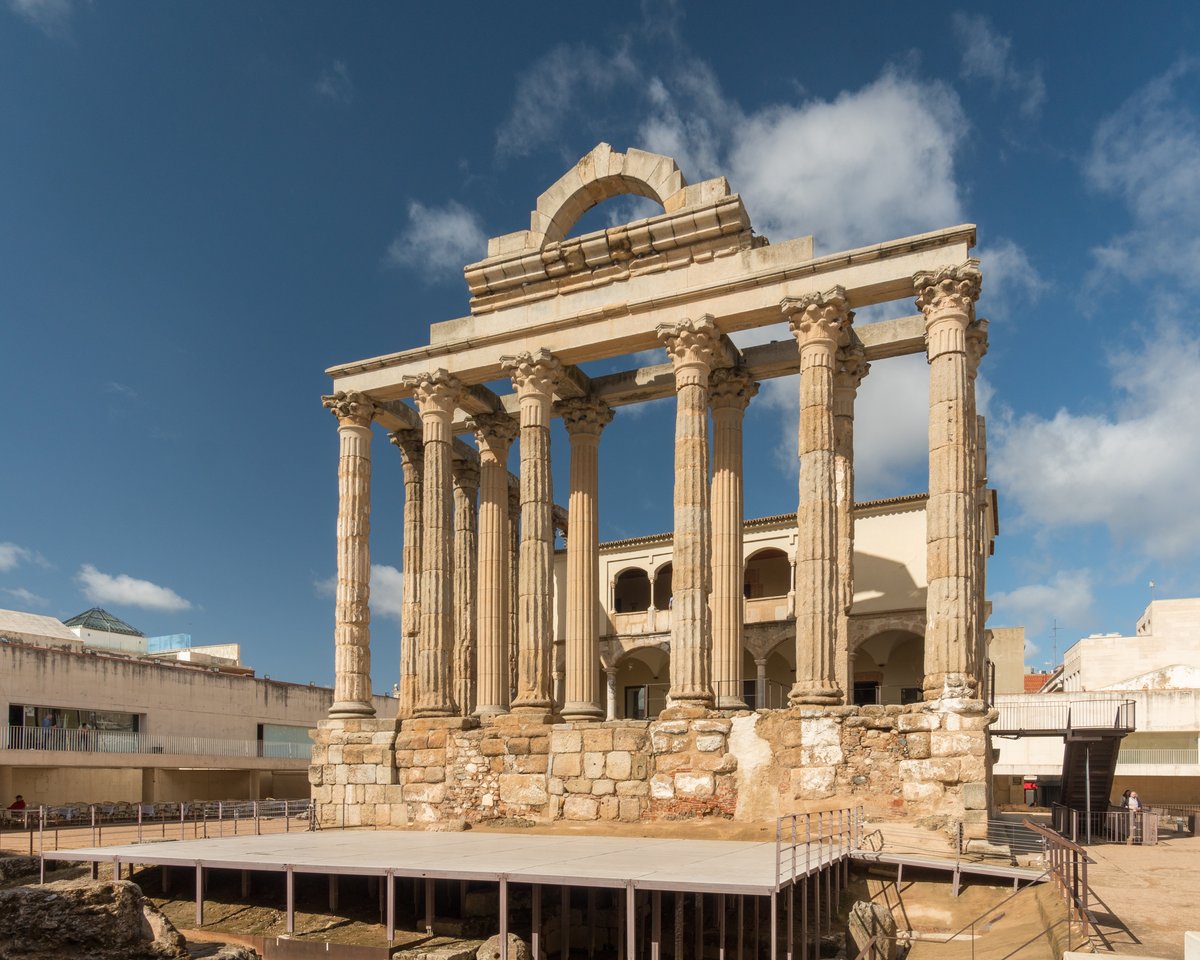

The Temple of Diana in Mérida, Spain, is no ordinary temple. It's a construction originating from the Roman cult of the Emperor, constructed during the 1st century AD. It holds the esteemed positions of a UNESCO World Heritage Site and a Monumento Nacional. Its hexastyle design, with eleven columns on each lateral facade and a pórtico furnished with pilasters, might resemble another temple, but its creation belongs to the Flavian period (69-96 AD).
Though graced with stucco-covered columns, the roof has vanished, leaving behind the remnants of an triangular fronton with a semicircular arch. The Senate and the Roman emperor were worshipped underneath the temple’s facade within the temple’s cella. The peculiar detail is, in the 16th century, a palace was erected within the cella using Roman and Visigoth materials. In 2018, an interpretation center was unveiled to delve into the temple’s Roman uses and subsequent history.
Sources: Wikipedia, OpenStreetMap, Wikidata, Wikimedia Commons
Written by Nicolo Ciampini
Discuss this with the author and others
No comments yet. Be the first to start the conversation.