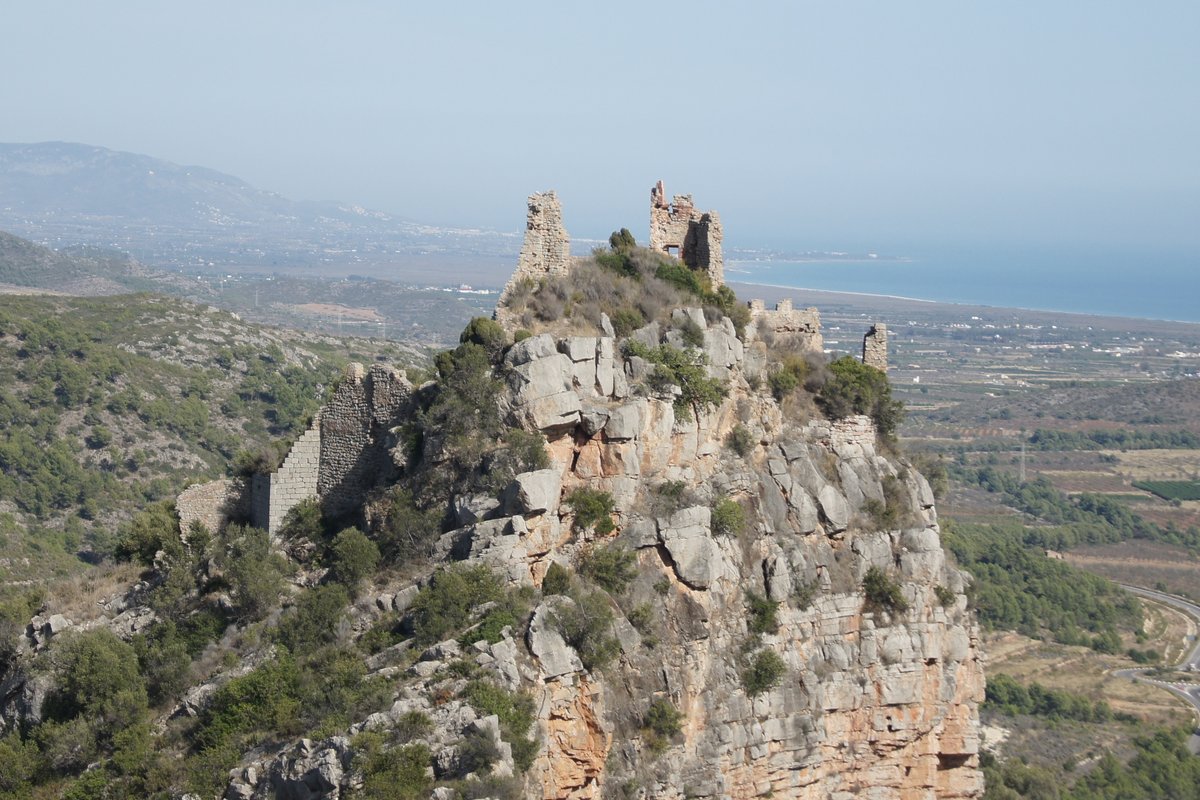

The mystery castle of Miravet, located in Cabanes, Castellón, Spain, is a architectural marvel that lies hidden in the hills near the road from Cabanes to Oropesa. It is an Islamic construction with medieval architecture, but its originality is unknown. The area was inhabited during prehistoric times, as evidenced by the yacimientos of the eneolític period found nearby. Some historians suggest that the location of the castle is the same as the mansión of Ildum from the Roman itineraries, but there is no full confirmation of this.
The castle is protected by the general protection of Spanish castles. It is a cultural property and is categorized as a monument. The history of Miravet dates back to the time of the Cid Campeador, who conquered it from the Muslims in 1091. Between 1093 and 1103, the castle was possessed by various Aragon governors, but the conquest was not consolidated. More than a century later, in 1178, King Alfonso II of Aragon promised to the cathedral of Tortosa various donations in this territory when the land was conquered from the Moors, but it was not until the reign of Jaime I that the conquest and full confirmation of these donations were consolidated.
On April 27, 1224, while Jaime I was in Huesca, he confirmed the ancient terms of the Diocese of Tortosa and the donations of various castles, including Miravet. On the same day, April 27, 1225, from Tortosa, he granted two new documents of donation of the castles of Miravet, Zufera and Fadrell, whose terms he fixed, donation that he reconfirmed on September 3, 1225 to the same Poncio de Torrella during the unsuccessful siege of Peñíscola to thank him again for the help he provided during the siege.
After these documented news, we know from the royal chronicle or 'Llibre dels feyts' that in July 1233 Burriana surrendered and, as a consequence, the castles of Borriol, Cuevas de Vinroma, Vilafames and Alcalatén fell at the end of the same summer. It is likely that Miravet, given its etymology, was a monastery of Muslim warrior monks dedicated to the holy war, and it is possible that Zufera (with the meaning of 'the peñasco') was the enigmatic Azafuz cited in a document of Pedro I from the year 1100 and, as such, it was absorbed by the neighboring and dominant Miravet after the conquest.
Sources: Wikipedia, OpenStreetMap, Wikidata, Wikimedia Commons
Written by Nik Frost
Discuss this with the author and others
No comments yet. Be the first to start the conversation.