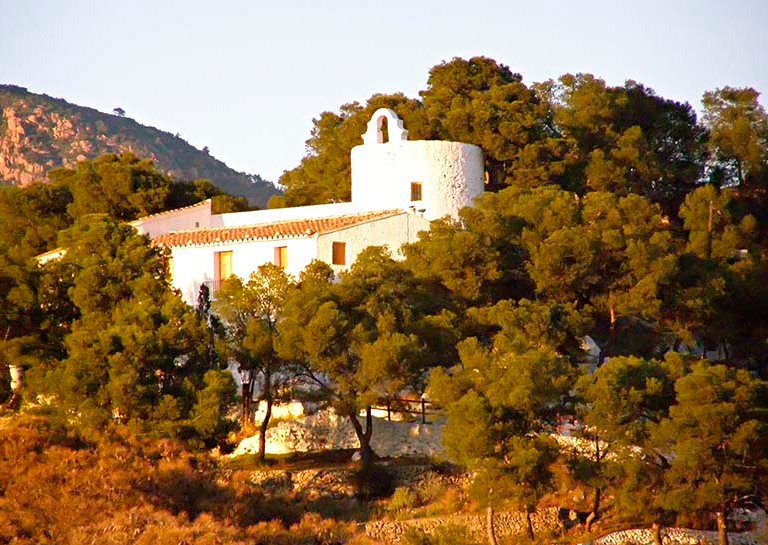

The Bé d'Interès Cultural (BIC) Ermita de la Magdalena is situated on a hill overlooking the city of Castelló de la Plana. The current building dates to the 15th century, with construction beginning in 1451 under a friar known as Frare Barbut from the Monastery of Santes Creus. The chapel features altars dedicated to Santa Maria Magdalena and Sant Bernat de Claravall, the founder of the Cistercian order. The construction of the hermitage was supported by contributions from the people of Castelló, for which the Archdiocese of Tarragona granted indulgences.
In 1455, the portico was built, and in 1456, the chapel was completed with a wooden altarpiece for the main altar. The Municipal Council of Castelló, as the owner, has carried out various works, including the construction of a kitchen in the 17th century and a hostel for pilgrims in the 18th century. In 1745, the hermitage fell into such poor condition that pilgrimages were suspended. It was subsequently rebuilt in 1758 under the direction of master builder Vicent Pellicer, which gave the building its current configuration.
The interior layout is irregular due to the reuse of the structure, featuring two parallel aisles separated by rudimentary arches and covered by a barrel vault. One wall preserves 14th-century paintings. At the altar of Santa Maria Magdalena, there is an oil on canvas imitating ceramic, painted by Joan Baptista Porcar Ripollés in 1940. Today, the hermitage and its surroundings are a municipal natural heritage site, used as a place of worship, leisure, and cultural heritage.", Alternately:
Sources: Wikipedia, OpenStreetMap, Wikidata, Wikimedia Commons
Written by Nicolo Ciampini
Discuss this with the author and others
No comments yet. Be the first to start the conversation.