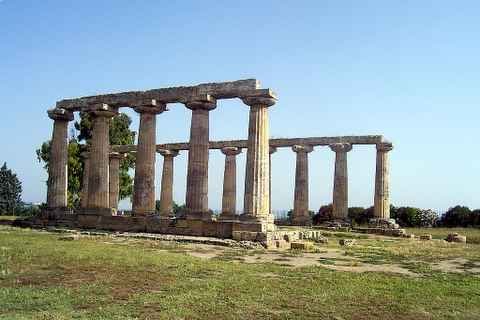

Metapontium or Metapontium (Ancient Greek: Μεταπόντιον, romanized: Metapontion) was an ancient city of Magna Graecia, located in southern Italy. Founded by an Achaean colony around 700-690 BCE, Metapontium was built to prevent Tarentines and the Oenotrians from taking possession of the territory. The city rose to prosperity due to the fertility of Metapontum's territory, providing grain to Sicily. A Golden Harvest offering was sent to the temple at Delphi, and an ear of grain was a characteristic symbol on Metapontum's coins.
One of the most famous Greek philosophers, Pythagoras, spent the latter part of his life in Metapontium, where he developed many of his philosophical teachings. The city was consecrated to Ceres, and a street named Museum was named after Pythagoras. Metapontium continued to be an ally of Athens during the Athenian expedition to Sicily in 415 BCE. However, during the Pyrrhic War, the city was occupied by a Roman garrison, resulting in its decline.
The ruins of Metapontium can now be found in the frazione of Metaponto, in the comune of Bernalda, Province of Matera, Basilicata region, southern Italy.
Sources: Wikipedia, OpenStreetMap, Wikidata, Wikimedia Commons
Written by Nicolo Ciampini
Discuss this with the author and others
No comments yet. Be the first to start the conversation.