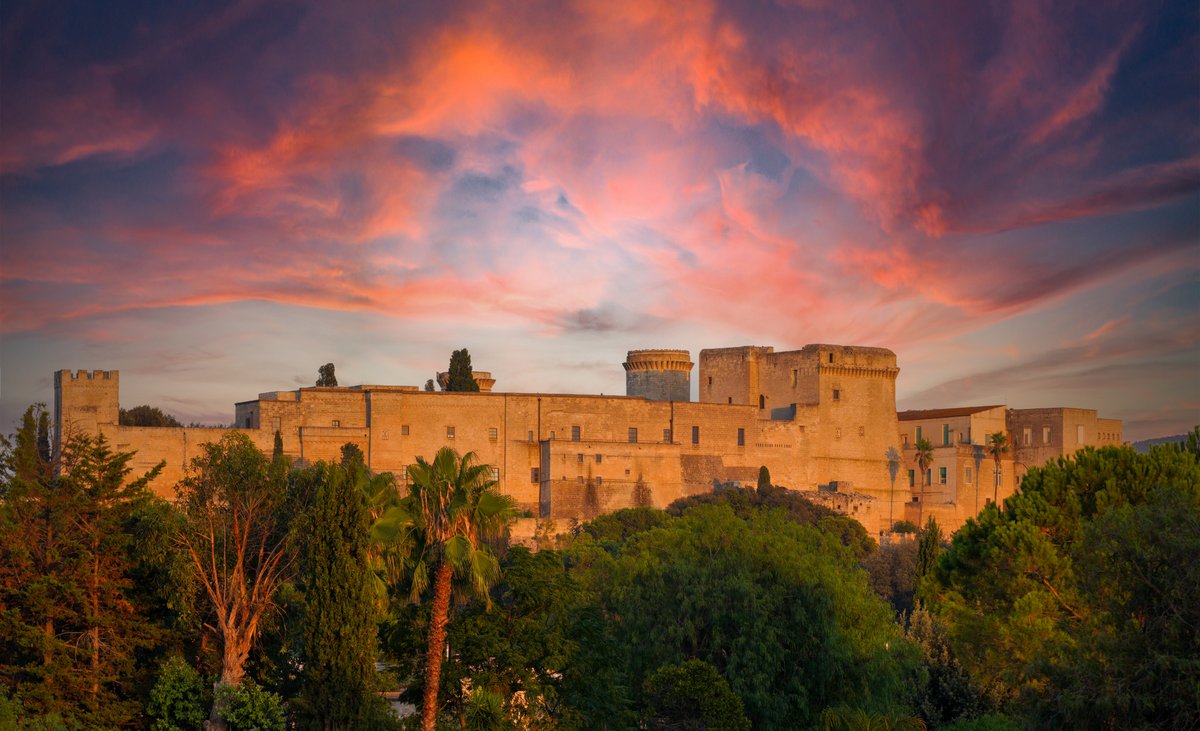

The Castello di Oria occupies the Vaglio hill, the highest point of the city at about 166 meters above sea level. The area has been inhabited since remote periods, including a Messapian acropolis that likely featured walls around the 6th century BC, some of which are still visible a few hundred meters below in Piazza Cattedrale.
The castle underwent significant modifications during the period of Federico II (1225-1233), leading to its name as Castello Svevo. While some local sources claim Federico II built the entire structure, it is more realistic to believe he expanded and modified it for residential needs; notably, the castle hosted numerous guests of honor during his marriage to Isabella II. Later, cylindrical towers known as "del salto" and "del cavaliere" were added. By the 15th and 16th centuries, the structure was adapted for gunpowder with the addition of numerous cannon ports.
Throughout its history, the castle resisted various sieges and hosted prominent figures, including Maria d'Enghien in 1407 and Alfonso II, who departed from Oria in 1480 to liberate Otranto. The architecture features a triangular shape with the Sperone tower at the northern vertex. This tower, likely from the 12th-13th century, was particularly suitable for defense with the bow, while the steep hill provided natural protection. To the south sits the Mastio, or Donjon, likely of Norman origin, featuring a sloping base to make it harder to attack from below and featuring small merlons.
Sources: Wikipedia, OpenStreetMap, Wikidata, Wikimedia Commons
Written by Nicolo Ciampini
Discuss this with the author and others
No comments yet. Be the first to start the conversation.