
The archaeological site of Torre Castiello, located on a hill north-east of Rutigliano in Puglia, preserves the ruins of the Peucet city of Azetium. While the area shows signs of human presence dating back to the Neolithic period, it was systematically occupied starting in the Final Bronze Age. The settlement eventually developed into an urban layout during the Classical era, specifically the 4th century BC, forming a precursor to the modern medieval village.
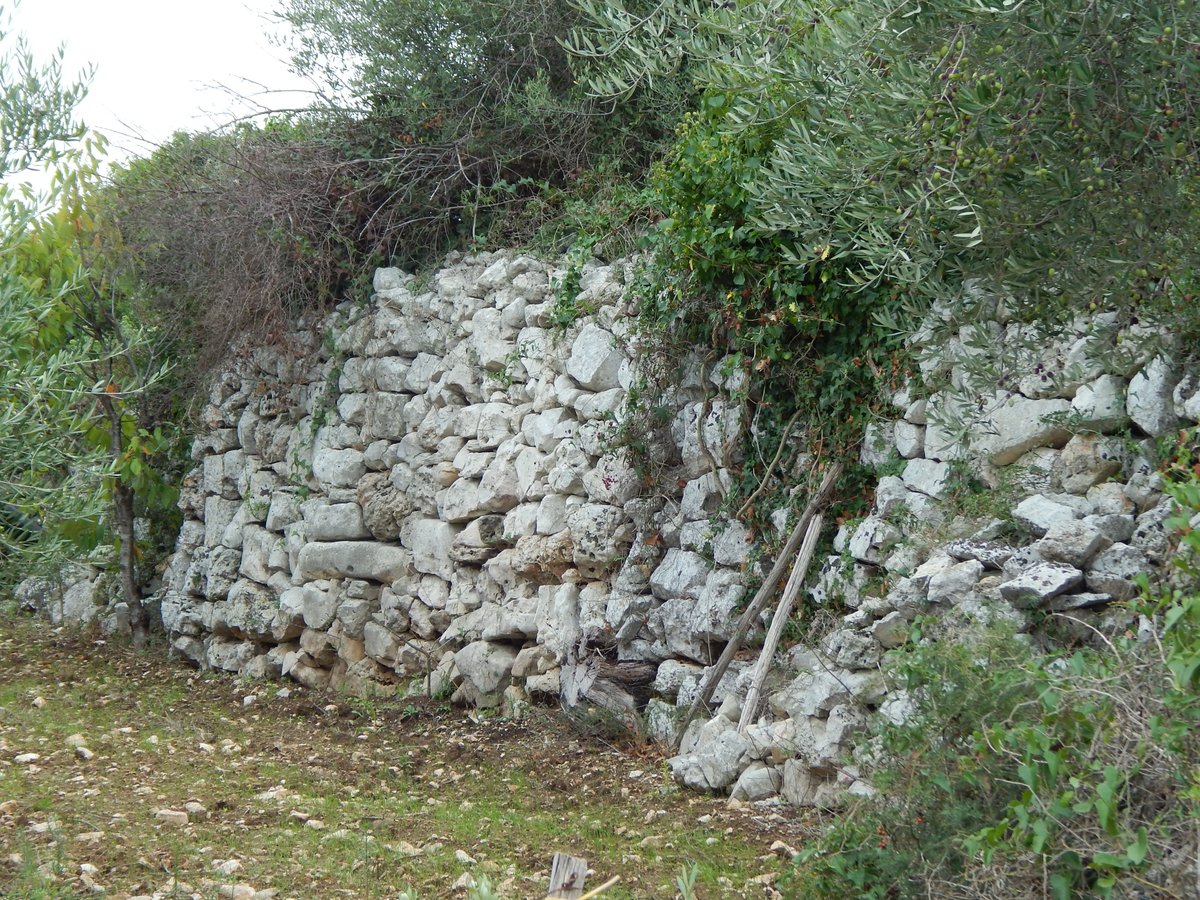
The plateau is surrounded by an impressive defensive wall measuring 3450 meters in total length. This fortification consists of a double parament with a central filling and is constructed from huge isodomic blocks assembled without mortar. Depending on their state of preservation, the walls reach heights of 4 to 6 meters, with some sections reaching a depth of 5 meters. The perimeter includes square projections and watchtowers, including the steep "Torre Belvedere" on the northern side.
On the northern margin, the walls are particularly robust to protect against potential attacks from the direction of the Adriatic. In contrast, the southern wall is less substantial because it faces the Lama di Mosca, a deep erosive gully of carstic origin. This natural valley provided the settlement with necessary water resources and served as a significant natural defense. The site was also well-connected by the "mulattiera di Strabone," a route linking Bitonto to Egnazia.
Sources: Wikipedia, OpenStreetMap, Wikidata, Wikimedia Commons
Written by Nicolo Ciampini
Discuss this with the author and others
No comments yet. Be the first to start the conversation.