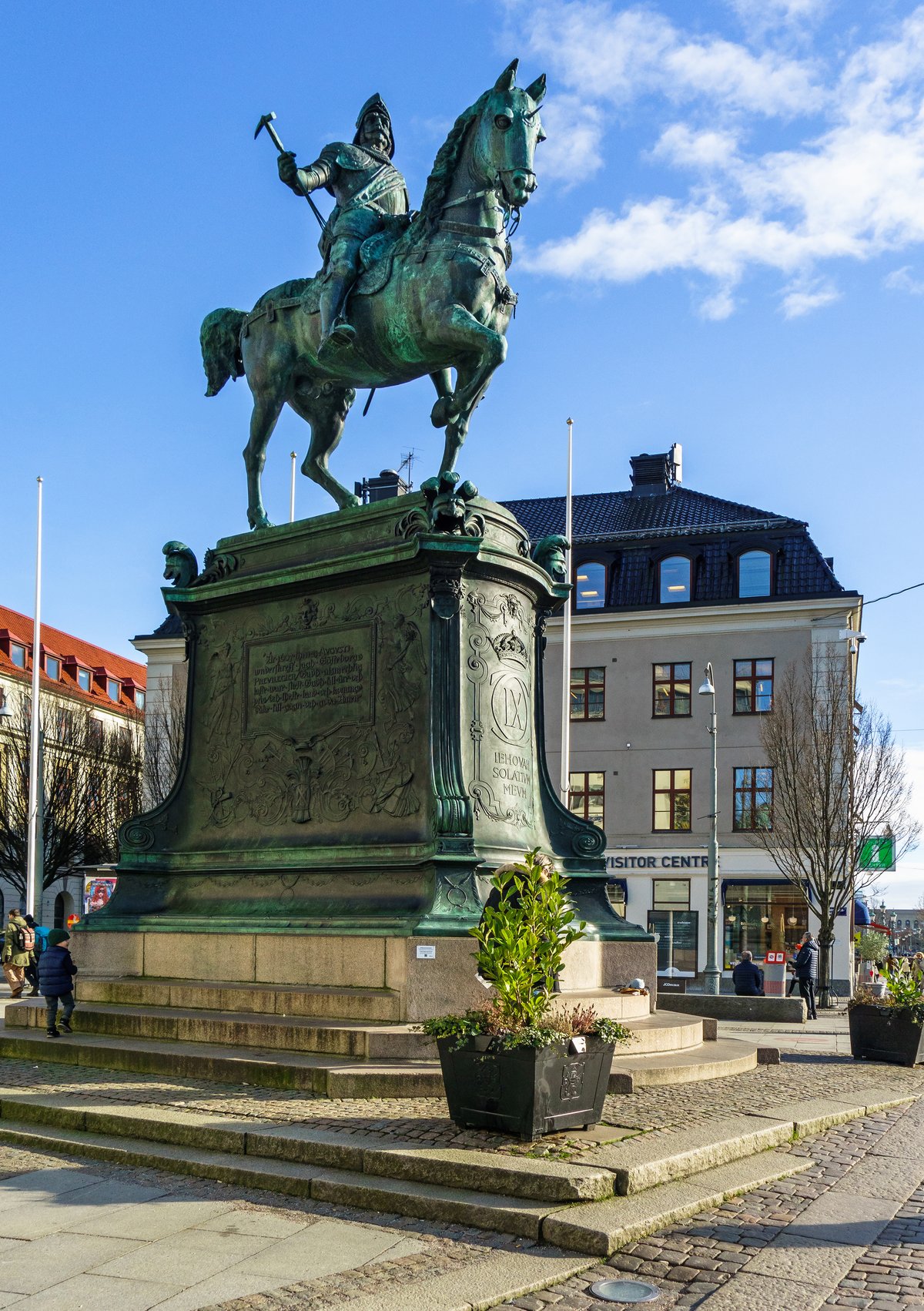

Albert Jacobsson, a lieutenant colonel in the First Göta Artillery Regiment, believed in the late 1890s that Karl IX was worthy of a statue. He sought support from the inhabitants of the city for his idea, eventually securing 75,000 kronor from the Statue Committee and 25,000 kronor from the city council for the foundation work. The bronze equestrian statue was created by the sculptor and professor John Börjeson.
The artwork was initially planned for Östra Hamngatan, but the city's authorities were initially hesitant about the timing. To find the best spot, a twelve-meter-high wooden mock-up called a provryttare was rolled around the area in December 1900. A water reservoir had occupied the site between 1797 and 1899. The statue was finally inaugurated by Oscar II on September 7, 1904, and was later moved to its current position in 1936 due to increasing traffic.
The bronze work, which weighs 6,659 kg, depicts the king in full war gear with a sword and a large war club. The statue bears the inscription Iehovah solatium meum, which was the king's motto. While the statue was being moved and restored, its history included the theft of the rider's sword in 1977, which was later replaced with a new sword weighing 30kg and measuring 190cm long. A comprehensive restoration was also conducted between April and October 2018 to remove corrosion and sand.
Sources: Wikipedia, OpenStreetMap, Wikidata, Wikimedia Commons
Written by Nik Frost
Discuss this with the author and others
No comments yet. Be the first to start the conversation.