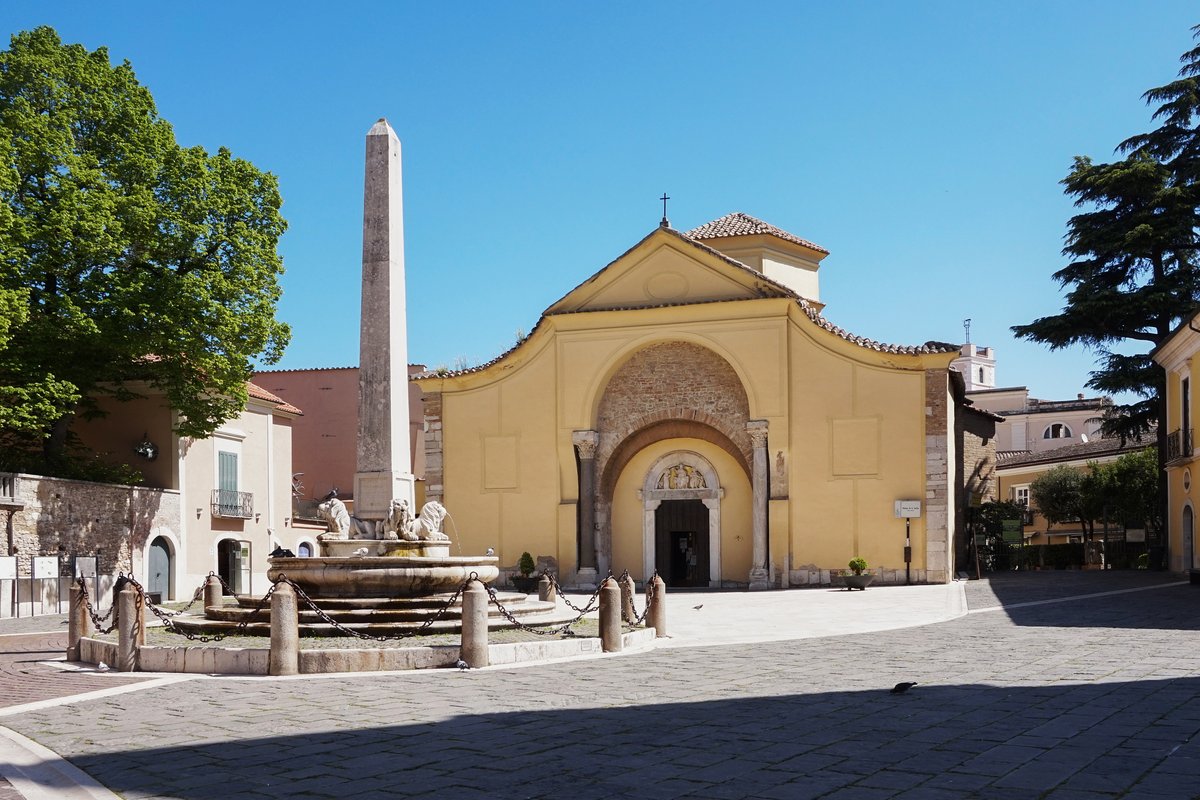

Built by Arechis II, the ruler of Benevento, Santa Sofia Church was modeled on the Palatine Chapel of the Lombard king Liutprand in Pavia. Dedicated to Holy Wisdom, the church was intended to assert Arechis' claim as the highest Lombard authority. However, the church was severely damaged by earthquakes in 1688 and 1702. Cardinal Orsini, the future Pope Benedict XIII, had the church rebuilt in Baroque style. The restoration work transformed the plan from a stellar to a circular one, added two side chapels, and changed the appearance of the apse, of the façade and of the pillars.
Most of the original frescoes were destroyed in the process. Today, Santa Sofia Church is a UNESCO World Heritage Site as part of a group of seven inscribed as Longobards in Italy. The church has a diameter of 23.5 metres (77 ft) and six columns, possibly taken from the city's ancient Temple of Isis, placed at the vertices of a hexagon and connected by arches which support the dome.
The church also features a bell tower built by abbot Gregory II while under the rule of Pandulf III of Salerno, as testified by an inscription in Lombard script. This tower originally protected the sepulchre of Arechis II but collapsed in 1688 and was rebuilt in 1703 in a different position. The church also has a 12th-century cloister which gives access to the Samnium Museum, a site containing remains from antiquity and the Middle Ages, including an obelisk that once decorated the Temple of Isis.
Sources: Wikipedia, OpenStreetMap, Wikidata, Wikimedia Commons
Written by Nicolo Ciampini
Discuss this with the author and others
No comments yet. Be the first to start the conversation.