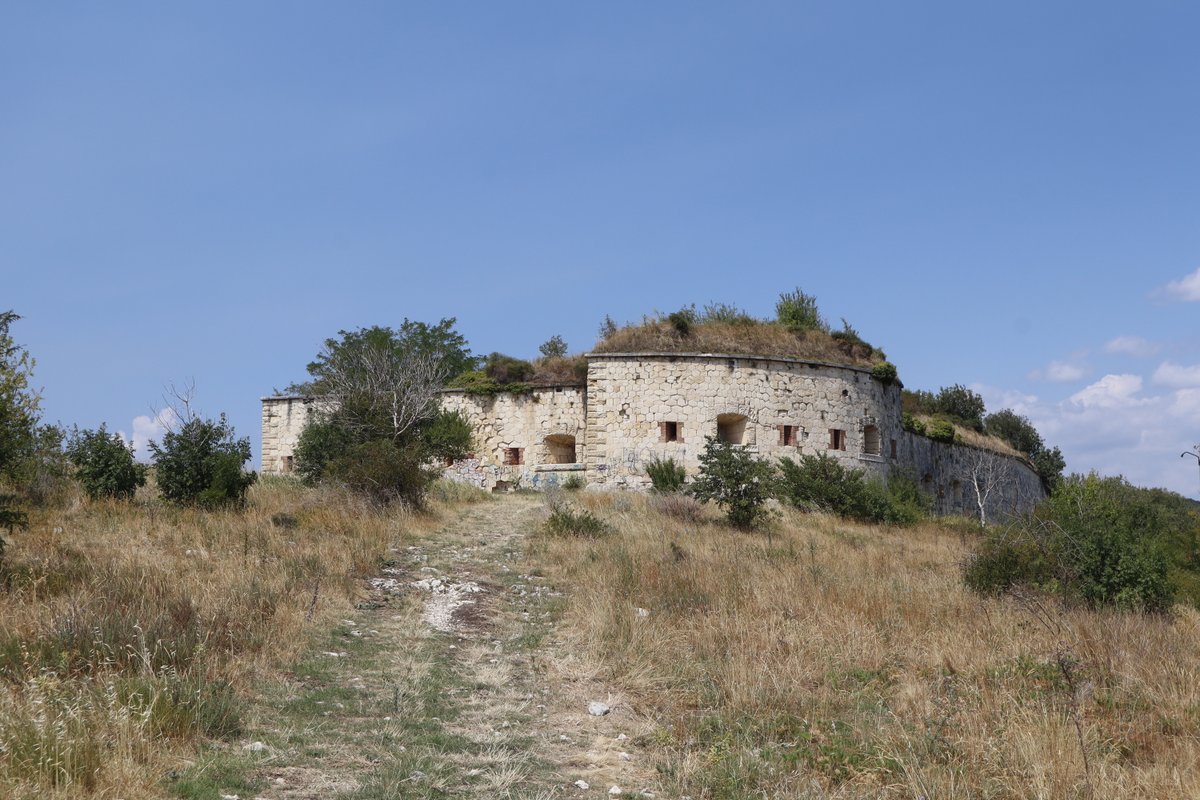

Step into the whimsical world of Forte Preara, a strategic maize for Maria Teresa's Knight, secreted away within the verdant hills of Verona. An interesting twist to the city's second defensive system, this conundrum was overseen by the Imperial Royal Office of Verona's Fortifications during its construction between 1859 and 1860. Intriguingly, Forte Preara exudes an irregular rugged charm that mirrors the surrounding terrain. Peering eastwards, one encounters a robust casemate of rectangular shape, gazing out onto the Valle di Mizzole.
A protective wall, adorned with loopholes and cannon ports, circles the internal courtyard, while a caponier casemate for riflemen graces the top of the western façade. Couldn't one say it's an enchanting playground for those with an inclination towards strategy? But there's more, my dear inquisitor. A northern battery, open to the sky, is accessed via a sloping ramp. Shadowed beneath it, to the right, rests the powder room, designed to withstand bombardment - a curious contraption indeed.
The central section accommodates the communication portal with the adjacent caponiers, forming short lateral galleries, both for riflemen, ensuring the moat's defense. Murals are found on the scarpa and counterscarpa, while the summit of the adjacent hill serves as a canvas for the flanking fire of artillery. If that weren't eerie enough, a substantial caponier for flanking and combat purposes resides on the southern angle, outfitted with two cannon ports facing the valley and Castello di Montorio.
To the right of the northern portal, a magazine for food reserves is ivory-placed, like a stolen precious gem, in symmetry with the powder room. Lastly, a colossal cistern for rainwater, buried in the courtyard, completes this cryptic masterpiece.
Sources: Wikipedia, OpenStreetMap, Wikidata, Wikimedia Commons
Written by Nicolo Ciampini
Discuss this with the author and others
No comments yet. Be the first to start the conversation.