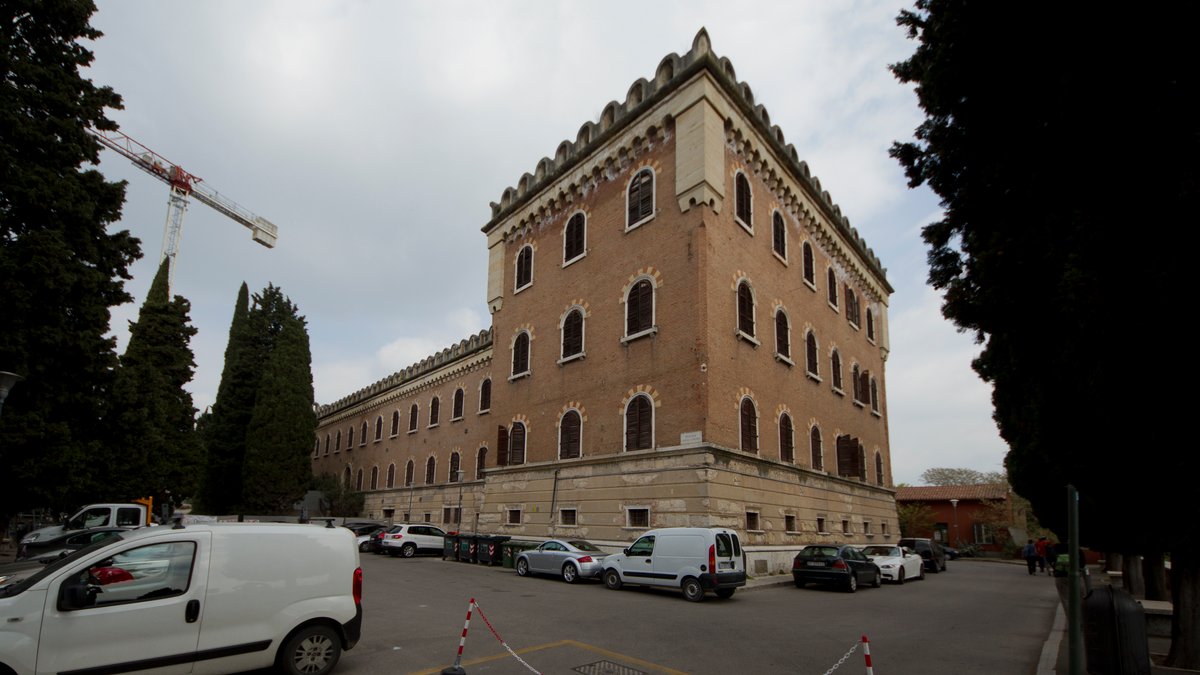

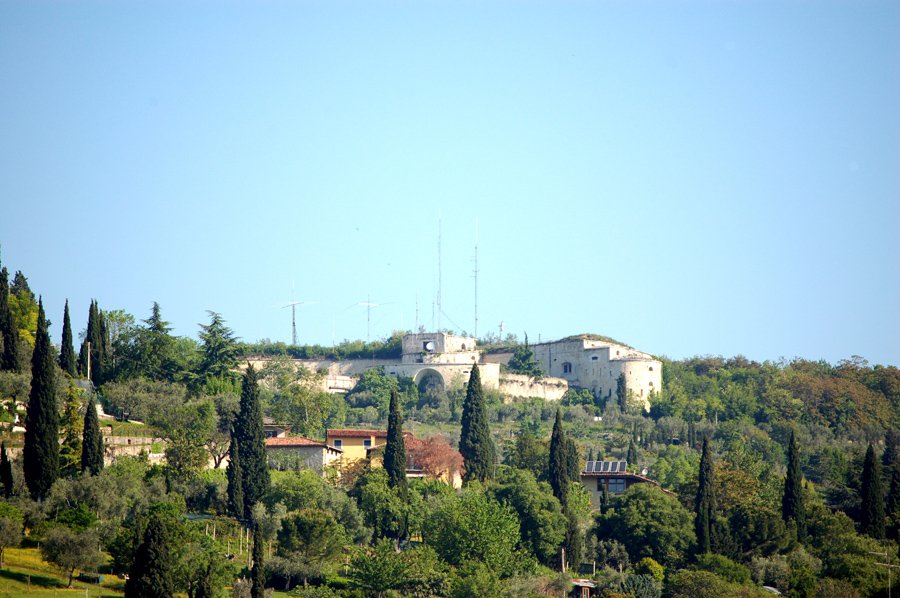
In the 1800s, the Austrians built a massive barracks on the site of a pre-existing castle built in the late 1300s. Although Napoleon's soldiers mined and destroyed much of the original castle and its church in 1801, the remains of the curtain walls were preserved. The current barracks was designed by the K.K. Genie-Direktion Verona under the supervision of Conrad Petrasch and constructed between 1852 and 1858.
The building was designed in the Rundbogenstil style, featuring exposed brickwork and polychrome arch rings that reflect both Central European medieval traditions and Veronese artistic heritage. The architects were tasked with ensuring the new structure harmonized with the surrounding hillside walls. The flat terrace roof, with its stylized white battlements, was designed both for military function and as a vantage point to observe the landscape of the city.
You can take the funicular up to the plateau to see the panoramic view of the city. After the transition to Italian control, the barracks remained under military control until 1934, when it was handed to the Comune to become a home for the poor. It later hosted the Accademia Cignaroli from 1939 to 1949, and served as an orphanage until 1978. Since 2002, a plan has been in place to restore the complex and its artifacts.
Sources: Wikipedia, OpenStreetMap, Wikidata, Wikimedia Commons

Written by Nicolo Ciampini
Discuss this with the author and others
No comments yet. Be the first to start the conversation.