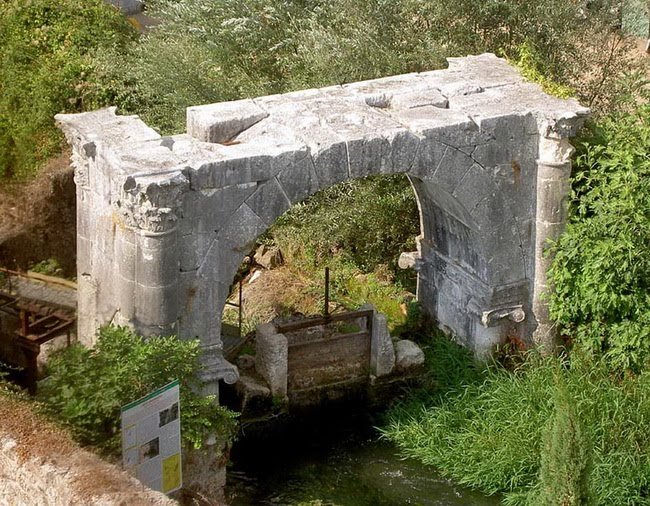

Local legend claims the people of Aquino constructed the Arco di Marcantonio in a single night. According to this tradition, the structure was built in honor of a visitor traveling between Cassino (Casinum) and Roma who stopped in the town. While this story provides a colorful local identity, the monument's physical history suggests a more standard commemorative purpose.
History points to a different timeline, suggesting the arch was likely erected in 41 B.C. during the colonial land grants for veterans. It was constructed using blocks of local travertine. The monument stood at the eastern entrance of the city on the via Latina. Its topographical position was isolated and elevated relative to the town, situated just beyond the urban center to serve as a visible frame for the settlement.
The arch has faced significant environmental and man-made challenges over the centuries. For a period, it was partially submerged in a man-made channel used to power mills and later a paper mill. One of its capitals was damaged during the second world war. Although restoration work in 1995-1996 removed the water from the channel, the structure remains partially buried in the earth today.
Visitors today can see the remaining pillars and the smooth, carved shafts of the arch. It is missing its upper part, the entablature, and the upper attic. Its width is 6.10 meters. It stands as a preserved piece of Roman masonry that once marked the gateway to Aquino.
Sources: Wikipedia, OpenStreetMap, Wikidata, Wikimedia Commons
Written by Nicolo Ciampini
Discuss this with the author and others
No comments yet. Be the first to start the conversation.