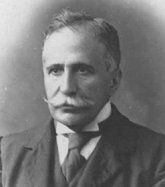

Raffaele Perla graduated from the University of Napoli at 21 years old after studying under De Sanctis, Settembrini, and Spaventa. Perla's contributions to the legal field began early with the publication of his commentary on De Legibus by Cicero in Latin. He also wrote two monographs, 'La legislazione normanna-sveva' and 'Il Regno di Guglielmo I di Sicilia', further solidifying his role as a major Italian historian of the law.
He entered the Italian magistrature and became a judge in the Tribunal of Napoli. Perla was conferred the cathera of Storia del diritto in the University of Napoli ‘Federico II’. He left the free profession and entered the Italian magistrature, becoming a judge in the Tribunal of Napoli. Throughout his career, Perla published numerous works, each affirming his expertise in Italian law.
He was President of the IV Sezione of the Consiglio di Stato and elected deputy at the Parlamento in 1900 and was nominated senator in 1909.
Perla’s magistrate career and publishing activity started when he graduated at 21 years old in 1879. His publications affirmed him as one of the major Italian historians of the law. Perla was President of the Superior Administrative Committee for Colonies, President of the Commission for local financial reorganization, and President of the Commission for the project of law on mandatory health insurance.
Perla was a member of the Commission of inquiry for public education, the Commission of statistics and legislation at the Ministry of Justice, and the Commission of the study and proposals for modification of administrative legislation.
Perla was a member of the Commission for the study and proposals for modification of administrative legislation. He was a Judge of the Supreme War and Navy Tribunal and the Contenzious Diplomatic Court. He was Vice President of the Heraldic Commission. After his death, a street in Lusciano was named after him, in front of the town hall. A street and a school in Santa Maria Capua Vetere were also named after him. A commemoration was dedicated to him during the inauguration of the new court building, with a plaque placed in his honor.
He is mentioned in the Enciclopedia Britannica, Rizzoli-Larousse, and Treccani. In 2011, he was one of the figures remembered for the 180 years of the State Council in Rome.
Sources: Wikipedia, OpenStreetMap, Wikidata, Wikimedia Commons
Written by Nicolo Ciampini
Discuss this with the author and others
No comments yet. Be the first to start the conversation.