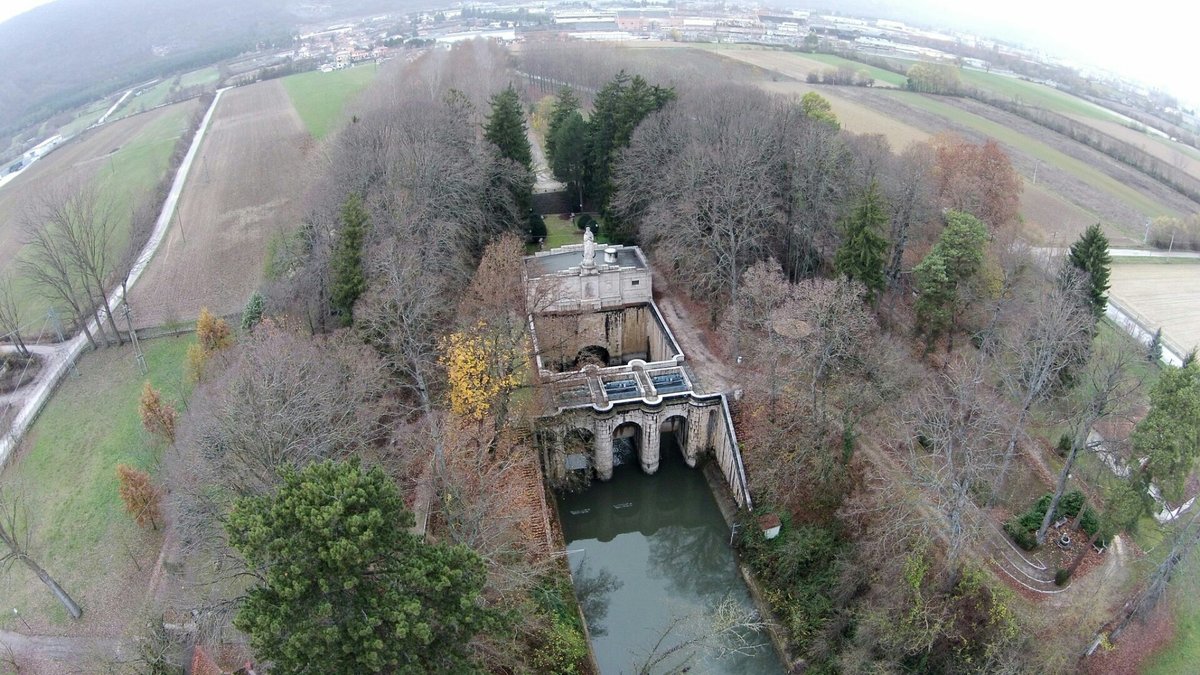

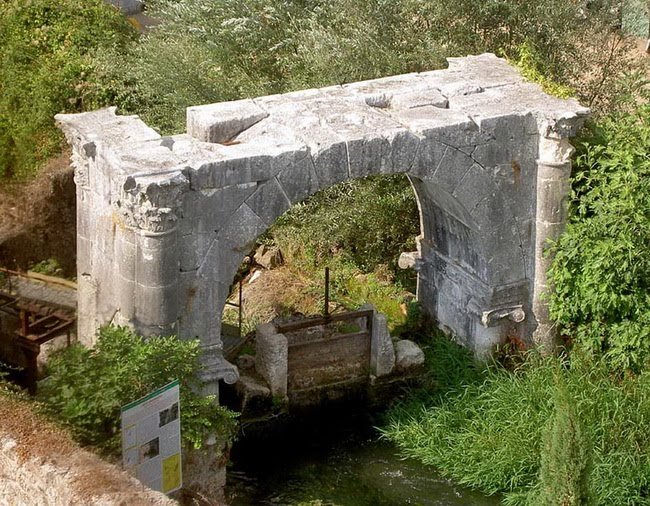
The Incile del Fucino is a monument built in 1876 on the head of the main emissary of the Fucine Lake in Italy. It is a Neo-Classical work made of local stone blocks, featuring a three-arched bridge of sluice gates. Rising above the bridge is a seven-metre-high statue of the Immaculate Conception, known as the Madonnone dell'Incile. This facility connects the outer drainage canal to the underground emissary, which is served by the system of the Tunnels of Claudius in Mount Salviano.
The project resumed the work of Emperor Claudius, who first attempted to drain the Fucine basin between 41 AD and 52 AD. After the Roman Empire fell, the underground canal eventually clogged, causing the basin to reflood. In 1856, Alessandro Torlonia resumed the work, enlarging sections of the emissary and building new vents. By 1876, the architect Carlo Nicola Carnevali built the monumental head of the emissary and an adjoining garden, completing a second drainage that was officially declared in 1878.
The facility regulates the flow of water from numerous canals into an outer drainage canal, using two storage basins - one trapezoidal and one hexagonal. The water flows through a tunnel crossing Mount Salviano for more than 6 kilometres before intersecting the Liri River. The main body of the building is almost 16 metres high and houses safety systems on the lower level and an engine-room on the higher level.
The Madonnone dell'Incile was rebuilt after a serious earthquake in 1915. While the current statue sits on the monument, fragments of the original work that collapsed during that earthquake remain exposed in the park of Villa Torlonia. The structure serves as a historical monument of hydraulic engineering, featuring bronze elements that call up the Biblical Apocalypse.
Sources: Wikipedia, OpenStreetMap, Wikidata, Wikimedia Commons
Written by Nicolo Ciampini
Discuss this with the author and others
No comments yet. Be the first to start the conversation.