

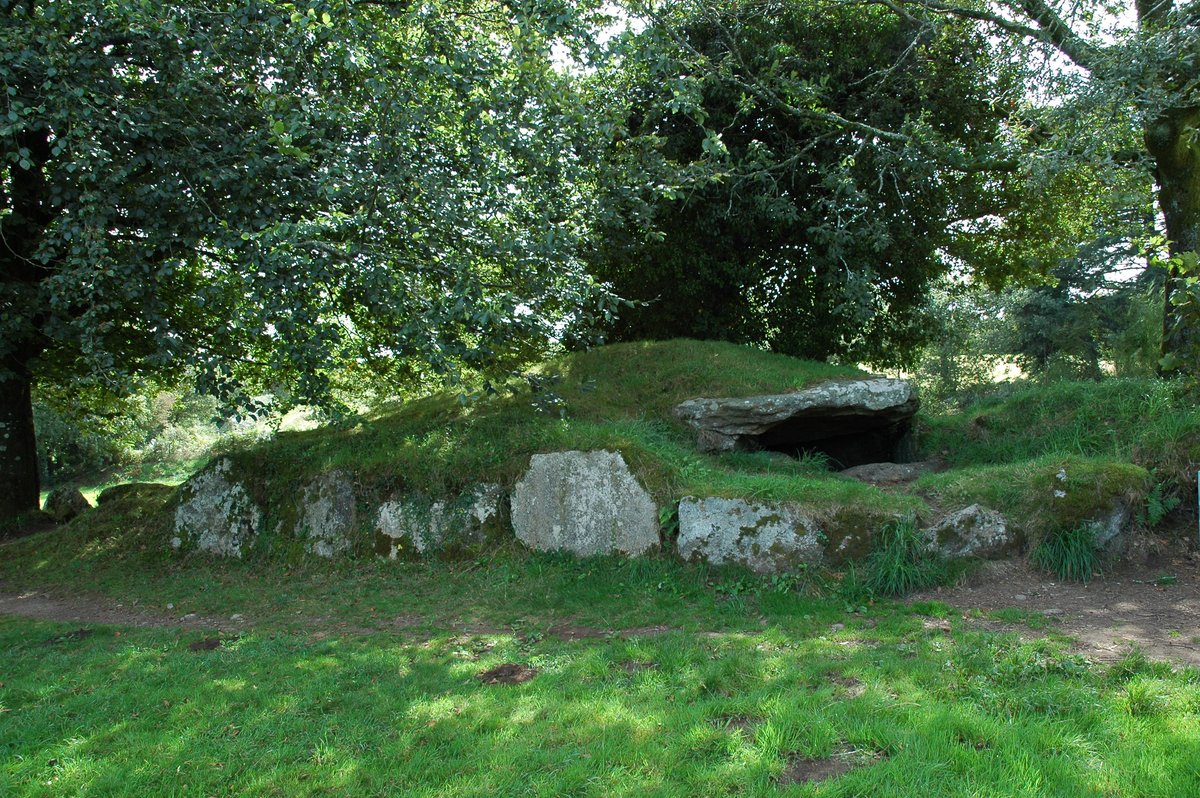
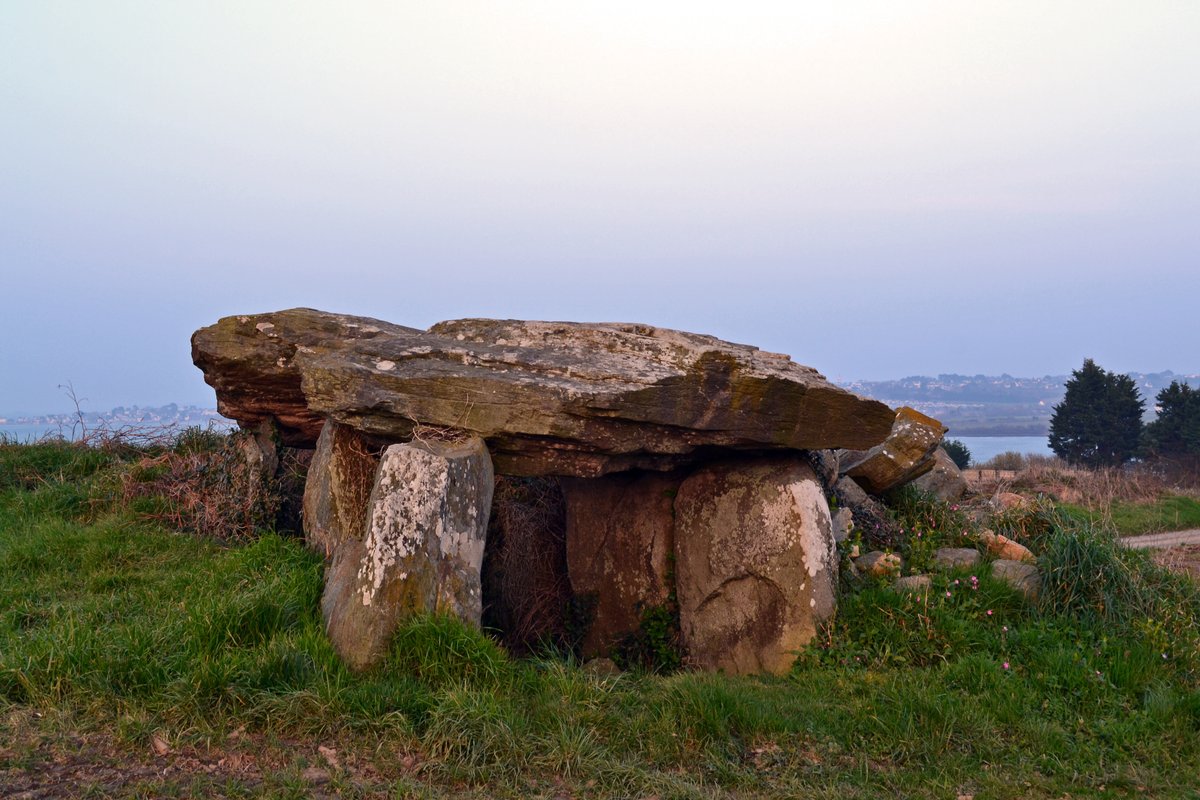
The Allée couverte du Mougau-Bihan, also known as Ti Lia Ven, is a megalithic pre-Celtic tomb located in the commune of Commana in the Finistère department of France. Dated by comparison to between 3,000 and 2,500 BC, the structure is oriented north-south and opens to the north-northeast. It measures 14 metres in length and features an internal width ranging from 1 to 1.40 metres.
The monument is constructed from granite and is delimited by eighteen orthostates - ten on the east side and eight on the west. It consists of a rectangular chamber 11 metres long and 1.50 metres wide, and a terminal cell 2.30 metres long and 1.40 metres wide. These two sections are separated by a headboard slab. The entire structure is covered by five granite slabs - four for the chamber and one for the cell. A first pillar that extends beyond the first cover slab suggests the existence of a vestibule.
Several slabs are decorated with bas-relief sculptures. The entrance pillar, placed obliquely, features two pairs of superimposed breasts and a "palette" on its exterior side. The last slab of the chamber on the eastern side features two other palettes, while the headboard slab displays a sculpture of an axe with a curved handle in the shape of a crook. The monument was first mentioned in 1843 by Jean-Baptiste Ogée and was officially classified as a historic monument by decree on 14.06.1909.
Sources: Wikipedia, OpenStreetMap, Wikidata, Wikimedia Commons


Written by Nicolo Ciampini
Discuss this with the author and others
No comments yet. Be the first to start the conversation.