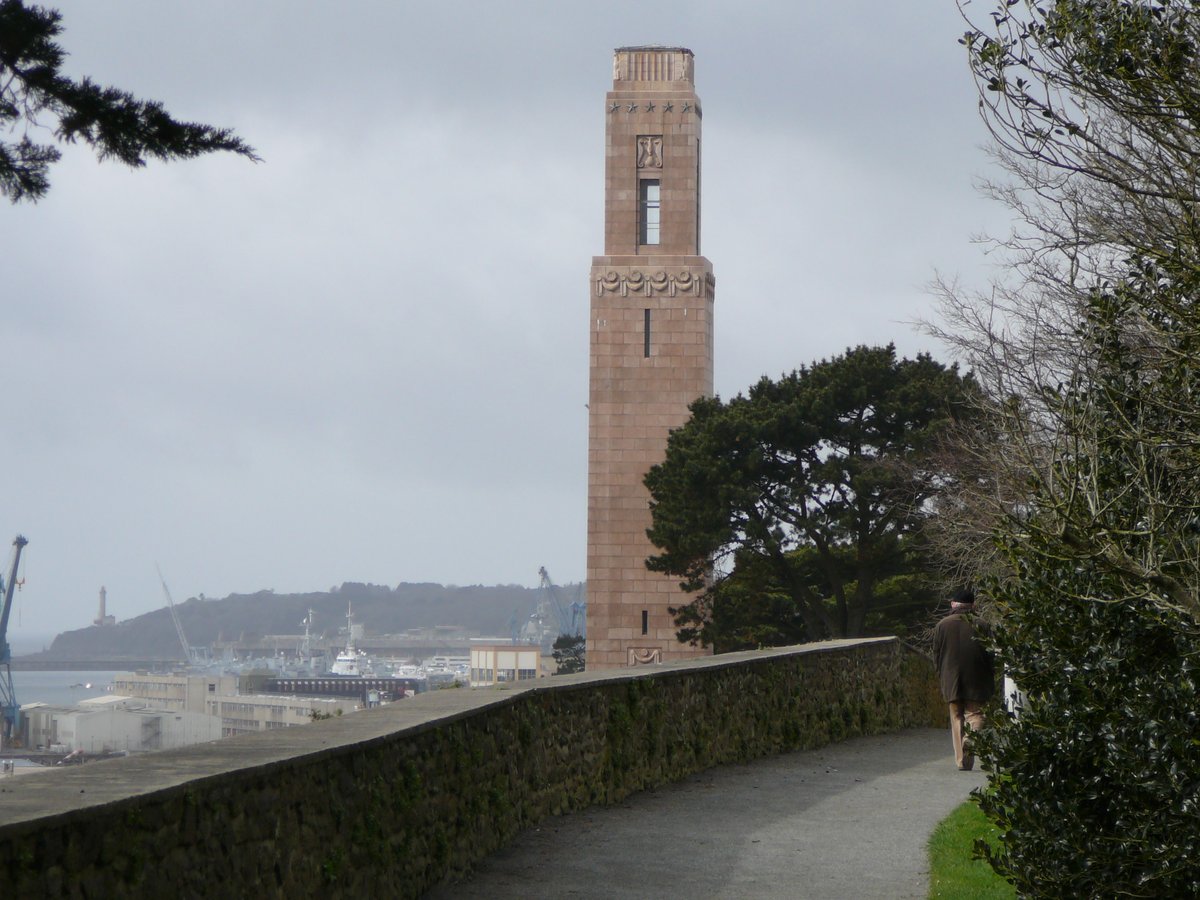

The Naval Monument, also known as the Tour rose, is an American war memorial erected near Dajot Street in Brest in the 1930s to commemorate the action of the U.S. Navy in European waters during World War I. The Naval Monument was destroyed by the Germans during the Occupation and was rebuilt in 1958. The monument was inscribed as a Monument historique since July 2015. The U.S. Navy was active in the conflict from the U.S. entry into the war in 1917 to the repatriation of the last American soldiers in 1919, several months after the Armistice.
The American Battle Monuments Commission (ABMC) was created in 1923 and decided to erect a monument to commemorate the action of the U.S. Navy in European waters. Brest was chosen as the location for the monument because it was the headquarters of the U.S. naval forces in Europe during the war and the main port of embarkation and disembarkation for U.S. troops. The SS Leviathan, then the largest steamship in the world, only served Brest. More than 700,000 of the 2 million members of the AEF arrived by Brest.
Woodrow Wilson, the President of the United States, arrived in Europe in 1919 via Brest. The Naval Monument was designed by architect Howard Van Doren Shaw but was built by his associate Ralph Milman from 1930 to 1932 and inaugurated in 1937. The Naval Monument is one of a dozen American war memorials built in Europe between the two World Wars by the ABMC, which was presided over by General Pershing who commanded the American Expeditionary Force during the conflict.
The Naval Monument was destroyed by the German army on July 4, 1941. The destruction was carried out on the anniversary of US independence. The Germans built a bunker on its original site in September 1944. General Pershing inquired about the state of the monuments under the ABMC’s supervision in September 1944. General Eisenhower, in a letter written a week before the liberation of Brest, reported that the monument was intact. The German occupying forces claimed the monument was destroyed by a Royal Air Force raid for propaganda purposes.
According to Lt. Col. Paul Krznarich, the American intelligence officer in charge of the investigation, reports from civilians alleged preparation and execution of a nighttime demolition by the Germans. The destruction may have been to deprive British aviators of a navigation reference. The Naval Monument was rebuilt in 1958 by Ralph Milman over the bunker, slightly off its original site. The rebuilt monument was inaugurated on July 16, 1960, in the presence of Michel Debré (French Prime Minister at the time).
Sources: Wikipedia, OpenStreetMap, Wikidata, Wikimedia Commons
Written by Nicolo Ciampini
Discuss this with the author and others
No comments yet. Be the first to start the conversation.