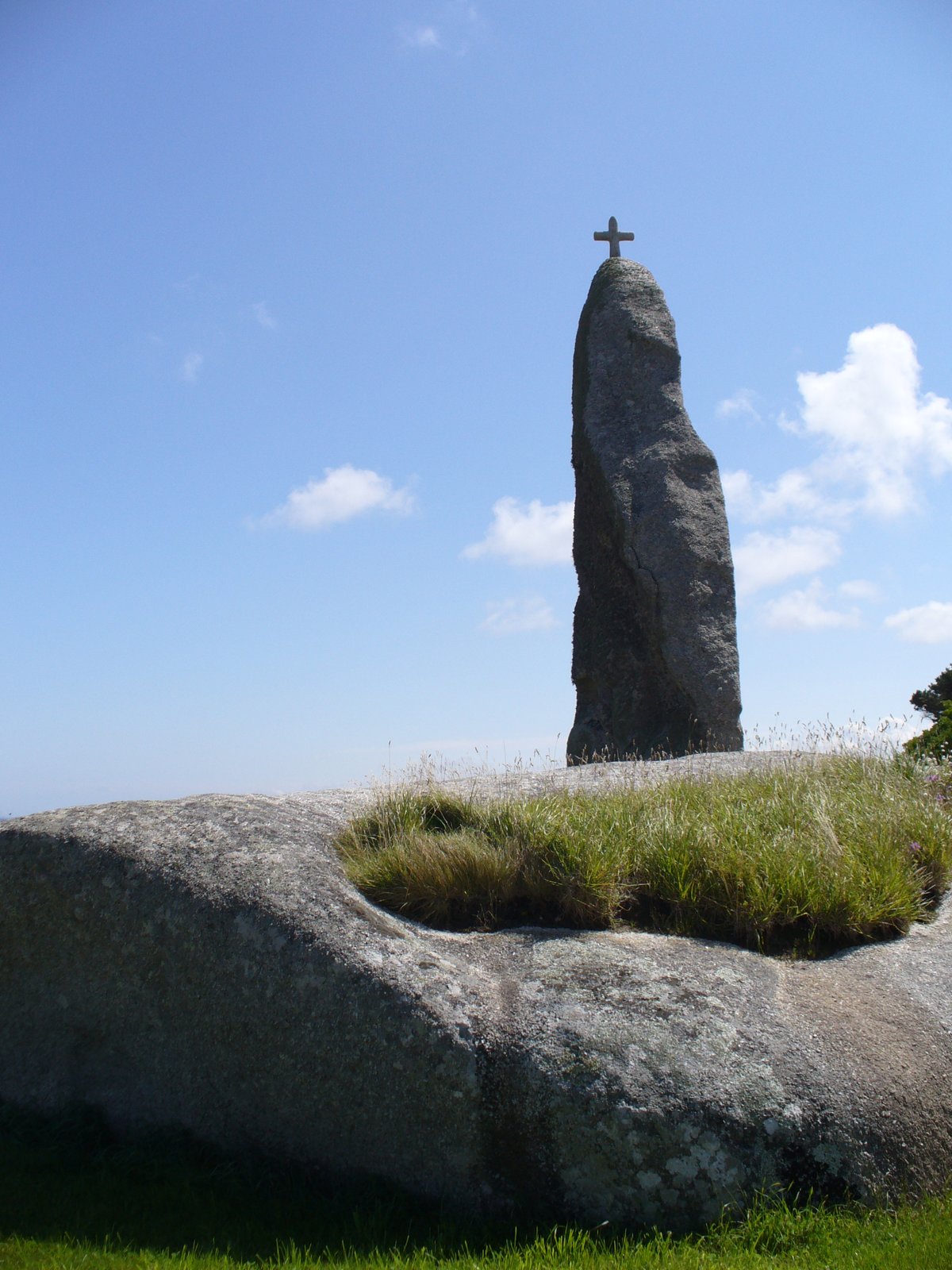

The menhir de Pontusval is a Christianized menhir located on the commune of Brignogan-Plages, in the French department of Finistère. Historically, the menhir is represented on the cadastral plan of 1818, and was first described by C.-P. de Fréminville in 1844. It was classified as a historic monument in 1889. The menhir is a bloc of granite porphyroide, measuring 8.35 meters in height, with a base width of 3.40 meters and a thickness of 1.50 meters.
Its estimated weight is 80 tonnes. It was Christianized in the 18th century by the addition of a first cross on its summit and the carving of a second cross pattée on its east face. However, local legends state that young girls would throw a small stone on the horizontal fissure that ornaments the south face of the menhir, and if the stone remained in place, they would marry in the year, or supposedly have an heir. According to another local legend, Saint Paul Aurélien ordered the sea, which was ravaging the lands of his abbey and those of his sister, to stop and never cross the line marked by the stone thrown by his sister, now called Pierre du miracle.
Sources: Wikipedia, OpenStreetMap, Wikidata, Wikimedia Commons
Written by Nicolo Ciampini
Discuss this with the author and others
No comments yet. Be the first to start the conversation.