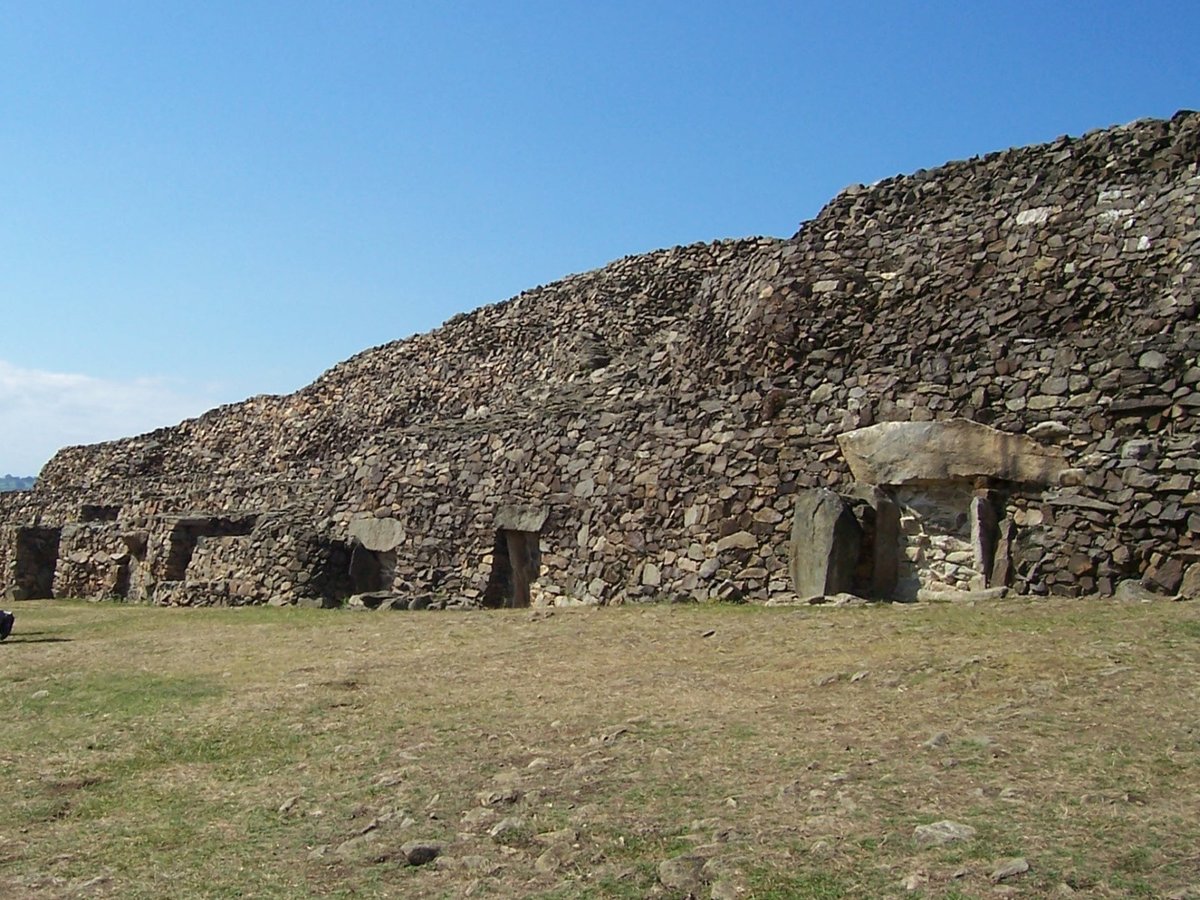

The Cairn of Barnenez is a Neolithic monument located near Plouezoc'h, on the Kernéléhen peninsula in northern Finistère, Brittany, France. It dates to the early Neolithic, around 4000 BC. Along with the Tumulus of Bougon and Locmariaquer megaliths, also located in Great West France, it is one of the earliest megalithic monuments in Europe and one of the oldest man-made structures in the world. It is also remarkable for the presence of megalithic art.
Radiocarbon dates indicate that the first phase of the monument was erected between 4850 and 4250 BC, and the second phase between 4450 and 4000 BC. Pottery found in and around the monument indicates that it underwent a period of reuse in the Bronze Age, in the 3rd millennium BC. The cairn was first mapped in 1807, in the context of the Napoleonic cadaster. Its first scientific recognition took place in the context of an academic congress in Morlaix in 1850, when it was classified as a tumulus.
The cairn was restored between 1954 and 1968. Today, the Barnenez cairn is 72 m long, up to 25 m wide, and over 8 m high. It is built of 13,000 to 14,000 tons of stone. It contains 11 chambers entered by separate passages. The mound has steep facades and a stepped profile. Several internal walls either represent earlier facades or served the stability of the structure. The cairn consists of relatively small blocks of stone, with only the chambers being truly megalithic in character.
Each of the 11 chambers is reached from the southeast via a long narrow passage (7–12 m long). They are arranged parallel to each other. Shapes and construction techniques differ slightly. In nine cases, narrow passages lead to corbelled chambers. Normally, the corbel vault rests on orthostats, in one chamber it actually sits on the ground, forming a true tholos. The passages have slab-built or dry stone walls and are covered with slabs. One of the chambers has a dry-stone vaulted ante-chamber. Engraved symbols occur in several of the chambers and passages. They depict bows, axes, wave symbols or snakes and a repeated U-shaped sign. One of the carved slabs is in secondary use; it was originally part of a different structure.
Only Cairn 2, namely chambers A, C and D, contained Neolithic finds at the time of excavation. They included pottery, polished stone axes (of dolerite), flint blades and arrowheads. Pottery shards found outside the monument indicate that it was reused in the Bronze Age (3rd millennium BC). A copper dagger and a barbed arrowhead are of Chalcolithic date.
Sources: Wikipedia, OpenStreetMap, Wikidata, Wikimedia Commons
Written by Nicolo Ciampini
Discuss this with the author and others
No comments yet. Be the first to start the conversation.