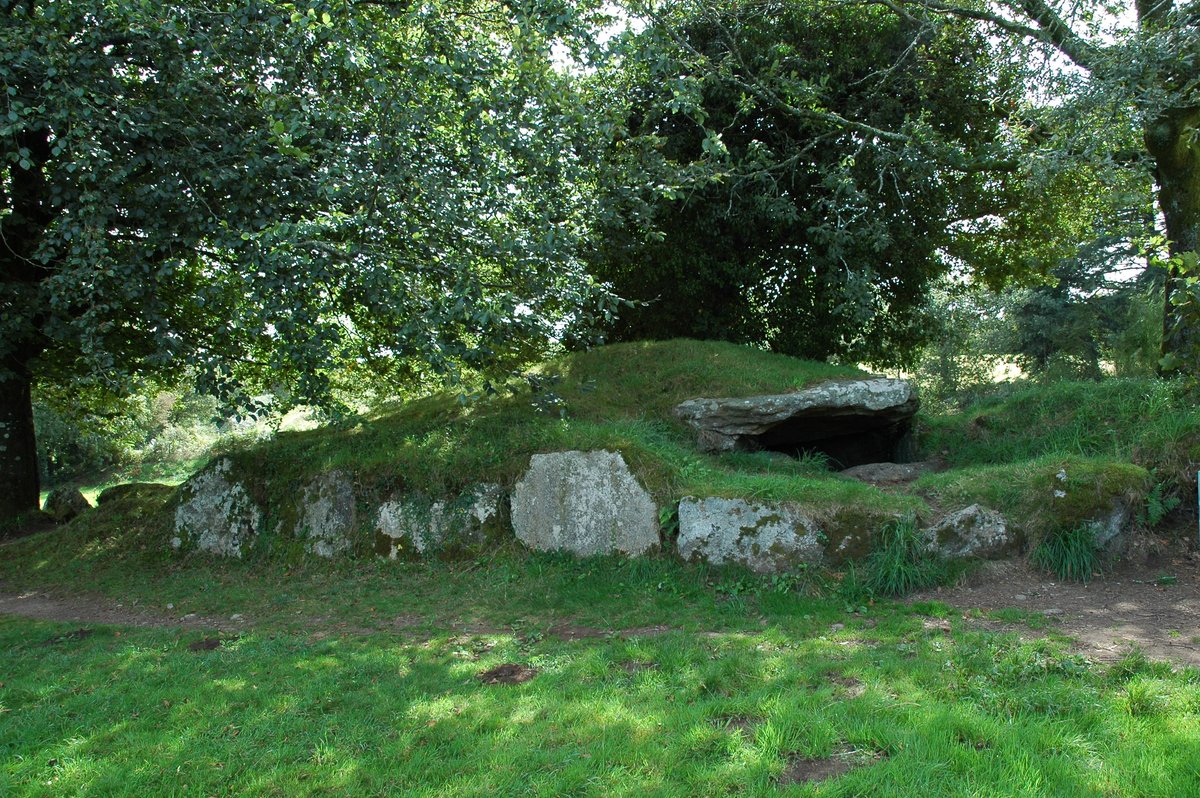

The Franco-Breton name of the dolmen is Ti ar Boutiged. It is a 'chamber en V' type dolmen, located on the commune of Brennilis, Finistère, France. This type of construction is rare in the center of Finistère but common in the south. The dolmen is represented on the Napoleonic cadastre in the middle of a large tract of land. It was first mentioned by R.-F. Le Men in 1876. R. de Kerret, a member of the Société archéologique du Finistère, purchased it in 1876 to ensure its conservation.
In 1878, du Kerret gave the monument to the Société archéologique du Finistère. A small plaque attesting to this donation was placed on the top of the edifice. Paul du Châtellier drew a plan of the monument in 1907. The orientation of the monument on the plan is incorrect and its architecture is partially extrapolated. A pillar of masonry was built inside the chamber in 1929 or 1930 to reinforce a cracked table of coverage. Pierre-Roland Giot requested a classification of the monument in 1956.
Jean L'Helgouach mentioned the edifice as the best preserved example of 'graves in V' in 1965. Michel le Goffic conducted two excavation campaigns in 1990 and 1991 before a partial restoration and public opening. The monument was left without classification or inscription as a historical monument until 1995. The dolmen is an oval mound, with a western-northwest/eastern-southeast oriented great axis. The surrounding circular burial structure is partially destroyed at the rear.
Ti ar Boutiged is an archaeological site with a dolmen. The dolmen measures 13.40 meters in length. The dolmen is a 'V'-shaped sepulcher: the chamber widens progressively and goes from 1.20 meters in width at the entrance to 2.20 meters at the altar stone. The height under the altar stone varies from 1.20 meters at the entrance to 1.73 meters at the back. The north wall is almost straight and consists of seven orthostates, of which three overlap.
The south wall begins by widening, then aligns parallel to the central axis. It contains six orthostates. These pillars are slightly tilted towards the interior of the chamber. The dolmen is covered by three large covering stones, the one at the back being particularly massive but having a crack which has served as an entrance into the chamber for tomb robbers. The altar stone is subtrapezoidal. A orthostate stands in the middle of the chamber, 3.20 meters from the altar stone, placed obliquely relative to the axis and without touching the covering stone.
It may be a stele or a partition. The first northern pillar of the chamber entrance contains three notches corresponding to a attempt at debarking. The covering stones are made of local granite porphyroid. The western part has been damaged and truncated by agricultural activities, but the discovery of an orthostate, parallel to the altar stone and 4.00 meters from it, allows the maximum extent of the cromlech to be known, since the two branches, in the shape of a crescent, converge towards this stone which barely rises above the current ground.
The height of the stone does not seem to correspond to its original height, in its present state, and it does not seem to be part of the cromlech. Ti ar Boutiged is an archaeological site.[1](https://fr.wikipedia.org/wiki/Dolmen_de_Ty-ar-Boudiged)
Sources: Wikipedia, OpenStreetMap, Wikidata, Wikimedia Commons
Written by Nicolo Ciampini
Discuss this with the author and others
No comments yet. Be the first to start the conversation.