

The Great Perspective Road (Nevsky Prospect), laid out in 1710, led to the Admiralty Shipyards. In 1715, Peter the Great issued a decree: "Build a bridge over the Fontanka River beyond the Bolshaya Neva along the perspective." By 1716, a wooden beam multi-span bridge on pile foundations was built across the Fontanka. The 150-meter-long bridge spanned the entire swampy floodplain of the river. By 1721, the bridge was rebuilt. The work was overseen by the "master of carpentry" von Boles. Architect Domenico Trezzini participated in the design of the new bridge. The bridge became a drawbridge, and its supports were laid with "wild stone." In 1749, Semyon Volkov built a new, wider bridge on pile foundations. The spans were sheathed with planks and finished to resemble granite. Lanterns on tall wooden poles were installed at the bridge entrance.
Near the bridge, on the left bank of the river, there was a city checkpoint where documents of those entering Petersburg were checked. Travelers entered Saint Petersburg through the Anichkov checkpoint. And they did not enter for free. Instead of money, they could pay with cobblestones. Everything was useful in the economy: if not money, then stones, and it was still unknown what was more needed in our swamps, reasoned the city’s founder. And he invented the "stone tax." In 1714, a decree appeared "On the delivery by river vessels and by land carts of a certain number of wild stones by those arriving in Saint Petersburg."
In the decree, Peter meticulously specified how many stones each newcomer to the city was obliged to bring and what size these stones should be. For example, three stones were taken from each cart, ten from a boat, and thirty from a ship. Moreover, for each "short delivery," a fine was imposed—one grivna per stone. This Peter’s decree was in effect for a full 62 years. It was only Catherine II who dared to abolish it in 1776. She probably considered that the empire was now capable of paving the capital’s streets on its own...
Over its nearly three-century history, the bridge was rebuilt several times for various reasons. For example, in 1749, architect Semyon Volkov built a new wooden bridge, which was little different from typical bridges of that time. The crossing was made without a draw span and was significantly reinforced because elephants sent as a gift from the Shah of Iran to the Russian Tsar had to be led across it.
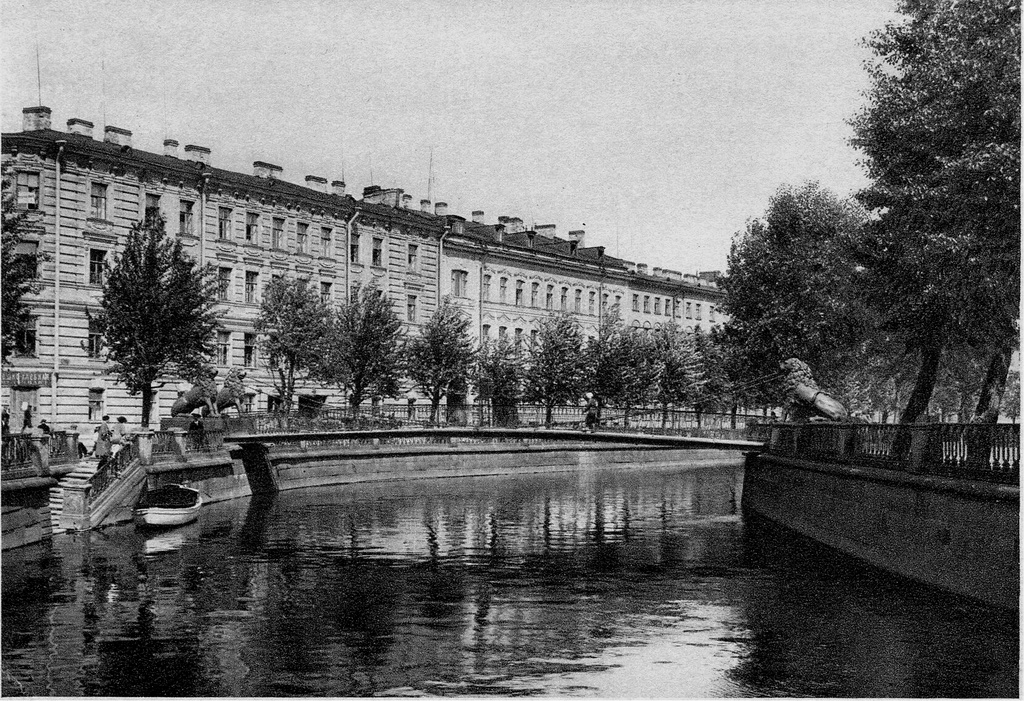
Finally, at the end of the 18th century, the Anichkov Bridge became stone. But it was still far from its current appearance. To imagine how that first stone bridge looked, you need to walk about 600 meters from Nevsky Prospect. You will see its preserved sibling—the Lomonosov Bridge over the Fontanka. Or you can simply look at an early 19th-century watercolor:
This is how the Anichkov Bridge looked under Catherine II—it was decorated with four granite towers. Today, our city has two similar bridges preserved—the Lomonosov Bridge and the Starokalinkin Bridge.

In fact, seven such twin bridges were built over the Fontanka during Catherine II’s reign. Not all have survived to this day. The bridges were good but cramped, which led to their subsequent reconstructions.
Years passed until finally the Nicholas era in Petersburg’s history began. By the early 1830s, Nevsky Prospect had become a busy transport artery. The capital had more than twenty thousand horses, and hundreds of carriages traveled the streets. At that time, Petersburg’s population exceeded 400,000.
Naturally, traffic jams often occurred near the Anichkov Bridge. So in 1839, it was decided to rebuild it again.
First, the old crossing with all four granite towers was dismantled. On May 22, 1841, the first stone was ceremoniously laid at the foundation of the new bridge. It was built in one summer. The bridge was widened but lost its poetic appearance: it lost the granite towers and parapets. The bridge project was developed by engineer Butats. The new bridge was decorated with cast-iron railings featuring alternating paired images of seahorses and mermaids. It is believed that the bridge railings were cast according to a drawing by architect Bryullov. Bryullov may have participated in their installation, but the true author of the railings is considered to be the German architect Karl Schinkel. The railings of the Anichkov Bridge are an exact copy of the railings of the Palace Bridge, built by him in Berlin several years before the events described here. According to one version, the decision to use copies of the Berlin bridge for its Petersburg counterpart was made personally by Nicholas I, who was known to favor German architects. This is the bridge we see today.
The name of the Anichkov Bridge dates back to its first builder in the first quarter of the 18th century. Since the first bridge with a checkpoint and barrier was guarded by soldiers of the nearby construction battalion under Lieutenant Colonel Mikhail Osipovich Anichkov, the bridge was named after Lieutenant Colonel Anichkov. However, in everyday speech, it was sometimes called Ánichkin—after some unknown Anya or Anichka. Remember the children’s riddle: "Name the Petersburg bridge with a female name." The answer: "Ánichkin."
Indeed, many residents of Saint Petersburg saw in this version of the Anichkov Bridge’s name some mysterious, romantic story connected with a woman named Anna. Several legends were dedicated to this theme. They all tell of a tragically ended romance with a certain mysterious Anna. Unrequited love for this Anna was attributed to almost "all the workers, engineers, and architects who worked on the bridge’s construction."
In 1908, a sign appeared near the bridge, on which the bridge’s name exactly matched the legend: "Ánichkin." Whether this was a random mistake by the sign makers or the authors’ confidence in the authenticity of the story with the unknown bearer of this name remains one of the mysteries of the Anichkov Bridge. The sign adorned the bridge entrance for four whole years until 1912, when a distant relative of Lieutenant Colonel Mikhail Osipovich Anichkov arrived in Petersburg. He noticed the scandalous inscription and wrote a complaint to the City Administration the same day. He pointed out that his ancestors were not Ánichkins but Anichkovs. The mistake was corrected.
By the way, it should be reminded that every time the bridge was rebuilt, the city authorities tried to rename it "Nevsky Bridge." But this toponym did not take root in Petersburg, and the bridge remained Anichkov.
After the last reconstruction, the greatest Petersburg animal sculptor, Pyotr Karlovich Klodt, entered the history of the Anichkov Bridge. A descendant of an ancient Roman family from Lombardy, Klodt von Jürgensburg graduated from the Academy of Arts in 1833, headed the academic foundry workshop from 1838, and later became an academician and professor of the Academy. Klodt was the founder of the animalistic genre in Russian sculpture, an unsurpassed master of his craft. Klodt’s horse sculptures were well known not only in monumental sculpture but also in miniature. Klodt’s horse figurines decorated the private chambers, reception rooms, and offices of Petersburg’s aristocracy. Witty Petersburgers nicknamed Klodt the "Cattle Sculptor."
Twenty-six sculptural depictions of horses adorned Petersburg’s streets and squares before the revolution, eleven of which were made by Klodt. The first were six horses in the chariot of Glory composition at the Narva Triumphal Gates. Then came the famous horses on the Anichkov Bridge, and finally, one horse—with the sovereign rider Nicholas I—decorated Isaakievskaya Square. It can be said without exaggeration that Klodt left his city a great legacy in the full sense of the word.
 During the reconstruction of the Anichkov Bridge, Klodt worked on an equestrian group for one of the artistic decoration projects of the pier on the Neva embankment opposite the Academy of Arts. For the sculptures, Klodt used an Arabian stallion named Amalatebek as a model. The horse was supposedly reared up by the sculptor’s daughter, who sat on the horse and lifted it while her father made sketches. At that time, the embankment near the Academy was planned to be decorated with sculptural groups of horses led by youths—similar to those decorating the entrance to the Champs-Élysées in Paris. But plans changed. Ancient sphinx statues brought from distant Egypt were installed at the pier. Klodt then proposed to place his horses on the western abutments of the rebuilt Anichkov Bridge. The sculptor’s proposal was accepted. After some time, he placed two gypsum copies, tinted to bronze, of these equestrian groups on the eastern abutments, intending to replace them with bronze ones within a year.
But a year passed, and the bronze copies, already ready for installation on the bridge, were sent abroad by order of Nicholas I as a gift to the Prussian king. According to official reports, the sculptures of the gifted horses caused "such universal delight in Berlin as had never or rarely been seen before." Klodt was elected a member of the Academies of Arts in Berlin, Paris, and Rome.
Meanwhile, Klodt made new castings. But these, too, were taken from Petersburg by imperial order. This time as a gift to the King of Naples, in gratitude for hospitality during the Russian Empress’s journey through Italy. By the way, on the high pedestals holding Klodt’s horses in front of the Royal Palace in Naples, a memorial plaque with a verbose Latin text was affixed by order of King Ferdinand II. The translation reads: "In honor of Nicholas the First, Russian Tsar, glorious commander and patron of the arts, returning to his homeland, and as a sign of faithful and eternal friendship, who gave us horses that once stood on the banks of the Neva, a magnificent work by a Petersburg master, we, Ferdinand the Second, King of the Two Sicilies, ordered this plaque to be erected as a testimony of gratitude and eternal memory of the happy royal visit to our Bourbon royal palace." This lengthy inscription with the ambiguous phrase "on the banks of the Neva" gave rise among Italians to the legend that they have horses in Italy "that once adorned one of the bridges on the Neva." The good-natured Italians probably had no idea about the existence of some Anichkov Bridge in Petersburg.
Meanwhile, Klodt made new castings of horses. But they were also refused installation on the Anichkov Bridge. The sculptural groups were placed near the Palace Belvedere Pavilion in the Meadow Park of Peterhof. They disappeared irretrievably during the Great Patriotic War. Another set of Klodt’s horses decorated the palace and park ensemble of Prince Alexey Fedorovich Orlov in Strelna. During the war, sculptures from Orlov’s park were also stolen by the Nazis. Finally, another casting of horses was installed at the Horse Yard in the Golitsyn estate in Kuzminsky Park. They have survived to this day.
Meanwhile, Klodt was seized by a new idea. He refused to install copies on the eastern abutments of the Anichkov Bridge and decided to create two new original compositions developing the intended theme called "The Conquest of the Horse by Man," or more broadly, "The Conquest of Nature by Man." In 1850, this grand design was fully completed.
To "read" Klodt’s story glorifying man’s conquest of nature, one should start with the group on the western part of the bridge—"Horse with a Walking Youth." The animal is still unbroken, and the naked athlete restrains the rearing horse by holding its bridle. The opposite group depicts a struggle. The horse’s legs are spread, its head is raised high, its mouth snarling, and nostrils flared, while the youth struggles to hold the escaping animal. In the third group, located closer to the Beloselsky-Belozersky Palace, the rider is thrown to the ground, and the horse has almost broken free. The horse’s head is triumphantly raised, and the youth barely holds the animal with his left hand. Finally, in the fourth group, we see the athlete conquering the horse. Kneeling, he tightly grips the bridle with both hands and tames the animal.
The Petersburg public was delighted. The press eagerly published enthusiastic reviews. Nicholas I was also pleased. During the ceremony for the solemn opening of the bridge, the emperor, known for his lack of refined expressions, reportedly exclaimed with soldierly straightforwardness, patting the sculptor on the shoulder: "Well, Klodt, you make horses better than a stallion."
It seems this thought stayed with the emperor afterward. In the Klodt family archive, there is a legend that once, while in Berlin with Nicholas I, Klodt appeared in the tsar’s retinue riding a rented horse. Unable to control it, Klodt jerked the reins unsuccessfully, the horse bolted, the sculptor’s hat fell off, his suit became disheveled, and he barely stayed in the saddle. Apparently trying to smooth the situation, true to himself, Nicholas I supported his compatriot in his own way: "You sculpt horses better than you ride them."
City folklore readily played along with the barracks humor of the emperor, who resembled a sergeant major. It is said that once four rhymed lines appeared on the croup of one of Klodt’s horses:
Baron von Klodt is assigned to the cross
For on the Anichkov Bridge
To the amazement of all Europe
Four a**es were placed...
According to rumor, upon learning from a police report about this prank by Petersburg rhymesters, Nicholas I took up the game and with a sweeping stroke of his pen wrote an impromptu poem directly on the report:
Find me immediately a fifth a**
And paint Europe on it.
Such legends circulated widely in Petersburg. The "horse" theme, especially connected with Klodt, became fashionable. It was told how once Klodt carelessly overtook the emperor’s carriage, which was "strictly forbidden by etiquette." Recognizing the sculptor by face, Nicholas I sternly wagged his finger at him. A few days later, the story repeated. This time the emperor, openly displeased, shook his fist. Soon the sovereign came to the sculptor’s workshop to see the horse models. He entered silently, did not greet or remove his helmet. Without a word, he examined the horses. Finally, he said: "For these—I forgive you."
According to one legend, while working on the equestrian groups for the Anichkov Bridge, Klodt finally decided to take revenge on one of his old noble offenders. The revenge was cruel and sophisticated. He supposedly decided to depict the face of this man under the tail of one of the rearing horses. It is said that a narrow circle of insiders easily recognized the bronze image of the unfortunate man. However, others believed that under the horse’s legs, the sculptor modeled a portrait of the hated Napoleon, the enemy of his beloved and only homeland—Russia. Still others claimed that one of the horse’s bronze balls was inscribed with obscene words.
The dynamic classical sculptures of naked youths, powerful figures of magnificent wild animals, the unusual closeness of perception for monumental sculpture combined with some ambiguity captured in the text of the commemorative bronze plaque fixed on one of the granite cubes serving as pedestals for Klodt’s horses: "Sculpted and cast by Baron Pyotr Klodt in 1841," gave rise to corresponding folklore, whose piquant frivolity is more than compensated by the good-natured harmlessness of the folklore texts themselves.
Here is a joke directly parodying the ambiguity of the bronze words. A man is standing on the Anichkov Bridge relieving himself. A policeman approaches and politely begins to scold the man: "How can this be, citizen... In the city center... In such a place... You must be a Petersburg worker..." — "Worker, worker..." the man impatiently waves him off. "Don’t you see what’s written: ‘cast by Baron Klodt’? If it’s allowed for the baron, why not for the worker?!"
One of the folklore names of the new bridge was born in the mid-19th century. For a long time, it was called the "Bridge of Eighteen Eggs." From its solemn opening until 1917, one of the obligatory attributes of the Anichkov Bridge was a city policeman on duty at the intersection of Nevsky and Fontanka. Later, the permanent duty of policemen at the Anichkov Bridge was canceled. Due to the changed situation, Leningraders readily adjusted the name. The bridge began to be called the "Bridge of Sixteen Eggs." The theme of horse genitals did not leave city folklore afterward. Elderly Leningraders recall how Petersburg boys, running away from home, would cheerfully shout in response to adults’ question "Where are you going?": "To Fontanka, to shake the eggs of 35 horses."
During the notorious fight against drunkenness and alcoholism, the folklore expression was born: "Only four people don’t drink in Petersburg. On the Anichkov Bridge. They’re too busy. They hold the horses" (another version: "Their hands are busy").
It should be said that in modern youth urban folklore, the Anichkov Bridge continues to occupy a very worthy place. Among the "Coolest People’s Stories and Slang" collected by the famous performer and musician Stepan M. Pechkin in 1988–1992, there is a prank related to the Anichkov Bridge: "Man, man, why are you standing? Hurry up. The horses ran away from the Anichkov Bridge. Everyone chips in: three rubles for catching them and five for the cart."
On the eve of Saint Petersburg’s 300th anniversary, the horses really left the Anichkov Bridge. The second time in its long history. The first time was during the Great Patriotic War. Then the sculptures were removed from the pedestals and buried in the garden of the Anichkov Palace. This saved them from direct hits by enemy bombs and shells. The traces left by German shelling on the pedestals remind us of what could have happened to them. These traces can still be seen today.
This time, Klodt’s horses were sent for restoration. Some wits had an almost irresistible urge to prank trusting Petersburgers. They said that the Klodt horses were not sent for restoration but "sold to cunning Italians" by the new democrats. Newspapers were even ready to publish exposing photos: Klodt’s horses at the royal palace in Naples. Not everyone remembers the story of their arrival in Italy back in the 19th century. But the prank did not take place. The staging of the "disappearance" of the horses did not fall on April 1, and, as the author of the failed prank, Petersburg Italian Mikhail Talalay, says, "it is unethical to mystify the public without reason." However, children do this easily and directly when passing over the Anichkov Bridge: "Mom, look: Peter the Great fell off his horse."
One of the city legends claims that the horses on the Anichkov Bridge have one characteristic feature typical of old guard Petersburg. Two horses depicted by Klodt are shod, and two others lack this sign of coexistence with humans. Folklore explains the matter further. It turns out that the shod horses are those looking toward the Horse Guards Manege, and the unshod ones seem to be heading toward the Smolny Cathedral, near which were the city’s famous forges where newly broken horses were shod.
But most of all, while on the Anichkov Bridge, ordinary people try to discern the distinctive features of the horses themselves and thus attempt to solve the mystery of Klodt’s death. Folklore directly connects it with the bridge’s sculpture. It is said that once, upon hearing from some "well-wisher" that two of the four horses lacked tongues, the sculptor became so upset that he withdrew, began to avoid friends, eventually fell ill, and soon died. Allegedly, because of this.
Sources:
https://ru.wikipedia.org/wiki/Anichkov_Bridge
https://www.citywalls.ru/house16913.html
Naum Sindalovsky, "Legends and Myths of Nevsky Prospect"
Naum Sindalovsky, HISTORY OF PETERSBURG IN URBAN JOKES
https://russo-travel.ru/landmark/sankt-peterburg/anichkov-most/



Written by Jermaine
Discuss this with the author and others
No comments yet. Be the first to start the conversation.