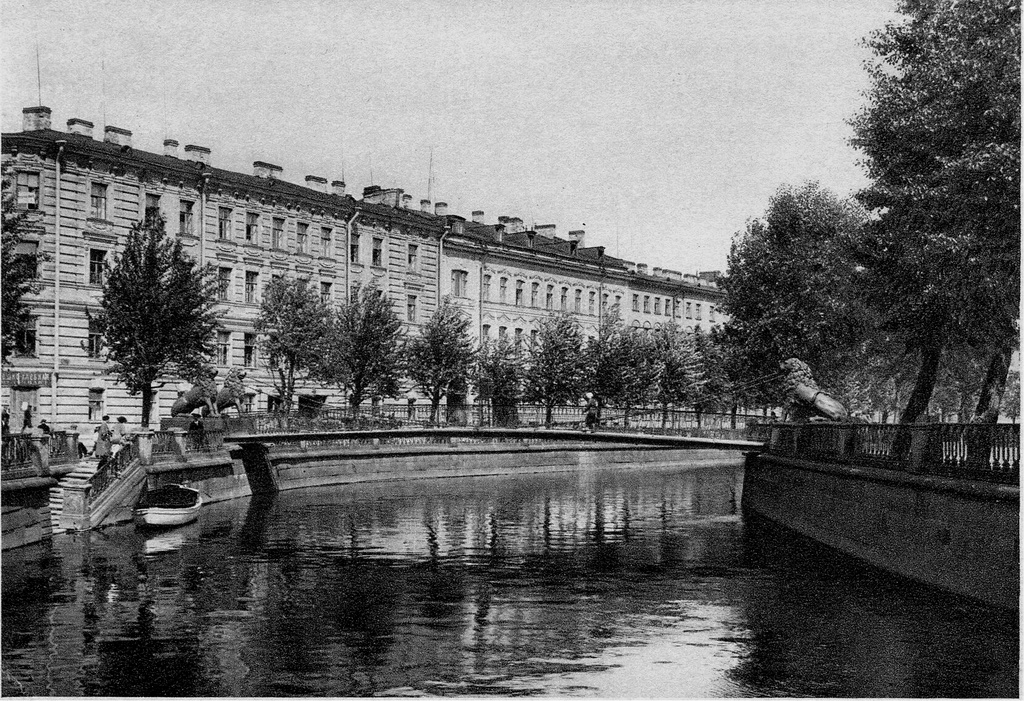
Lomonosov Bridge

Lomonosov Bridge, Lomonosov Street, Saint Petersburg, Russia, 191038

The Lomonosov Bridge over the Fontanka is one of the oldest and most beautiful bridges in St. Petersburg, which has not only changed its name several times but also altered its structure: it used to be a drawbridge. It is the only crossing over the Fontanka that has preserved its architectural appearance almost unchanged for 130 years. The bridge connects Spassky and Nameless Islands. Nearby are Zodchy Rossi Street, a bust of Lomonosov, and the square bearing the same name.

The Lomonosov Bridge over the Fontanka is one of the oldest and most beautiful bridges in the city, which has not only changed several names but also altered its structure a few times: it was once a drawbridge. At the same time, it is the only one of the crossings over the Fontanka that has managed to preserve its architectural appearance almost unchanged for over 130 years. The bridge connects Spassky and Nameless Islands. Nearby are Zodchy Rossi Street, a bust of Lomonosov, and the square of the same name.

Upstream is the Anichkov Bridge, downstream — the Leshtukov Bridge. The bridge was built according to a standard design by Jean Rodolphe Perroné and is one of the outstanding monuments of the city's bridge-building culture. The Lomonosov Bridge stands at the intersection of the river with Lomonosov Street. It is a stone three-span structure 62.9 meters long and 16.1 meters wide. The railings are cast iron on granite pedestals, with a pattern repeating the design of the Fontanka embankments.

It changed several names before being called the Lomonosov Bridge: until 1798 — the Catherine Bridge, from 1798 to 1948 — the Chernyshev Bridge (named after Count General G.P. Chernyshev), near whose estate it was built. It is worth noting that originally this bridge was absent from urban planning schemes, and therefore construction began later than others, when the embankment was already faced with granite. However, probably at the request of Catherine II, the bridge was included in the project for the arrangement of the Fontanka banks and was initially called the Catherine Bridge. The Chernyshev Bridge was not planned during the development of the Fontanka embankment project and was started later than others, when the embankment was already clad in granite. It was built in 1785-1787 according to a standard project of stone bridges over the Fontanka River.

The bridge consisted of two side stone arches faced with granite and a central lifting part — a wooden double-leaf drawbridge span. Granite towers were placed on the river piers, housing lifting mechanisms with long chains. The decking of the side parts of the bridge was paved with cobblestones (until the 1830s, bridges on the Fontanka had end pavements), and the middle span was covered with wooden decking. The sidewalks were lower than the roadway and fenced off from it by high granite parapets along the entire length of the side parts of the bridge. The railings repeated the pattern of the railings on the Fontanka embankment but were interrupted by granite reveals at the junctions with it. Similar parapets, but pointed, were installed on the piers between the water-facing columns of the gazebos. On the four corners of the bridge at the entrances stood stone lantern obelisks with two oval-shaped lanterns on metal brackets. Another feature of the structure is the lanterns — true works of art. Made in a hexagonal shape, they are supported by brackets in the form of mythical hippocamps — winged creatures resembling unicorns, with the head and body of a horse and a fish tail. Currently, the lanterns have been restored and covered with gold leaf.

In the mid-19th century, due to increased urban traffic, stone tower-type bridges — Simeonovsky, Anichkov, Semenovsky, Obukhovsky, Izmailovsky — began to be rebuilt by demolishing the towers and replacing the lifting spans with permanent ones. The Chernyshev Bridge and Staro-Kalinkin Bridge most fully preserved their original appearance. The Chernyshev Bridge is the only one among its peers that stood unchanged for over a hundred years, undergoing only routine repairs.

The ensemble of bridges, while remaining an outstanding work of architecture, no longer played the previous role that stemmed from the border position of the Fontanka, beyond which in the 18th century the suburbs essentially began.

In 1911-1912, the bridge underwent major repairs. The piers and arches were reinforced, and the wooden span structure in the middle span of the bridge was replaced with a metal beam structure.

At the entrance to the bridge in 1915, the obelisks with lanterns were restored according to the design of academician architect Fomin. The above-water parts of the piers and abutments were also relaid. The sidewalks were raised above the roadway level, and the parapets separating them from the roadway were removed. The entire roadway was paved with cobblestones, the sidewalks on the side parts with granite slabs, and the central part with asphalt.

Granite drainage gutters were laid along the sidewalks.

In 1950, the granite obelisks with lanterns, damaged during the city's blockade, were restored, and in 1967 the architectural details were gilded. In 2006, the obelisks were restored again, refreshing the gilding of the lanterns, spherical finials, and hippocamps.

The bridge can be seen in the film "The Incredible Adventures of Italians in Russia." Although the academician and great scientist Mikhail Lomonosov has no connection to the bridge, a belief has taken hold among St. Petersburg students that visiting the bridge helps in the process of acquiring knowledge. It is believed that if you visit the Lomonosov Bridge before an exam, you can draw a "lucky" ticket.

Sources:

https://vecherka.spb.ru/?p=29926

https://mostotrest-spb.ru/bridges/lomonosova

Kochedamov V. I. Bridges of Leningrad. — Leningrad: Iskusstvo, 1958

https://www.citywalls.ru/house13279.html

Follow us on social media

More stories from Petersburg: Bridges, Their Stories and Legends

Trinity Bridge - History, Legends, and Interesting Facts.

Troitsky Bridge, Troitsky Bridge, Saint Petersburg, Russia, 191186

The Troitsky Bridge is a metal drawbridge over the Neva River in Saint Petersburg. It connects Petrogradsky and 1st Admiralteysky Islands. It is the third permanent bridge over the Neva (after the Blagoveshchensky and Liteyny bridges), one of the most beautiful bridges in Saint Petersburg, and one of the symbols of the graduates' celebration "Scarlet Sails."

Egyptian Bridge

Egyptian Bridge, Fontanka River, Saint Petersburg, Russia, 190068

A certain Maria Ilyinichna Ratner, who lived near the bridge, shouted out the window during the passage of the cavalrymen: "May you all fall through!" and her wish was immediately fulfilled.

The Hermitage Bridge and Poor Liza

Hermitage Bridge, Winter Canal Embankment, Saint Petersburg, Russia, 191186

One of the most romantic and mystical places in Saint Petersburg is the arch over the Winter Canal. It is a small stone bridge near the Hermitage, which often appears on tourist postcards.

Bank Bridge with Griffins

Griboedov Canal Embankment, 32, Saint Petersburg, Russia, 191186

One of the three surviving pedestrian chain or suspension bridges in St. Petersburg, adorned with massive figures of mythical winged lions – the work of Pavel Sokolov, it has long become a symbol of the city. The winged lions of the Bank Bridge are mistakenly called griffins. In fact, griffins are mythical winged creatures with the body of a lion and the head of an eagle. But despite the obvious differences, this name has firmly stuck to the sculptures.

Lion Bridge, also known as the Bridge of Four Lions

Lion Bridge, Griboedov Canal Embankment, Saint Petersburg, Russia, 190068

The Lion Bridge is an outstanding monument of bridge-building architecture from the first quarter of the 19th century. It is one of three preserved pedestrian chain bridges in St. Petersburg (alongside the Bank and Post Office bridges). It is one of six suspension bridges built in St. Petersburg in the first quarter of the 19th century. The Lion Bridge was constructed in 1825-1826, simultaneously with the Bank Bridge. It did not become known as the Lion Bridge immediately. At first, it was called the "Bridge of Four Lions" in a longer form, later shortened to "Bridge of Four Lions," and only after some time was the current name invented.

Liteyny Bridge. History and Mystical Legends

Liteyny Bridge, Liteyny Bridge, Saint Petersburg, Russia, 194044

The Liteyny Bridge has the most mystical and dark history among all 342 city bridges of Petersburg. Since ancient times, even before the city was founded, there was a crossing at this spot on the route from Russia to Sweden. And the place of this crossing over the Neva has always had a bad reputation. Accidents constantly happened here: fishermen’s boats capsized; sailors from passing ships fell and drowned; and sometimes a careless, slightly drunk passerby, gazing at the water, would fall down through the bridge’s railings…

Blagoveshchensky Bridge - the first permanent bridge across the Neva River

Blagoveshchensky Bridge, Blagoveshchensky Bridge, Saint Petersburg, Russia, 199034

The Blagoveshchensky Bridge spans the Bolshaya Neva River. It connects the Admiralteysky District with Vasilievsky Island. Along the axis of the bridge runs the watershed between the Gulf of Finland and the Bolshaya Neva. This is the first permanent crossing over the Neva River, both in terms of construction time and location.

Ioannovsky Bridge - the first bridge in Saint Petersburg

Peter and Paul Fortress, Saint Petersburg, Russia, 197046

The first bridge of Saint Petersburg — the Ioannovsky Bridge. Its history began in 1703, along with the founding of the Peter and Paul Fortress. The bridge connects Hare Island and Petrogradsky Island.

Italian bridge

Italian Bridge, Griboedov Canal Embankment, 13, Saint Petersburg, Russia, 191186

The Italian Bridge is located in the center of Saint Petersburg, near Nevsky Prospect. It is a continuation of Italian Street and crosses the Griboedov Canal, connecting Spassky Island with Kazansky Island. Nearby are famous city landmarks: the Church of the Savior on Blood, the Zoshchenko Museum-Apartment, and the Mikhailovsky Theatre.

Kiss Bridge or Bridge of Kisses

Kisses Bridge, Glinki Street, Saint Petersburg, Russia, 190000

Having bought a bouquet of snowdrops, Loving and tender, We always walked to the Kiss Bridge...

Rossi's Cast-Iron Bridge in the Mikhailovsky Garden

Sadovaya St., 4, Saint Petersburg, Russia, 191023

The bridge was built in the 18th century based on the design of architect Carlo Ivanovich Rossi and was reconstructed in 2003.

Second Engineering - Useless Bridge

Fontanka River Embankment, 34, Saint Petersburg, Russia, 191014

One of the bridges in St. Petersburg stands out because there is water only on one side of it. The space under the bridge, therefore, is not a span but a niche. This is the Second Engineer Bridge at the Mikhailovsky Castle.

Old Kalinkin Bridge

Staro-Kalinkin Bridge, Staro-Petergofsky Ave., Saint Petersburg, Russia, 190121

The Staro-Kalinkin Bridge in Petersburg is one of the 7 standard stone three-span bridges over the Fontanka River, built in the 18th century and preserved to this day. In 2033, the bridge will turn 300 years old. The bridge is located in the Admiralteysky District of Saint Petersburg, with Staro-Petergofsky Avenue approaching it from the left bank. The central span is covered by a gentle circular arch, while the side spans are covered by stone vaults of box-shaped outlines.

Anichkov Bridge and Its Legends

Anichkov Bridge, Nevsky Prospect, Saint Petersburg, Russia, 191025

The bridge over the Fontanka on Nevsky Prospect, with four sculptures of horse tamers, is one of the most recognizable bridges in Saint Petersburg. It was named after a lieutenant colonel whose battalion took part in the construction of the first wooden crossing over the Fontanka. During the construction of the bridge, the battalion was stationed in one of the nearby Finnish villages, which came to be called Anichkova Sloboda. This name was also given to the bridge and to the much later built imperial Anichkov Palace.

Green or Police Bridge

Green Bridge, Nevsky Ave., Saint Petersburg, Russia, 191186

Regarding the time of construction of the first wooden drawbridge over the Moika River at the alignment of Nevsky Prospect, there are different versions. Local historian Antonov, in the book *"Bridges of Saint Petersburg,"* writes that it was built in 1717-1718. Historian Burenina, in the book *"Walks along Nevsky Prospect,"* names the year of construction as 1720. Schultz Jr., in the book *"Nevsky Perspective: From the Admiralty to the Moika,"* provides a third option — 1716. In any case, in 1735 the bridge was repaired and painted green, which is how it received its first official name — Green. Similar "color" names were then given to other bridges over the Moika: Blue and Red.

Singers' Bridge at the Palace (formerly Yellow)

Singers' Bridge, Moika River Embankment, 20, Saint Petersburg, Russia, 191186

The Singing Bridge is the closest bridge to Palace Square; it is even considered its continuation. It is the fourth widest bridge in St. Petersburg (after the Blue, Kazansky, and Aptekarsky bridges). The bridge connects Kazansky and 2nd Admiralteysky Islands across the Moika River and was formerly called the "Yellow" bridge. The Moika is the only river in St. Petersburg over which bridges with "color" names have been built. They were constructed by different specialists at different times. These are the Yellow (now Singing) Bridge near Palace Square, the Green (later Police) Bridge at the corner of the Moika River and Nevsky Prospect, the Red Bridge at the intersection of Gorokhovaya Street and the Moika Embankment, and finally, the widest bridge in our city, the Blue Bridge, at Isaakievskaya Square.

Laundry Bridge

Laundry Bridge, Palace Embankment, Saint Petersburg, Russia, 191187

On the Laundry Bridge, where you and I were like the hands of a clock face, embraced at twelve before parting not for a day, but forever, — today here, on the Laundry Bridge, a fisherman, suffering from a Narcissus complex, stares, forgetting about the float, at his wavering reflection. Joseph Brodsky

Stock Exchange Bridge

W8W2+8X, Saint Petersburg, Russia, 199034

The Exchange Bridge can be seen in many films about Saint Petersburg. For example, in *The Incredible Adventures of Italians in Russia*, a riverboat passes under the bridge, and the character played by actor Andrei Mironov hangs from the wing of the bridge. For the filming, the bridge was specially raised during the day; the scene was shot with stunt doubles, but for close-ups, the actor himself hung over the river at a height equivalent to a 15-story building. This is the bridge often shown in movies when the action takes place on Palace Bridge: they look very similar, but it is much easier to close the Exchange Bridge to traffic during filming.

Pikalov Bridge or Semimoscie

Pikalov Bridge, Kryukov Canal Embankment, 19, Saint Petersburg, Russia, 190068

Pikalov Bridge was built between 1783 and 1785 at the intersection of the Catherine and Kryukov Canals. Its design was a standard model used for all bridges in this part of Saint Petersburg. It was named after the construction contractor. The original Pikalov Bridge was a wooden beam crossing on stone supports. The middle section of the bridge was movable but was later replaced with a fixed one. On the central supports, outside the railings, granite obelisks with lanterns on ornate pedestals topped with "pinecones" are installed.

English Bridge

Fontanka River Embankment, 144, Saint Petersburg, Russia, 190121

The English pedestrian bridge spans the Fontanka River along the axis of the eponymous avenue and connects Pokrovsky and Bezymyanny Islands. It is a three-span continuous metal beam bridge, 58.4 meters long and 4.5 meters wide. The welded span structure consists of two I-beams with a curved outline of the lower flange. The supports are reinforced concrete on a wooden pile foundation, faced with granite. The origin of the name of the English Embankment (and later the eponymous avenue and bridge) is connected to the fact that in the 18th century, merchants from England settled on the embankment, where the Anglican Church of Jesus Christ was also established. The traders occupied an entire block, and the embankment served as the "soul" of aristocratic Petersburg: balls and literary-musical evenings were held there, and social life flourished. The avenue was built up in the nineteenth century and was inhabited by the theatrical bohemia of the Northern capital.

The Blue Bridge is the widest bridge in the world.

Blue Bridge, Antonenko Lane, 5, Saint Petersburg, Russia, 190000

The Blue Bridge in Saint Petersburg is the most inconspicuous landmark of the city. Many tourists and residents do not realize that they have walked across it. Yet this structure has a deep historical past, including legends and beliefs. Thanks to its record-breaking width, the Blue Bridge has become a kind of "invisible bridge" — many perceive it not as a crossing over the Moika River, but as part of the square. The Blue Bridge fits organically into the surrounding architectural ensemble with all its historic buildings and monuments. Many guides conducting tours of Isaakiyevskaya and Senate Square note that the bridge and the nearby Mariinsky Palace "fell out of favor" with two Russian emperors at once: the equestrian statues of Nicholas I and Peter I (the Bronze Horseman) stand with their backs turned to the bridge and the palace.

Bolshoy Konyushenny Bridge

Bolshoy Konyushenny Bridge, Moshkov Lane, Saint Petersburg, Russia, 191186

The Bolshoy Konyushenny Bridge, connecting the banks of the Moika River, invariably attracts the attention of passersby with its beautiful architectural decoration. It is a cultural and historical monument protected by the state.

Novo-Konyushenny Bridge - a bridge that bore the name of a terrorist

Novo - Konyushenny Bridge, Griboedov Canal Embankment, Saint Petersburg, Russia, 191186

A wide wooden beam bridge was built at this location back in the early 1880s to facilitate the construction of the "Church of the Resurrection of Christ on the site of the mortal wounding of Emperor Alexander II on the Catherine Canal" (this is the canonical name of the church). During the construction period, the width of the bridge reached up to 115 meters. After the completion of the church in 1907, the bridge was retained and named the "Bridge of the Lord's Resurrection" — this name lasted until 1917. After the October Revolution of 1917, it was officially renamed the "cover bridge," in accordance with its structure and purpose. Throughout its existence, the wooden bridge was repeatedly rebuilt.

Triple Bridge (also Three-Arch Bridge, Three-Jointed Bridge)

Moika River Embankment, 1/8, lit. A, Saint Petersburg, Russia, 191186

The Triple Bridge (also known as the Three-Arch Bridge, Three-Knee Bridge) is the informal name of a unique bridge composition connecting three islands: Spassky, 1st Admiralty, and Kazansky in the Central District of Saint Petersburg. Two bridges at this location were built in the late 1730s, during the reign of Anna Ioannovna.

Hemp Bridge

Petrovskaya St., 6b, Saint Petersburg, Russia, 197762

The Penkovy Bridge was built in 1873 and rebuilt in 1887-1888. Drawbridges over the Obvodny Canal, which the Penkovy Bridge originally was, allowed the passage of sailing ships with tall masts along the canal. It spans the Obvodny Canal. The crossing acquired its modern appearance in 1971–1972, during another reconstruction. The bridge has preserved the historic roadway surface, made of cast iron tiles.

2nd Kamennoostrovsky Bridge

2nd Kamennoostrovsky Bridge, Bolshaya Nevka River Embankment, Saint Petersburg, Russia, 197183

The 2nd Kamennoostrovsky Bridge is located in the north of Kamenny Island; it spans the Small Canal, which runs along the left bank of the Bolshaya Nevka. The bridge is pedestrian, single-span, reinforced concrete, and of a fixed-arch system. The length of the bridge is 12.3 meters, and the width is 2.8 meters.

3rd Kamennoostrovsky Bridge

3rd Kamennoostrovsky Bridge, Bolshaya Nevka River Embankment, Saint Petersburg, Russia, 197183

The 3rd Kamennoostrovsky Bridge is located in the north of Kamenniy Island; it spans the Small Canal, which runs along the left bank of the Bolshaya Nevka.

1st Winter Bridge

Millionnaya St., 34, Saint Petersburg, Russia, 191186

The 1st Winter Bridge spans the Winter Canal along the axis of Millionnaya Street, connecting the 1st and 2nd Admiralty Islands in the Central District of Saint Petersburg.

2nd Winter Bridge

2nd Winter Bridge, Winter Canal, Saint Petersburg, Russia, 191186

The 2nd Winter Bridge spans the Winter Canal at the alignment of the Moyka River embankment and connects the 1st and 2nd Admiralty Islands. There was no bridge over the Winter Canal at its confluence with the Moyka River until the 1930s. Only in 1933 was a floating crossing laid across the Winter Canal along the Moyka embankment. The bridge was needed to allow the passage of columns after the festive demonstrations on May 1 and November 7.

1st Sadovy Bridge

1st Sadovy Bridge, Sadovaya St., Saint Petersburg, Russia, 191023

The 1st Sadovy Bridge, spanning the Moyka River along the axis of Sadovaya Street, connects Spassky and 1st Admiralteysky Islands in the Central District of Saint Petersburg.

2nd Sadovy Bridge

Second Sadovy Bridge, Moika River Embankment, Saint Petersburg, Russia, 191186

The 2nd Sadovy Bridge, spanning the Moyka River along the axis of Mars Field passage northwest of the Mikhailovsky Garden, connects Spassky and 1st Admiralty Islands in the Central District of Saint Petersburg.

Alarchin Bridge

Alarchin Bridge, English Ave., Saint Petersburg, Russia, 190121

The Alarchin Bridge spans the Griboyedov Canal at the alignment of English Avenue and connects Kolomna and Pokrovsky Islands in the Admiralteysky District of Saint Petersburg.

Bolshoy Okhtinsky Bridge - Emperor Peter the Great Bridge

Bolsheokhtinsky Bridge, Bolsheokhtinsky Bridge, Saint Petersburg, Russia, 195112

The Bolshoy Okhtinsky Bridge over the Neva connects the Central District of Saint Petersburg with Krasnogvardeysky (Bolshaya Okhta). The ceremonial laying of the bridge took place on (June 26) July 9, 1909, a day before the celebration of the 200th anniversary of the Battle of Poltava. Therefore, the bridge was named in honor of Emperor Peter the Great.

1st Lavra Bridge

Monastyrka River Embankment, 1L, Saint Petersburg, Russia, 191167

The 1st Lavra Bridge spans the Monastyrka River near the main entrance to the Alexander Nevsky Lavra.

2nd Lavra Bridge

2nd Lavrsky Bridge, Lavrsky Drive, Saint Petersburg, Russia, 191167

The 2nd Lavra Bridge connects the territory of the Alexander Nevsky Lavra with the necropolises of the State Museum of Urban Sculpture.

Tuchkov Bridge

Tuchkov Bridge, Tuchkov Bridge, Saint Petersburg, Russia, 199053

Tuchkov Bridge is located across the Malaya Neva River in line with Bolshoy Prospekt of the Petrograd Side and the 1st and Syezdovskaya (now Kadetskaya) lines of Vasilievsky Island.

Palace Bridge

Palace Bridge, Palace Square, Saint Petersburg, Russia, 199034

Thrown across the Bolshaya Neva between Palace Square and the spit of Vasilyevsky Island

Post Office Pedestrian Bridge

Pochtamtsky Bridge, Prachechny Lane, Saint Petersburg, Russia, 190000

The Post Office pedestrian bridge spans the Moyka River at the junction of Bolshaya Morskaya Street and Prachechny Lane, connecting Kazansky and 2nd Admiralty Islands.

Upper Lebyazhiy Bridge

Upper Lebyazhiy Bridge, Palace Embankment, Saint Petersburg, Russia, 191186

The Upper Lebyazhiy Bridge is one of the few crossings that have survived to this day almost without any changes to their structural and architectural forms. The bridge forms a unified architectural ensemble with the Palace Embankment and the fence of the Summer Garden and is an object of historical and cultural heritage of federal significance.

Lower Lebyazhiy Bridge

Lower Lebyazhiy Bridge, Moika River Embankment, Saint Petersburg, Russia, 191023

The Lower Lebyazhiy Bridge is located in the very heart of St. Petersburg, among historic gardens and parks. Nearby are such famous landmarks of the Northern Capital as the Summer Garden with Peter I's Summer Palace and a unique collection of sculptures, the Engineering (Mikhailovsky) Castle, and Mars Field.

Blue Bridge (Kronstadt)

Karl Marx St., 1/1, Saint Petersburg, Russia, 197760

The Blue Bridge is a vehicular and pedestrian bridge over the Obvodny Canal in Kronstadt. It is famous for the Kronstadt footstock installed here and is considered a historical and architectural monument.

Demidov Bridge

Demidov Bridge, Grivtsova Lane, 9, Saint Petersburg, Russia, 190031

Thrown over the Griboyedov Canal at the alignment of Grivtsov Lane, it connects Kazansky and Spassky Islands. The length of the bridge measured along the back edges of the abutments is 38.5 meters, and the width between the axes of the railings is 16.2 meters. This is a single-span structure on stone abutments reinforced with steel-reinforced concrete and faced with granite. The span structure is a metal arch, assembled from cast-iron tubing. The bridge abutments are massive, stone, on a pile foundation, faced with granite. The bridge railings are cast-iron artistic grilles, with a pattern designed in the form of fan-shaped palm leaves. On the bridge’s wing walls are granite parapets.

Staro-Nikolsky Bridge

Staro-Nikolsky Bridge, Sadovaya St., 64, Saint Petersburg, Russia, 190068

The former Pereshivkin Bridge, now known as the Staro-Nikolsky Bridge, is located along the axis of Sadovaya Street and crosses the Kryukov Canal at the point where its waters meet those of the Griboedov Canal.

Apothecary Bridge

Aptekarsky Bridge, Karpovka River, Saint Petersburg, Russia, 197101

Аптекарский мост расположен в истоке реки Карповки по оси Петроградской и Аптекарской набережных и соединяет Петроградский и Аптекарский острова. Общая длина моста составляет 30,4 метра, а ширина — 96,8 метра. Это второй по ширине переход в Санкт-Петербурге после Голубого моста.

Obukhovsky Bridge

Obukhovsky Bridge, Moskovsky Ave., Saint Petersburg, Russia

One of the oldest bridges in Saint Petersburg. Built across the Fontanka River along the Saarskaya Perspective (later Tsarskoye Selo Avenue, now Moskovsky Avenue).