

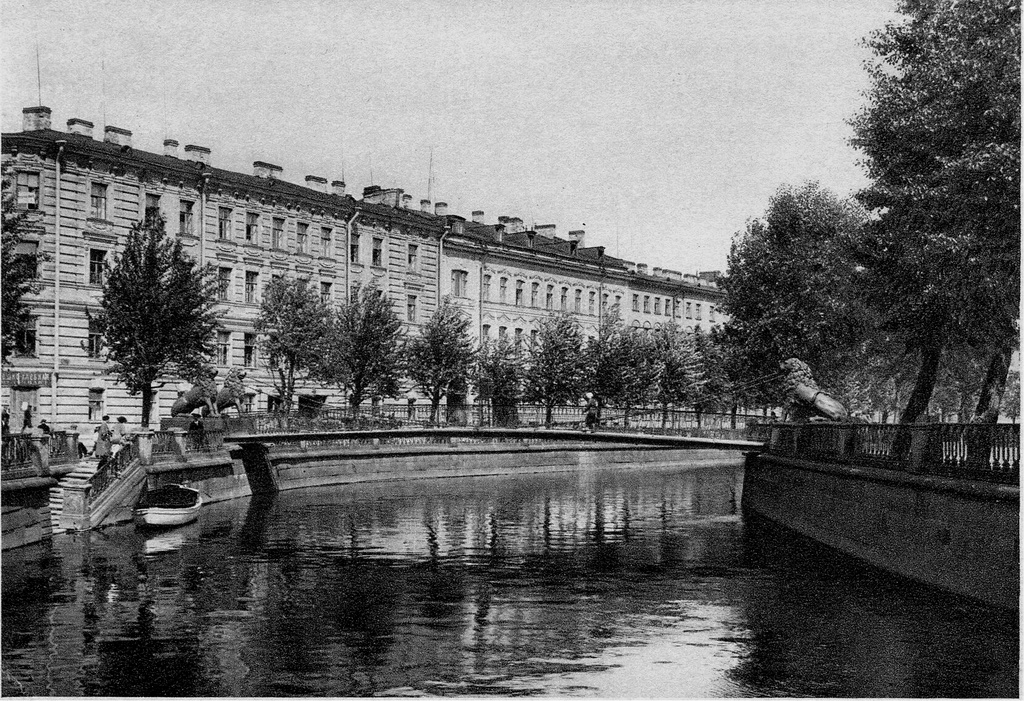
One of the three surviving pedestrian chain or suspension bridges in Petersburg, adorned with massive figures of mythical winged lions — the work of Pavel Sokolov, it has long become a symbol of the city. The winged lions of the Bank Bridge are mistakenly called griffins. In fact, griffins are mythical winged creatures with the body of a lion and the head of an eagle. But despite the obvious differences, this name has firmly stuck to the sculptures. The Bank Bridge over the Griboedov Canal is one of the coziest pedestrian crossings in Petersburg. The bridge was decided to be built due to the sharply increased population in the area around the Griboedov Canal, which was originally called the Catherine Canal. The bridge project belonged to two engineers — Tretter (1788–1859) and Khristianovich (1803–1847).

Tretter, a hereditary civil engineer, was a German who worked in Russia for many years. He is considered the founder of the era of German architecture in Saint Petersburg. It was largely thanks to him that iron bridge construction began in the city. Tretter especially advocated for the construction of suspension bridges, which were widespread in Europe and America. The Russian engineer Khristianovich assisted the brilliant German. The project approval and the start of construction took place in 1825. The single-span suspension bridge was built in 1825–1826. Traffic on the bridge was launched in the summer of 1826. The Berd factory played a significant role in the bridge’s construction.
The structure includes two chains, suspenders, and a wooden deck. The supporting chains are held by cast-iron frames. At both entrances to the bridge stand sculptures of griffins with gilded wings, mounted on cast-iron pedestals. Lamps are fixed on the heads of these mythical creatures.

The bridge’s railings are artistic castings. Wishes related to financial well-being and personal life are guaranteed to come true here. The author of the griffins, Pavel Sokolov, was by then already a well-known sculptor, a “master of carved artistry” at the Admiralty, and the creator of the famous Tsarskoye Selo fountain “Girl with a Pitcher.” The cast-iron figures he created are not only outstanding examples of Empire-style monumental sculpture but were made not only to decorate the bridge but also to mask the chain fastening structures. The mythical animals, whose images had previously appeared only in furniture decoration and architectural details, were cast in huge sizes for the first time and adorned the urban space. The need to build the bridge was caused by the population growth in the area adjacent to the Griboedov Canal, and it was intended only for pedestrians. The structure connects Kazansky and Spassky islands. The nearest bridges to the Bank Bridge are the Kazansky Bridge (on the axis of Nevsky Prospect) and the Muchnoy Bridge (leading to Muchnoy Lane). Simultaneously with the Bank Bridge, a project was developed for the second chain pedestrian bridge over the canal — the Lion Bridge.

Why were griffins chosen for the bridge? The thing is, the Bank Bridge is located in front of the building of the former Assignation Bank (now Saint Petersburg State University of Economics), and since Ancient Hellas, mythical griffins were believed to reliably guard gold from any encroachments. So these winged lions had the duty to guard the gold reserves of the Russian state. Besides the magnificent lions, the bridge is decorated with a beautiful openwork railing featuring images of open fans and palm leaves. Originally, the railing was made of cast iron but was later replaced with metal. The lions’ wings and some elements of the bridge’s fence were covered with gold leaf, which attracted many lovers of easy profit. Although the gold layer was so thin that scraping it off and collecting it was practically impossible — it simply turned into gold dust — this did not stop thieves. As a result, by the end of the 19th century, all gilded elements were severely damaged, the railing was removed and sent for restoration. During the restoration, the fence disappeared without a trace. Only in the mid-20th century did architect Rotach restore the Bank Bridge railing according to old drawings and returned it to its original place.
Since the early 19th century, there has been a city legend that the majestic guardians of the Bank Bridge can bring solutions to financial problems and wealth. There are several versions of how to gain the griffins’ favor: rub the paw of one of them or put a coin under it; walk across the bridge holding banknotes pressed tightly to your head; or, while crossing the bridge, shake small change in your pocket (the more small change, the more likely your financial situation will improve); kiss the mythical creature where the tail begins. That is why some parts of the cast-iron figures look worn. Moreover, the Bank Bridge legend says: if you rub the left thigh of the griffin closest to Kazan Cathedral, your wish will come true, even if it is not related to finances.
For a long time, simple railings served as the parapet of the Bank Bridge. They replaced the artistic fence lost at the end of the 19th century. In 1952, the fence was restored along with the lamps above the griffins’ heads according to a project. In 1994, the wooden deck covering of the bridge was restored. In 2008, the griffin figures were repaired right on site. Then, one of the caring residents of Petersburg helped restore the gold coating on the wings: a woman donated four books of gold leaf sheets for the restoration of the Bank Bridge griffins. According to the Petersburg resident, she bought the books in 1988 for 100 Soviet rubles, which corresponded to the average monthly salary at that time.
In January 2017, for the first time in almost 200 years, the famous winged lions left the Bank Bridge. Before sending them to the workshop, specialists literally managed to separate the one-and-a-half-ton cast-iron sculptures along the seams. Initially, the griffins were supposed to be sent for restoration back in November of the previous year, but the work was postponed. All this time was spent searching for the key to the secret of the legendary guardians of the Bank Bridge.
Experts found that the sculptures are a complex engineering structure. Each griffin consists of five parts: two side parts and three inserts on the front paws and chest. The halves of each figure are connected by special fasteners that the designers never intended to disassemble.
The work was complicated by the lack of detailed drawings and damage caused by time to the fragile winged lions. Specialists promised that after the latest restoration, the much-suffering figures would finally receive an anti-vandal coating. It is expected that by the 2018 FIFA World Cup, the griffins will return to the already restored bridge.
During the dismantling work, a treasure was found inside the hollow sculptures — a huge number of coins and personal notes, which fortunately were left by Petersburgers and tourists. Modern Russian, old Soviet, and foreign banknotes and coins, and even a rare teapot lid resting at the base of the third griffin.
One of the found notes records a girl’s wishes. The sheet reads: “Work in the specialty in court, career, financial success, successful marriage, registration in Petersburg, well-being.” On another — a plea: “I urgently want a man who will respect me, love me, and support me.”
All the notes and messages, kept for years by the Petersburg griffins, have already been promised to be museumized by the KGIOP (Committee for State Control, Use and Protection of Historical and Cultural Monuments). Possibly, they will be exhibited for public viewing after the restoration of the bridge and sculptures. Notes that do not disclose personal data and represent historical interest will be sent to the museum. The collection will obviously include the monetary treasure as well.
On June 19, 2019, the restoration of the Bank Bridge over the Griboedov Canal was completed. The crossing was reopened, and the restored griffin figures appeared before the townspeople in all their glory.
During the restoration, the griffins changed color to their original — darker. Now they are handsome noble black with gilded wings.
The “bridge of four lions”’s native brother, its smaller copy, is located in Berlin’s Tiergarten Park. The Löwenbrücke, built 12 years after the original, became the first suspension bridge in the German capital.
Sources:
https://peterburg.guide/mosty/bankovskij-s-grifonami-na-kanale-griboedova/
https://ru.wikipedia.org/wiki/Bank_Bridge
https://www.tourister.ru/world/europe/russia/city/saint_petersburg/bridges/37828




Written by Jermaine
Discuss this with the author and others
No comments yet. Be the first to start the conversation.