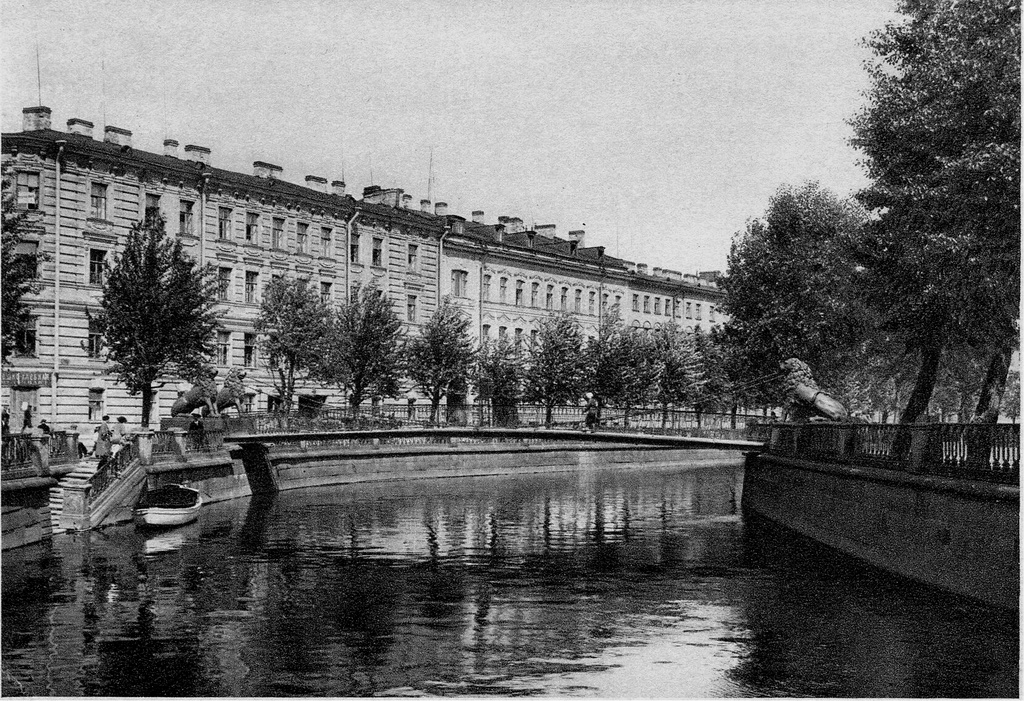

The Lion Bridge is an outstanding monument of bridge-building architecture from the first quarter of the 19th century. It is one of three surviving pedestrian chain bridges in St. Petersburg (alongside the Bank and Post Office bridges). It is one of six suspension bridges built in St. Petersburg in the first quarter of the 19th century. The Lion Bridge was constructed in 1825-1826, simultaneously with the Bank Bridge. It did not become known as the Lion Bridge immediately. At first, it was called the "Bridge of Four Lions" in a long form, later shortened to "Bridge of Four Lions," and only after some time was the current name invented.
The Lion Bridge is pedestrian-only. It spans the Griboedov Canal at the alignment of Lion Lane and Malaya Podyacheskaya Street, connecting Kazansky and Spassky Islands. The bridge is a single-span beam bridge, measuring 27.3 meters in length and 2.9 meters in width. The railings are made of artistic cast iron, featuring a pattern of a mesh of intersecting rectangular bars, the ends of which are connected at the top and bottom by semicircular rosettes. In the middle of the bridge, two octagonal lanterns on cast iron torcheres are embedded into the railing fence.
At the beginning of the 19th century, when the main material for engineers was cast iron—strong but poorly resistant to tension—it was replaced by iron, which performed well under both compression and tension. This led several engineers in the Old and New Worlds to come up with the idea of suspending bridge spans on iron chains. These chains were thrown over tall supports and anchored in the shore abutments. So the three-meter lions here are not just sitting idly; they hold the 27-meter span and us on the bridge. The powerful muscular lion figures conceal complex metal structures. All three surviving pedestrian bridges were designed by Georg Treeter. The lions, like the griffins on the Bank Bridge, were cast based on models by sculptor Pavel Sokolov.

It was planned to complete the work by October 1825, but due to delays in manufacturing the metal parts of the bridge, assembly began in spring 1826. To build the bridge supports, the rubble fill of the embankment was dismantled (without removing the granite facing). The Berd factory produced the cast iron and metal parts and assembled the elements on-site. On July 1, 1826, the bridge was opened to traffic. Like the Bank Bridge, the Lion Bridge is a single-span suspension bridge. The span structure consists of chains, hangers, and wooden beams. The beams were attached to the metal chains on hangers. The chain ends were hinged to cast iron pylons inside the lion heads, firmly anchored to the supports with anchor bolts. The pylons are hidden inside decorative sculptures—lions and metal pedestals.
The sculptures were created by academic sculptor Sokolov. The lion figures were cast from cast iron at the Alexandrovsky Cast Iron Foundry. Crossbars and a wooden deck were laid over the wooden beams. The bridge abutments are made of rubble stone on a pile foundation, faced with granite. The bridge was equipped with a cast iron openwork railing, on which lantern posts were mounted directly into the railings in the middle of the bridge. In 1838, a reduced copy of the bridge (17.3 m long, 2 m wide) was built by the Borsig firm according to the design of German architect L. F. Hesse in the Berlin park Große Tiergarten.
The Lion Bridge became the first suspension bridge in Berlin. Unlike the St. Petersburg original, the span structure and railings of the Berlin Lion Bridge are still wooden. In 1880, the originally created cast iron railings were removed and replaced with a simple-patterned wrought iron railing, and the lanterns were altered.
In 1948, a major repair of the bridge was carried out according to engineer Yanovsky’s design. Wooden beams were replaced with metal ones, and to give them a curved shape, they were made from five segments welded together. As a result, the stiffening beams acquired a slight camber. All other bridge structures were preserved in their original form.
In 1954, the original railings and lanterns were restored according to architect Rotach’s design. The pedestals and lion sculptures were restored.
In 1999-2000, a major overhaul of the bridge was carried out. In 2015, vandals tore off one lantern and damaged another; restoration work was done on the lanterns and they were reinstalled on the torcheres. The following year, the railings, cornices, and torcheres were painted.
The most recent restoration of the lion sculptures on the Lion Bridge began on August 10, 2018, and lasted until October 2018. Unlike the 2000 restoration, the sculptures were not dismantled; all work was carried out under protective canopies directly on the bridge.
Many stories and legends are associated with this bridge.
For example, the origin of the word "tolkuchka" (meaning a bustling market or crowd) is connected to this bridge—it is a word that came from St. Petersburg, more precisely from the Lion Bridge itself. Near Voznesensky Prospect, which is nearby, there was the Tolkuchiy Market, which, according to all the rules of the Russian language, launched the popular abbreviation "tolkuchka." It might seem simple and tautological, but no. The second version of the word’s origin also has a right to exist. In Leningrad, there was a small spot near the Lion Bridge where people came to rent and sublet housing. By the way, this tradition lasted quite a long time.
The second name of this bridge is the "Bridge of Meetings." It was called that at the time when a ballet school was located nearby, where ballerinas lived, and mustached cavaliers came to the bridge to wait for their beloveds with champagne and flowers. Later, young couples arranged dates here. Related to the name "Bridge of Meetings," it also has another name, "Bridge of Acquaintances"—people did not just meet random passersby here, and this is not a legend’s name but simply another amusing fact. At a certain period in the 1990s, a dating newspaper with the same name—Lion Bridge—was published in our city. At that time, the newspaper helped couples find each other and meet for personal acquaintance on the Lion Bridge. Perhaps there are families in St. Petersburg who met this way, and now this bridge is probably a symbol of their family.
Similar to the Bank Bridge, this is also a "Bridge of Wishes." The legend is very simple, although such beliefs exist for almost every landmark. If you rub the paw of one of the lions, all your wishes will come true. Residents of St. Petersburg and visitors are lucky. They can come to the Lion Bridge, which will fulfill their dreams and desires. The main thing is to perform certain actions correctly: approach the sculpture of one of the lions, rub the animal’s paw, make a wish—but not aloud; there is also a second option: stand between the figures of two lions and try to reach the sculptures with your palms. There is no reliable data on how often wishes come true. However, before exams, St. Petersburg students come alone or in groups to the Lion Bridge.
It is said that this bridge can determine the sex of an unborn child. A pregnant woman only needed to come to the bridge and see who would cross it first, a man or a woman. They say the result was 100% accurate, but this is just another legend. Although...
Of the three bridges spanning the Catherine Canal in this block, the Lion Bridge is the only one preserved without changes and remains one of the three surviving suspension bridges in the city.
Sources:
https://www.citywalls.ru/house13163.html
Quarterly Overseer No. 23, Supplement to the magazine "SPb Sobaka. RU No.11(46) 23.11.2004
https://mostotrest-spb.ru/bridges/lvinyj
https://p24p.ru/lviniy-most.htm


Written by Jermaine
Discuss this with the author and others
No comments yet. Be the first to start the conversation.