

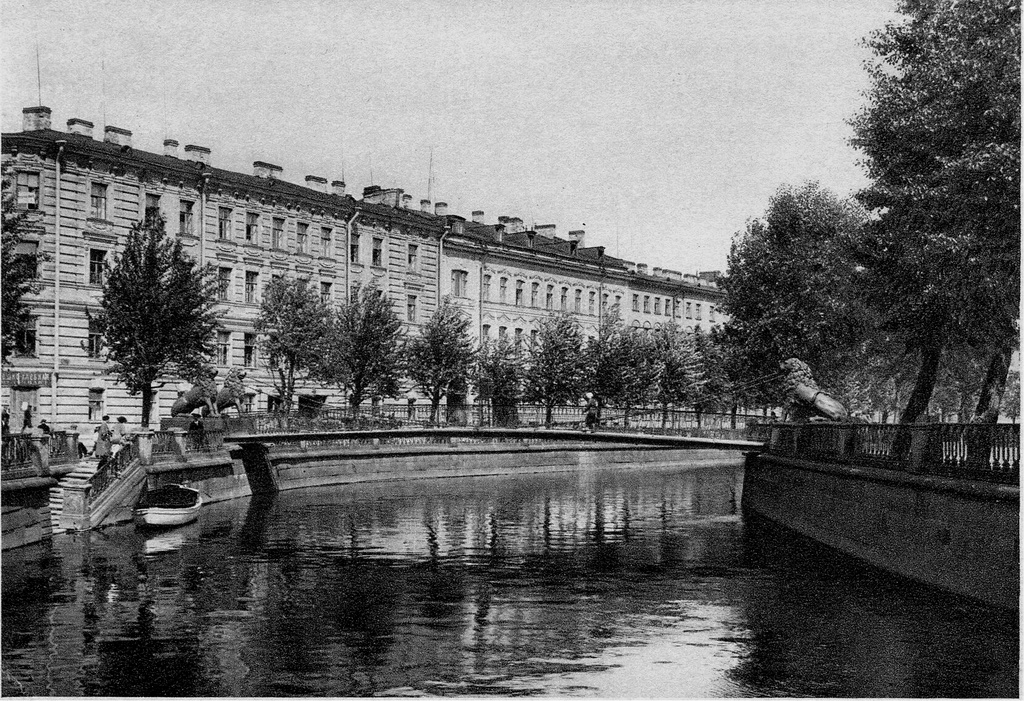
One of the most romantic and mystical places in Saint Petersburg is the arch over the Winter Canal. This small stone bridge near the Hermitage, which often appears on tourist postcards. The Hermitage Bridge is the very first stone bridge in Saint Petersburg. Its history is closely connected with the Palace Embankment and the formation of waterways in the center of the Northern capital.
Preserved engravings from the Petrine era give an idea that there were many more navigable waterways then than there are today. The canal dug in 1719 from the Myya River (the old name of the Moika) to the Neva was no exception. It was laid near Peter I’s Winter Palace (now part of the State Hermitage) and was called the Winter Palace Canal. At that time, vessels moved along the Winter Palace Canal, which has now greatly shallowed and is called the Winter Canal. The Tsar, known to be a great fan of navigation, could immediately board a boat upon leaving his home. It is not surprising that the predecessor of the Hermitage Bridge at the confluence of the Winter Palace Canal and the Neva was a drawbridge. The wooden crossing, built according to the design of the Dutch master Harman van Bolles in 1720, was a three-span structure on pile supports with a drawbridge middle section. The span was manually moved aside using levers and gear wheels.

The bridge was named Winter Palace Bridge, and an attempt to rename it to Upper Embankment by the 1738 decree was unsuccessful. Until the end of the 18th century, the bridge retained its old name, which gradually changed to Palace Bridge.
As part of the design of the granite Palace Embankment in 1766, a wide stone bridge—the first in the city—appeared on the site of the narrow wooden bridge designed for one carriage. This single-span arched structure harmoniously matched the renovated Neva embankment. And when a gallery connected the Hermitage Theatre building, erected on the site of Peter I’s old Winter Palace, with the Old Hermitage building, the bridge was complemented by a romantic arch and began to be called the Hermitage Bridge. There is a legend about this arch. The essence of it is that the envious rivals of the architect Giacomo Quarenghi, wishing to discredit him in the eyes of Catherine II, convinced the Empress of the unreliability of the structure, claiming it might collapse. After a thorough check of all calculations, a grand banquet with many guests was held in the gallery. The slanderers were disgraced because the arch withstood the load, and the question of its strength was settled.

The legend is most likely a myth, as modern historians attribute the authorship of this unique architectural structure to architect Felten, according to whose design the Old Hermitage was built. To be fair, it should be noted that it was previously believed that the creator of the arch was still Quarenghi, who built the Hermitage Theatre. We will leave this dispute to the professionals, only noting that the author of the stone bridge remains unknown to this day.
Now it is called the "Hermitage" Bridge. The embankment of the Winter Canal and the Hermitage Bridge appear in Pyotr Ilyich Tchaikovsky’s opera "The Queen of Spades." It is from here that Liza, from whom the mad Hermann flees, jumps into the water. As is known, this episode is completely absent in Pushkin’s original work, where Liza survives and even gets married. This plot element is absent in Pushkin’s story "The Queen of Spades" and appears under the influence of the real fact of the suicide of a certain Yulia Perova, committed at this place due to unhappy love, and described in one of the St. Petersburg newspapers in 1868. In 1890, Pyotr Tchaikovsky sent a newspaper clipping to his brother Modest with a request to include Liza’s suicide in the opera libretto. Now the image of this bridge is used in the opera’s scenery, and since then lovers have come to Liza and her ghost with their requests — which is why among St. Petersburg residents it has earned the nickname "Liza’s Bridge."
Sources:
https://ru.wikipedia.org/wiki/Hermitage_Bridge
Petrov P. N. History of Saint Petersburg from the founding of the city to the introduction of elective city government according to the provincial institutions. 1703-1782. - St. Petersburg, 1884.
https://spbguidebook.ru/ermitazhnyj-most/




Written by Jermaine
Discuss this with the author and others
No comments yet. Be the first to start the conversation.