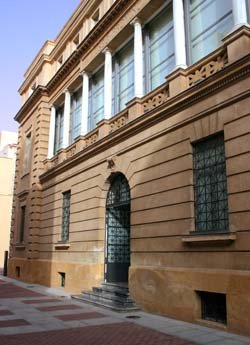

The Museo de Bellas Artes de Murcia (MUBAM) is a museum institution in the city of Murcia. Its origins date back to 1864, when the Museo Provincial was created by the Provincial Commission of Monuments. Initially located in the Levante Salon of the Teatro de los Infantes, the collection moved to the main hall of the disappeared Palacio del Contraste de la Seda because the original space was insufficient. Between 1903 and 1905, architect Pedro Cerdán began construction of the current building on the site of the antiguo Convento de la Trinidad.
The new building, which opened in 1910, incorporated architectural elements from the convent, such as marble columns and a wooden staircase. In 1962, the museum was declared a monumento histórico-artístico, making it a Bien de Interés Cultural with the category of monument. In 1953, the museum became the Museo de Bellas Artes de Murcia after the archaeological section was moved to its own museum.
Today, MUBAM features two pavilions: the Pabellón Cerdán, which houses the permanent collections, and the Pabellón Contraste, which contains offices, a lecture hall, and temporary exhibition rooms. The first floor houses paintings by Hernando de los Llanos, Juan de Vitoria, and others, alongside works by authors such as Pedro de Orrente, Nicolás de Villacis, Mateo Gilarte, and José Mateos Ferrer.
On the second floor, the museum displays works by 17th-century painters including Zurbarán, Ribera, Murillo, Valdés Leal, and Bartolomeo Cavarozzi. This floor also holds a collection of 18th-century Murcian painters, such as Juan Ruiz Melgarejo, Lorenzo Vila, Ginés Andrés de Aguirre, and Joaquín Campos.
Sources: Wikipedia, OpenStreetMap, Wikidata, Wikimedia Commons
Written by Nicolo Ciampini
Discuss this with the author and others
No comments yet. Be the first to start the conversation.