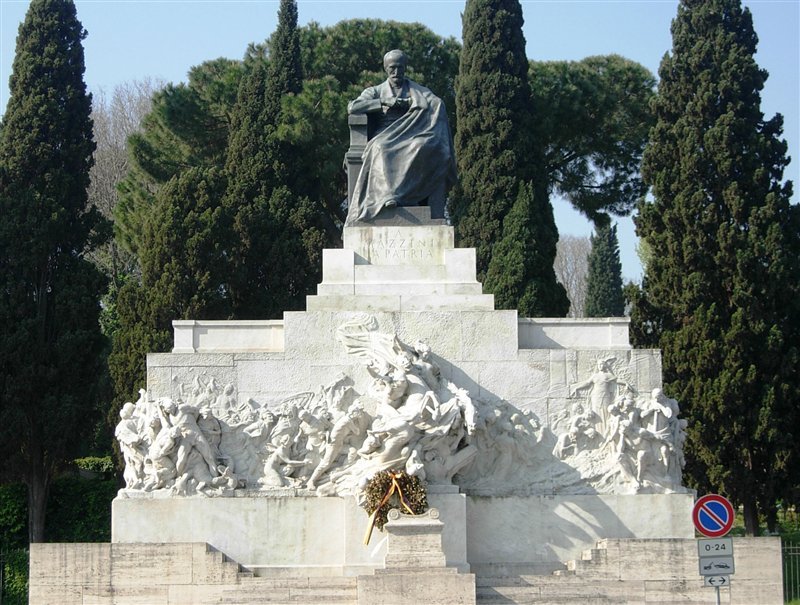

How does a man become both a hero and a pariah at the same time? Giuseppe Mazzini managed it. He was a primary figure of the Italian Risorgimento, but his republican leanings made the monarchy uneasy. It took over sixty years of political drama before his monument finally stood on the slopes of the Aventino.
The first proposal appeared in 1887, but the project suffered from a long list of complications. Scultore Ettore Ferrari was commissioned in 1902, but the work slowed to a crawl. The Fascist regime held a particular grudge against masonry - a connection shared by both Ferrari and Mazzini himself. During this time, the sculptures were scattered - the marble groups sat in a private garden while the bronze statue was kept in a foundry.
Construction didn't truly resume until 1948, under a republic that was far more comfortable with Mazzini's ideals. Even then, the Vatican protested, forcing the removal of several sculptures deemed too anti-clerical. It finally opened in 1949, to coincide with the centenary of the 1849 Republic. Today, the monument features a brooding bronze Mazzini atop a marble base decorated with allegories of liberty and the fallen.
Despite a major restoration in the late nineties, the marble high-relief has been defaced in several places. Some figures are now missing their fingers, hands, and sometimes even their heads.
Sources: Wikipedia, OpenStreetMap, Wikidata, Wikimedia Commons
Written by Nicolo Ciampini
Discuss this with the author and others
No comments yet. Be the first to start the conversation.