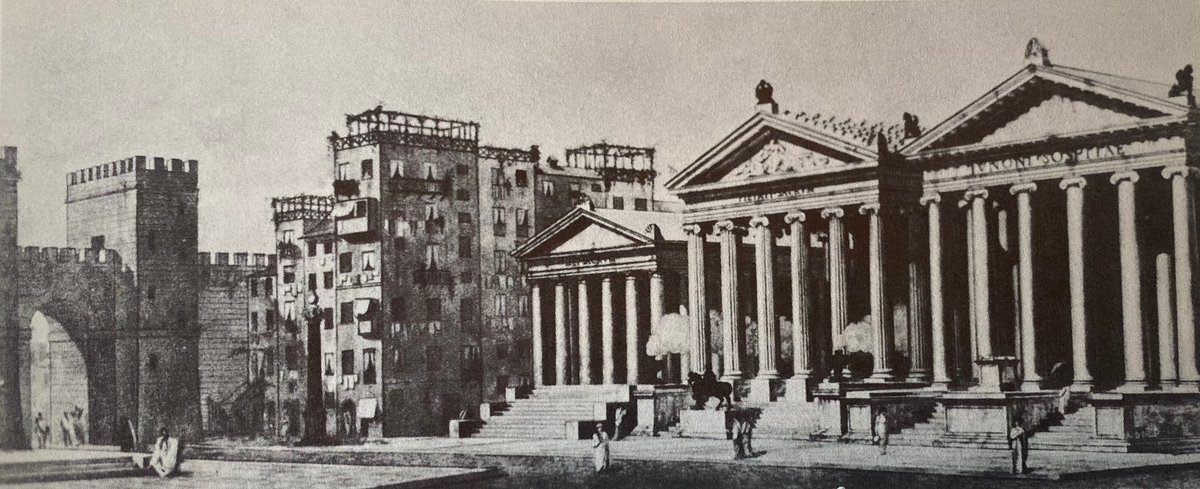

Nestled amid the undulating hills of the Capitoline, the Forum Holitorium stood as the city's vegetable market. A stone's throw away, the Forum Boarium served as its carnal counterpart. In the epicenter of these bustling markets, a confounding triad of temples emerged, dedicated to various gods. The temples of Bellona and Apollo Medicus stood steadfast at the edge, while the once-prominent Temple of Diana, exhibiting more temper tantrums than transcendence, was demolished during the rise of the Theatre of Marcellus.
A shame, indeed, for it was constructed during the republic. The Temple of Spes, a vision brought to life by Aulus Atilius Calatinus and restored by Caecilia Metella, still manages to stand – in parts, at least. Six of its columns, grotesquely decapitated, now adorn the left side of the San Nicola in Carcere. The Temple of Janus, a creation of Gaius Duilius and refurbished by Tiberius, followed a design known as a peripteros temple sine postîcum, a Latin lexicon for those intrigued by such matters.
Boasting eight tuff columns on its long sides and six on the front, it was a spectacle to behold. Yet, the Temple of Juno Sospita, erected by Gaius Cornelius Cethegus around 195 BC, held the grandeur. Restored by Caecilia Metella in 90 BC, it now lies in ruins, entombed beneath the current church. The travertine staircase leading to the pronaos of the temple remains, as does the temple’s subterranean chamber, nestled within the church. Three columns from the temple decorate the façade of the church, one severed of its head.
Other remnants of the temple can be found within the church, sharing their secrets with those seeking the tale of the forgotten goddess once revered in this hallowed ground.
Sources: Wikipedia, OpenStreetMap, Wikidata, Wikimedia Commons
Written by Nicolo Ciampini
Discuss this with the author and others
No comments yet. Be the first to start the conversation.