

The forts of Kronstadt have different fates. Most of them were abandoned by the military in the 1950s-60s. The "Citadel" fort (or Peter I) is still occupied by some organization, and tourists cannot enter. The forts "Konstantin" and "Krasnaya Gorka" were luckier than most—they have been turned into museums and are accessible to tourists. Meanwhile, most forts stand abandoned and are visited only by enthusiasts of urban exploration. Quite recently, the military left another Kronstadt fort—the 6th Northern.
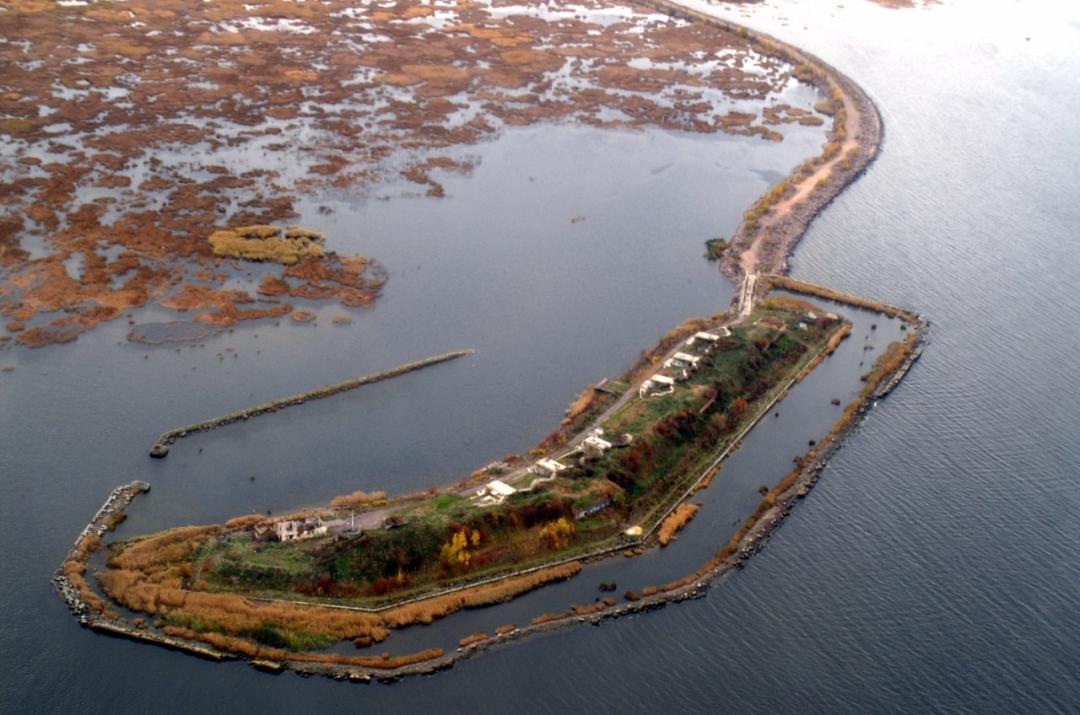
The Northern Fort No. 6 (Marine Northern Battery No. 6) was built during the Crimean War in 1853-1854 by the fortification engineer Totleben and rebuilt in 1864–1869 by Zverev. It has a horseshoe shape with an inner bay. There is a pier with bollards.

Similar in design to the first southern fort and the 1st, 2nd, 3rd, and 7th northern forts, this fort had four casemates, each housing two guns. The casemates were located along the front facade, which had a slight bend. Like the others, the fort had an earthen rampart and was surrounded by a stone mole forming a harbor on the southern side of the island. The brick casemates, as well as part of the mole, have survived to this day.
Throughout the second half of the 19th century, the fort was repeatedly rearmed, and the island was expanded to install heavier guns on open platforms.
Before World War I, concrete courtyards were built here for four 6-inch rapid-fire Canet guns. By the beginning of World War I in 1914, the fort was quite outdated but was part of the second line of defense of Kronstadt. The fort did not participate in any combat operations.
In the early 20th century, two permanent firing points were installed on the fort, each with three embrasures. During the Great Patriotic War (World War II), the fort was part of Kronstadt’s air defense system, and an anti-aircraft gun battery was installed on its rampart.
By the mid-1950s, the fort lost its military significance, and its armament was removed. Since 1962, military services (JSC Hydropibor) were stationed at the fort, which, disregarding its historical value, built structures from silicate bricks, completely distorting the architectural appearance of the mid-19th-century buildings, although the fort has been one of UNESCO’s World Heritage cultural sites since 1990. JSC "Hydropibor" traces its history back to 1914. It develops and prototypes naval underwater weapons, mine, anti-mine, and torpedo armaments for the Russian Navy. Over its history, the enterprise has frequently changed names and subordination but its core work remained the same. The company’s headquarters are in St. Petersburg, with branches and testing sites across Russia. It was for the sake of this enterprise that the architectural appearance of the old fort, built in 1856 as part of the Russian Empire’s naval rearmament after its shameful defeat in the Crimean War, designed by engineer Totleben, was disfigured.
Walking through the abandoned rooms of the fort is quite interesting. They are located on two, and in the central building, three levels. The basements are partially flooded, so visiting the fort in winter is the most reasonable option. There is no need to think about a boat to reach the island fort from the dam or about high rubber boots.

In some of the old casemates, remnants of quite decent modern repairs and details of the guards’ everyday life, who protected the equipment of the JSC "Hydropibor" branch from looters until recently, have been preserved.
The 6th Northern Fort of Kronstadt is quite large, and a detailed inspection of its structures will take almost a whole day. It is difficult to predict the future of the fort abandoned by the military. Most likely, like the majority of its counterparts, it will continue to deteriorate from Baltic dampness and relentless time. In 2018, eight guns, each weighing about four tons, were stolen from this battery by unknown vandals. Four of the guns were found in the industrial zone of Kronstadt in autumn 2019 and returned to the fort.

Another four guns were found at the bottom of the Gulf of Finland, raised to the surface in March 2020, and will be returned to the battery.
Sources:
https://www.citywalls.ru/house28850.html
https://pikabu.ru/story/6y_severnyiy_fort_kronshtadta_6413844




Written by Jermaine
Discuss this with the author and others
No comments yet. Be the first to start the conversation.