

In 1896, a major reconstruction of the Kronstadt fortress began, during which it was decided to build new large artillery forts on artificial reclaimed islands in the Gulf of Finland, northwest of Kotlin Island, between which the Northern fairway passed. One of them was Fort "A," which was constructed according to the design of Captain Shishkin of the Engineering Department on a shoal 10 km from Kotlin Island. The estimated cost of construction amounted to 6,500,000 gold rubles. At the end of 1896, exploratory work at the future construction site was completed, and after the construction plan was approved by Emperor Nicholas II on January 27, 1897, construction began. By 1898, the fort’s outline was formed, piles were driven for the pier and escarp wall, but a severe storm with flooding destroyed much of what had been built, significantly delaying the work schedule. In 1901, a concrete plant with a workers' settlement was built on the island, and the foundations for the future artillery batteries of the fort began to be laid. In 1903, the construction of the reclaimed island, the frontal wall, and the harbors was completed, after which concrete work on the artillery batteries commenced. By 1909, the concrete gun courtyards and casemates were ready, and the installation of guns capable of firing up to 18 km began. In 1910, taking into account the experience of military actions in "Port Arthur," it was decided to rebuild the fort’s mortar batteries by mounting the guns on higher Durlich system carriages. The fort "A" was decided to be named in honor of the outstanding Russian military engineer-builder of the Kronstadt fortress, Totleben. In 1913, the fort was transferred to the command of the fortress artillery chief, but construction continued. In 1915, rangefinder pavilions were built for the new horizontal-base Launitz rangefinders, and special shaft-wells were arranged to shelter powerful "Schuckert" system searchlights.
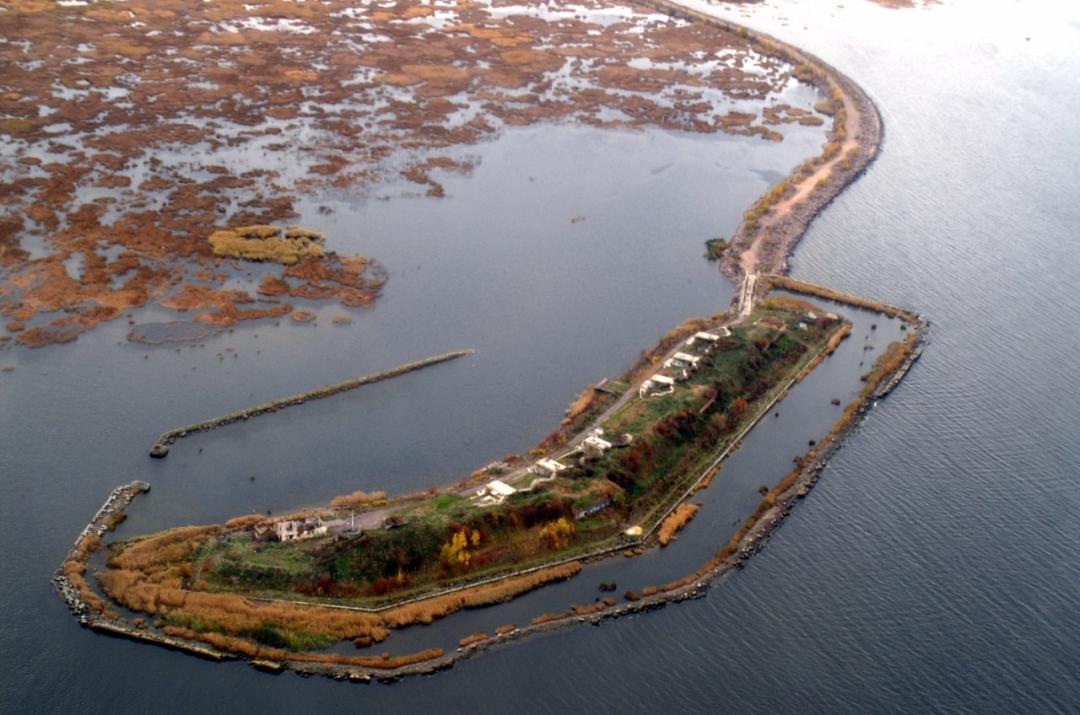
This fort measured about 700 by 50 meters and consisted of three frontal faces, two flank faces, and a military street at the rear. The fortification was built to be completely autonomous and included sewage and water supply systems, a water desalination system, its own bakery, bathhouse, and pharmacy, various warehouses, a telephone station with telegraph, a cinema projector room, and even its own church of Saint Mary Magdalene. For the fort’s power supply, six diesel-generator power plants of 100 hp each were provided.
The personnel numbered about 700-800 people, who were housed in barracks for enlisted men and a building for officers.
The location of the future fortification was not chosen by chance. This placement allowed control over the distant and near approaches to Kotlin Island from the northwest, and the depths of the water area allowed uninterrupted supply of everything necessary for life and combat operations. The fort’s design carefully addressed and solved all necessary issues. It was fully autonomous. With its water supply, sewage, and electric lighting systems, the fort could support the life of a garrison of up to 700 people. The fort was equipped with kitchens-dining rooms, bathhouses, provision warehouses, and shops selling various small items. Telephone, telegraph, indicator, and mine cables were laid for communication with the fortress. The artificial island of Fort Totleben was about 700 meters long. The total area of casemates, powder magazines, and traverses (a transverse rampart serving as a barrier against bullets and shells) exceeded 7,000 square meters. Throughout the history of the Kronstadt fortress, this was one of the largest construction projects. About 600 workers (carpenters, laborers, icebreakers) worked daily at the site. The treasury spent 6.5 million gold rubles. The fort embodied all the latest achievements in artillery and fortification, becoming a first-class structure of its time. All its combat equipment, command posts, storage, and living quarters were housed in reinforced concrete shelters capable of withstanding hits from large shells and aerial bombs. During the Great Patriotic War, Fort Totleben was part of the first line of defense, armed with guns ranging from 45 to 254 millimeters in caliber. As one of the most powerful forts of the Kronstadt fortress, it could repel enemy advances by water and shell enemy-occupied territory at distances up to 20 km. Artillerymen proudly called it the "sniper fort." A sharp reduction in funding in the 1950s forced the Navy leadership to remove Fort Totleben from all records and supply. For many decades, the fort has been neglected and now resembles more an overgrown island than a military facility.
Then came the revolution in 1917, but since the fort was deep in the rear, it did not take active part in the events of that period. After the establishment of Soviet power, it was decided to rename it Fort "Pervomaysky." In 1923, during modernization, the fort was armed with 203-mm turret guns removed from the cruiser "Rurik," which allowed firing at ranges up to 20 km. In the 1930s, the fort underwent a complete reconstruction. New machine gun caponiers were built then. From 1939 to 1940, the fort’s artillery supported the advance of Soviet troops on the Karelian Isthmus during the Soviet-Finnish War. Considering experience on landing-threatened directions, new machine gun pillboxes (DOTs) were additionally constructed. During the Great Patriotic War, this fort supported the defending 23rd Army of Sestroretsk with fire, and the fort’s garrison participated in repelling a Finnish landing. The fort’s artillery fired on enemy troops from Beloostrov to Terijoki, and in June 1944, the fort’s artillery conducted preparatory bombardment before the Soviet troops’ offensive.

At various times, the fort was armed with 11-inch mortars, 45-mm semi-automatic naval guns 21K, 6-inch Canet system guns, etc. Honestly, we got confused while gathering information about the exact armament of the fort in different years, so we will skip this point. In the first half of the 1950s, the fort underwent its last modernization with replacement of electrical equipment and construction of a chemical protection shelter. Four positions were rebuilt to install new 130-mm B1-130 mounts, but already in 1955, the fort’s garrison was disbanded, and the fort itself was disarmed. In 1957, by order of the Navy Commander-in-Chief, the fort was removed from the records, and in 1958, the military left it.
In the first half of the 1960s, part of the fort’s metal structures was dismantled for scrap metal. In 1985, it was transferred to the balance of the Leningrad City Executive Committee, and in 1988 to the "Spetstrans" administration as a base for the special technical fleet. At the same time, it was decided to establish a recreation base here and carry out restoration work on the fortifications. In 1990, the fort was included in the UNESCO list of cultural heritage sites and in 1992 was transferred to the Kronstadt administration.
Since 1999, it was occupied by an Emergency Situations Ministry (MChS) support post, but already in the 2000s, the fort was put up for sale, and in March 2008, the fort was raided by vandals and looters who destroyed the museum located there and wreaked havoc in the casemates. Since then, the fort has been completely abandoned.
Sources:




Written by Jermaine
Discuss this with the author and others
No comments yet. Be the first to start the conversation.